
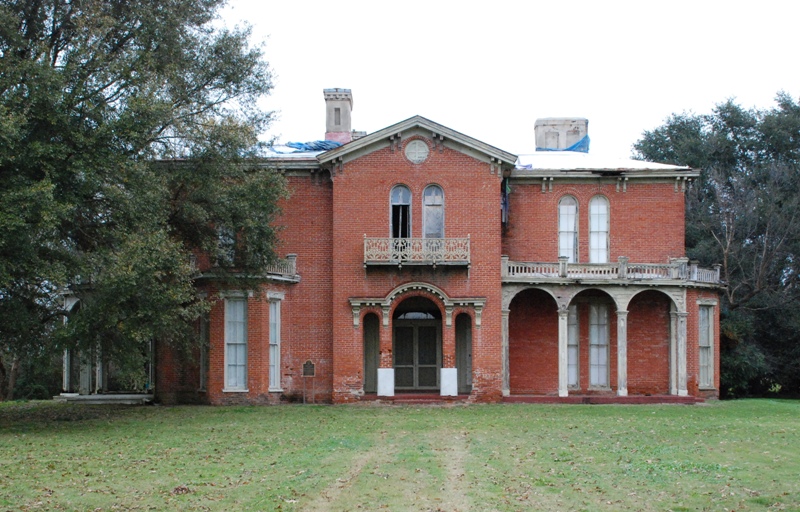
 On my recent trip to Greenville, I swung through the Lake Washington community to check on Mt. Holly, the Italianate antebellum mansion that I had heard was falling into disrepair. As you may recall, Mt. Holly was one of the mystery places in our latest Name This Place contest, and to summarize the information we discovered from the answers to that post: Mt. Holly was completed around 1859 and is very similar to Oxford’s “Ammadelle,” both being based on the same published drawing by New York architect Calvert Vaux in his “Villas and Cottages.”
Many people more knowledgeable than me believe that the Vaux plan was adapted to Mt. Holly by Kentucky architect Thomas Lewinsky, who also designed Henry Clay’s “Ashland” and Natchez’ Memorial Hall. This connection is not firmly documented as far as I can tell. If you missed the discussion about this, you can catch it in the comments to Name This Place 4.2
I came across a little historical account of the house and property when I was researching it at MDAH. In the 1910 “Greenville Times Souvenir Edition” under the heading “A Successful Planter, Mr. Hugh L. Foote,” we find this description of the owner and the house:
Mr. Foote came to the Delta when but a stripling of a boy from Macon, Miss., Neshoba’s county seat [actually it’s Noxubee County]. At first he began his planting on a small scale, but by ability, the practice of economy and possessing an eagle eye for good investments, he has yearly added to his planting interests until today . . . he owns one of the finest pieces of property in the Great Yazoo-Mississippi Delta, together with a plantation at Egremont, in Sharkey county, noted for its fertility.
Mr. Foote, with his family, resides on the Dudley Lake Washington plantation. The home is in a way an ideal one, being constructed of brick, before the war, by the hands on the place, from the soil on which it stands, it holds a place in the Southern heart. The rooms are many and large, and spacious halls run through the entire house. By the aid of a tank, water is run into every room of the home and every other convenience, enjoyed by the residents of a city, are enjoyed by Mr. Foote and his estimable family.
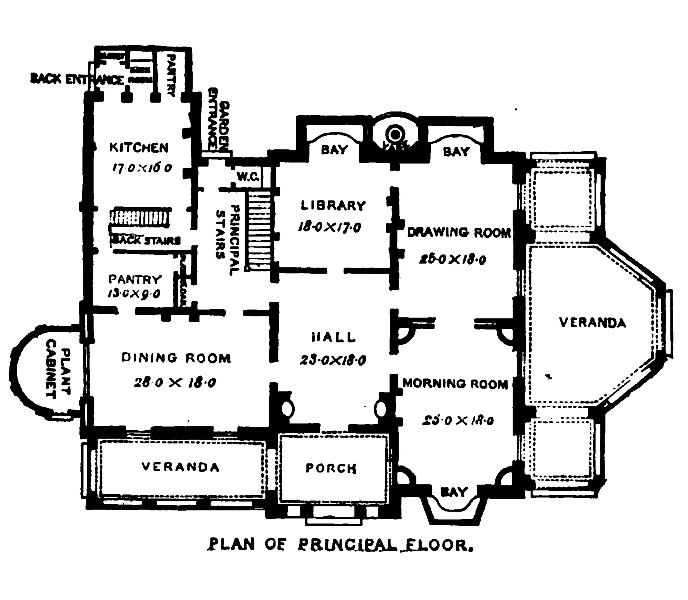
Calvert Vaux published plan, Villas and Cottages
Unfortunately, this amazing mansion sitting on a special atmospheric spot in the Delta has been abandoned for about a decade by my reckoning. I believe the previous owners died, and the house was sold around 2001 to a buyer from Texas. For some reason, this new owner has done nothing with the property, and it is starting to really show signs of neglect.
While on site, I noticed another issue apart from lack of maintenance; in fact, I guess it could be chalked up to over-maintenance, or incorrect maintenance. It looks like an earlier owner, maybe in the 1970s or 1980s, no doubt with the best of intentions, decided to repoint the brick, replacing the original lime mortar–which is naturally very soft–with a portland cement-based mortar–which is very hard. You would think that a hard mortar would be better for the house than a soft mortar, but when hard mortar is placed next to soft 19th-century bricks that weren’t baked to the same hardness as bricks are today, the wall can’t react to the change in seasons as it’s supposed to. Because of this new rigidity, as the wall expands and contracts with the freezing and thawing of the air, the bricks begin to break down, often losing their outer skin and exposing their even softer interior sections, which begin breaking down with the rains. You can read more about this in the National Park Service’s Preservation Brief: Repointing Mortar Joints in Historic Masonry Buildings and a good summary of portland cement vs. lime mortars at U.S. Heritage Group’s site.
I’m hoping for the best for Mt. Holly. I’m not sure that it’s for sale: does anyone out there know? Maybe if somebody made an offer, the owner would jump at the chance to get it off his hands and let somebody else fix this rare and beautiful Delta mansion and make it their home.

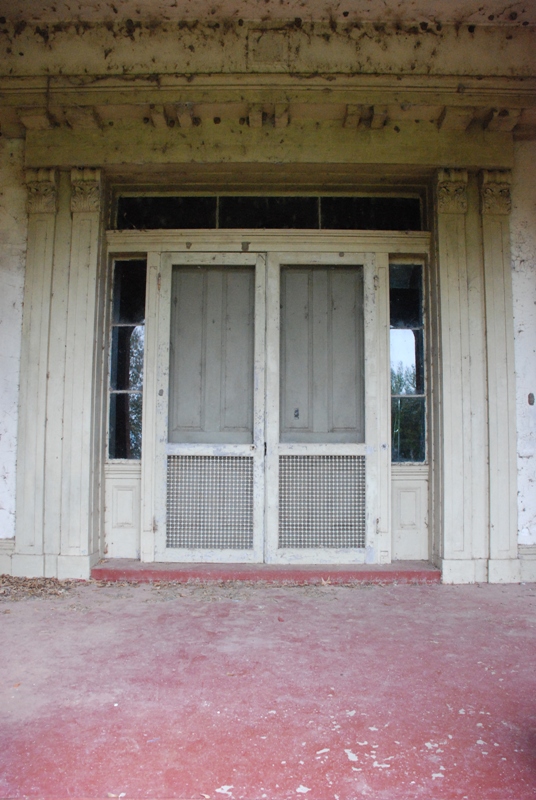

brick spalling on front porch column

Large side porch with entrances from parlor and dining room

Side porch with view toward the lake

more mortar/brick problems

more Abandoned Mississippi . . .




Categories: Abandoned Mississippi, Architectural Research, Cool Old Places, Demolition/Abandonment, Historic Preservation, National Register
 Preservation in Mississippi
This has eerie similarities with Arlington without the fire. Does anyone know much about the owner?
LikeLike
The owners name is Matt Wiggins. He lives in Clinton and owns a bed and breakfast there. Don’t have a phone number, but maybe could find it out. So wish someone would buy it and fix it up. In our area it is truly a one of a kind house. Have been in it on many occasions. It is amazing. It would have to be someone who really wants a big project.
LikeLike
There are plenty of people with money, just maybe not willing or interested in this project. I wonder if Mr. Wiggins would even be interested in selling? Did he buy it to start a B&B there and it just never materialized?
LikeLike
To my knowledge, when he bought the house he just needed a way to spend some money. I don’t know if he ever had serious intentions to renovate the house. The owners before him did use the house as their personal residence and as a bed and breakfast. I think the upkeep just got too much for them. I would think Mr. Wiggins would be delighted to sell!
LikeLike
Ive made phone calls to an answering machine and sent the owner several several emails requesting whether he had any interest in selling
He did not respond
LikeLike
The owner passed a couple of months ago.
LikeLike
Was just wondering if you have heard anything on this house?
LikeLike
Thanks for posting this on the internet
Im from Boston and Ive been an historical restoration contractor for 33 years
Ive worked all over the U S
I bought and restored 2 fantastic Italianate mansions ( The Aashael Gridley Mansion and Duncan Manor) in Illinois along with lots of other historical property and was very involved with Old House Society there
Both the mansions were ready to be demolished and Duncan Manor was on the 10 most endangered list, which is what brought it to my attention.
Unfortunately I lost both propertiies due to a change in my marital status before I could complete the cosmetic finishing phase of both projects, but I was able to complete the structural stabilization work on both of them up through plastering while I still had them and it brings a sense of satisfaction that theyll continue to stand and the nextcaretaker of the properties will be able to bring the restorations to fruition .
Im looking for a new project to tackle and this mansion is exactly what I love to do
I see that 2 years taxes were sold to the bank which indicates that the owner may be interested in selling
I will make contact with Mr. Wiggins and discuss acquiring the property from him
Thanks again for your efforts to bring this home into the limelight
Bud Sullivan
Woodandbricks@gmail.com
LikeLike
Good luck. Would love to see someone take it on and restore it to its original beauty. I always loved driving by this place and daydreaming about who lived there, what its history was, etc. I have a deep love for these old, historic homes.
LikeLike
Hey Bud I sent you an email concerning an old historical site you might want to check out!
LikeLike
It would be QUITE a project. I just couldnt resist and entered though a door left open (literally). The inside looks like it’s been used as an occasional hunting lodge and is in serious need of attention. SO strange because the grounds are neatly kept and the exterior issues seem mostly cosmetic. Very quiet, serene place…we were there at sunset. AMAZING! My dream home…..
LikeLike
That was a wonderfull idea just to explore the house, Me myself would love to open it as a home to orphans that have lost there family in some way all over the world.I know that the Goverment will love to be apart of a place that is needed to help childern in a Big! way.I would not mind; being a mother of eight childern myself and single to give all my time to other childern out there that need a loven and caring mom.Mother Teresa was blessed by God to do the same before she died.We all should never forget what she did for so many that was in need of her love and help.I hope that Mr. Wiggings were ever he resides reads this letter are even the last owners.The Goverment can give me a loan or help me in some way in restoring it .Even home extreams the T.V show if they could hear this story and help.I am willing to be apart of saving history and so will many others knowing it will put a smile on so many childern faces that have had there smiles taking away from there lost family members. Save the children it takes a community to come together.
.
LikeLiked by 1 person
They are presently filming a horror movie there..That is sad, that this ole mansion has ended up as a stage for a horror movie…What a waste of heritage…
LikeLike
Just for your information, Mt. Holly is not where they are filming the horror movie. They are filming at the old Law house at the corner of Suzie B Law road and Lake Washington road. Rest assured there is no heritage being lost at the present time.
LikeLike
I JUST WONDERED WHAT MOVIE IS GOING TO BE FILMED AT THE SUSIE BUSICK LAW HOUSE.. SHE IS RELATED TO MY HUSBAND AND WE WOULD LOVE TO SEE IT. WHEN AND IF SOMEONE WHO KNOWS CAN ANSWER THIS QUESTION, PLEASE SEND THE ANSWER TO bdbusick@gmail.com, Thank you.
LikeLike
The movie is called Haunted it will be starring Tobin Bell (Saw I-V) movies.
Can you give me some info on Susie Law. Any history or anything about
the house. I need it asap. please send anything you have about her and the
house to my email addy. ldarlin64@yahoo.com.
LikeLike
REading this is like a trip back to my chldhood.My grandparents lived near there, and I have been to most of these homes, and many times to Mrs. Law’s home. By the time I knew Mrs. Law, she was a character. I don’t know if she always was, or if she just aged that way. Always wore red lipstick, beautifully manicured nails, and had red-ish hair.
LikeLike
My grandmother was Elizabeth jones Williams Susie was her aunt. Wasn’t Mt Holly in the family too? My mother is Elizabeth Williams Bullard.
LikeLike
The Suzie B.Law House is where the filming is. It also is another House that is endangered.There is going to be a fundraiser for the Suzie B. June 23rd
at the Southern Star Camp ground.
LikeLike
Actually they filmed down the road at the Susan B. Law mansion. I heard the owner is asking $750,000. for it.
LikeLike
Mount Holly burned today. Ashes are still smoldering as I type.
LikeLike
I just saw that, too! So, so sad. Does anyone know if it was ever bought from the Texas man who, I believe, had passed away?
LikeLike
JUNE 17, 2015
Mount Holly burned to the ground! a beautiful part of history gone forever. I hope the person responsible for this loss is brought to justice. There was no power nor gas to the home, therefore speculations in this community are running rampant.
LikeLike
This states that Macon was county seat of Neshoba county. Philadelphia is.
LikeLike
The author of the quote mistakenly places Macon in Neshoba County, but my note in italics corrects this error to say that it is in Noxubee County.
LikeLike
Lake Washington is such a fascinating area, and the ruins of St. John’s are also really fun to explore. When I first saw Mt. Holly, I was shocked by the shape it was in, especially considering its history and how it may be the most significant antebellum house in the Delta. I’ve seen a copy of the original Vaux plan and vignette in his book, and while Mt. Holly is not an exact copy, it could definitely have been influenced by it. Also, Vaux, although influenced by this earlier plan, drew a specific one for Ammadelle that varies slightly. I believe he was also responsible for the landscaping there (so a house in Oxford has the distinction of being landscaped by the same guy as Central Park!) and considered it one of his best works.
LikeLike
Cool–I didn’t know that about the landscaping!
I hear from another reader that the owner also has ties to Jackson, so I don’t know whether he lives in Texas or here. I also hear speculation that architectural salvage was more in the plans when he acquired the house, but that may be just hearsay. I didn’t see any evidence that the house was being stripped when I took these pictures a few months ago, just general neglect. That Lake Washington community seems very close-knit and I would think they would put a stop to any such capers if they saw them happening.
LikeLike
Has anyone seen a map or plan of plantations or established antebellum properties in the delta or along the mississippi river between vicksburg and memphis?
How isolated where the folks who built and initially lived in Mt. Holly?
LikeLike
The book, LIKE SOME GREEN HOLLY , which are the letters of Margaret Johnson Erwin (1821-1863), gives the details of the planning and building of Mount Holly. The architect was Samuel Sloan, who also designed Longwood in Natchez. She despised Calvert Vaux. This book was compiled by her Great-Grandson, John Seymour Erwin and published by LSU Press.
After reading this book it so sad the Mount Holly is in such a deteriorated condition.
LikeLike
Where can I find this book, Like Some Green Holly?
LikeLike
I have a copy of it. Email me at joshua@saxonydesignbuild.com and we’ll work out getting it to you
LikeLike
the book is available through McCormick Book Inn, Greenville, Ms. 662.332.5038
LikeLike
Hank, happy that you corrected the architect’s name. I was beginning to wonder is what we had always believed was incorrect. Lots of good times in that old house and a pity it is falling into ruin and did the C&G and probably the Burrus House by now after the recent renovation.
Cheers, Joe Weilenman, FAIA
LikeLike
There name of the book is actually, “Like Some Green Laurel.”
LikeLike
Well, on the one hand I want to thank you for introducing me to this book, of which I hadn’t been aware, but after digging into it, I kind of wish I hadn’t been introduced to the snake pit of controversy that surrounds Like Some Green Laurel. Finding that there was a whole string of back-and-forth articles and letters to the editor in The Journal of American History in 1983, I got a friend who has access to JSTOR online to print them out for me, and WOW! was I unprepared for what they contained: pretty serious accusations that seem to add up to the letters being fabrications, with people and events that could not have happened because the people were either dead or known to be elsewhere at the time, etc.
I read the counter-accusations from the LSU editor and Mr. Erwin against John Simon who wrote the initial article hoping they might convince me that Simon was way off-base, but unfortunately, all they seemed to do was sling mud and hope some of it stuck.
So, I’m not an expert on this, but given the evidence before my eyes, which is that the house looks like a mirror image of Calvert Vaux’s published plans, I’m going to stick with that unless the controversy surrounding Like Some Green Laurel is explained and clarified in favor of the Sloan attribution.
Nevertheless, it is heartbreaking to see the house this way, and hopefully someone will come forward to buy it and repair it and love it like the original family did.
LikeLike
Well I am gullible as I thought anything historical published by LSU press was reliable. I thought though as I read this book that U.S. Grant was pictured in an unfavorable light whereas W.T. Sherman was almost a member of the family.
H.B. Stowe was the real villain…. according to Mrs. Margaret.
I did think it was highly unlikely for one person of whom most have never heard was in such close proximity to so many historical figures of that age.
Hopefully this old historical home may be restored. I would like to visit it!
LikeLike
You aren’t at all gullible–LSU is a reputable press, very much so in southern history, so I would have completely trusted the source except for a friend who pointed me to these articles in the JAH. But you’re right, once I read the criticisms, they made sense–how did this one lady know all these people and have such strong, almost prescient opinions about them? Simon in fact points out that her opinions about Uncle Tom’s Cabin predate the publication of the book, and Grant and Sherman weren’t in New Orleans together as she asserts in some articles, etc.
I can send you a copy of the article if you’d like to read it, or if you have access to the JAH, the initial article and LSU response are in March 1983, and Mr. Erwin’s response and Simon’s response are in June 1983. Since you’ve read the book–I haven’t–I’d be interested in your thoughts about the controversy.
The letter to the JAH editor from the LSU editor was actually the most disturbing of the bunch–it’s in March 1983. She really tears into Simon and the JAH for running his article, and defends the book by essentially saying, “yeah there are mistakes, but it gives the spirit of this interesting Southern woman and isn’t meant to be taken as documented history.” Very weird.
Sometimes I veer between unquestioning trust and complete suspicion, so this whole thing reminds me again, as I need to be reminded, that a healthy level of discernment must be brought to bear on all historical sources, even when they come from what we expect to be trusted sources.
LikeLike
I would love to read about all of this stuff. Can you tell me how to go about
finding all these articles you are referring to?
LikeLike
Unfortunately, I was only able to find them because a friend gave me the references, and another friend happened to have an online subscription to the JAH that allowed him to access archived copies. Most large reference libraries should have back copies of the JAH available in paper format. If you’re near a college or university, stop by their library and see what you can find.
LikeLike
By all means read the book. You may have access to it on the www. Most of it are the letters (spurious?) by Margaret to a few individuals.(most to Sloan) The best part are the photographs and family tree. There are floor plans by Vaux and by Sloan showing the difference between the two and the current Mt. Holly She was from Kentucky where much of of her life was spent before moving to New Orleans. They were related and close friends with Henry Clay whom she calls “Uncle H.” According to the book, they owned plantations in several states and were very wealthy. She paid $100,000 for the land on which Mt. Holly was built. (quite a sum!)
Even though this may be a 19th century, “Da Vinci Code,” it contains lots of historical tidbits.
LikeLike
I visited Mount Holly in the mid 1980’s. It was amazing. It is a travesty that the Magnificent home has been allowed to get in its present shape. Shame on the present owner. I hope he will decide to repair it to the grandeur the home deserves.
LikeLike
Personally I think the best option for the house now is a new owner, but if that doesn’t happen, at least the current owner needs to take some basic protective measures for the good of the house. Glad you got to see it in its prime.
LikeLike
So sad to see this historical house burn today. It’s really makes my stomach sink to see such history gone in a span of 30 mins
LikeLike
Did this really happen, was there in April.
LikeLike
Yes, I’m afraid it really happened. See pictures here: https://misspreservation.com/2015/06/17/sad-news-from-lake-washington/
LikeLike
Has anyone heard of any ghost stories related to the history of Mount Holly.
LikeLike
Not I, but then again when it comes to ghost stories I’m a non-believer so I tend to tune them out, I’m afraid. Maybe somebody else round these parts knows one.
LikeLike
Yes I have. It is haunted.
LikeLike
BS”D
Just came back from Greenville after 30 years…ok..this is a crime…can’t someone find out what the deal is with this property. We’d be interested in buying it.
412 287 7810
LikeLike
See my earlier post on March 1st. The owner’s name is Matt Wiggins, and he lives in the Clinton area. Could probably find a phone number for you.
LikeLike
Mr. Wiggins replied by letter to my request to include Mount Holly in “Great Houses of Mississippi”; that was around 2002. I haven’t been able to locate him since, and MH looks more forlorn every time I go over to Lake Washington. As to the question someone asked about the isolation of this area: There was a large and prosperous group of settlers, primarily from Kentucky, in the Lake Washington area from the 1830s-on. For the antebellum Mississippi Delta, MH wasn’t isolated at all. And several of my most reliable historic architecture sources around Mississippi consider “Like Some Green Laurel” to be the most egregious hoax ever perpetrated on an academic press.
LikeLike
Across the river, in Chicot County, Arkansas, is Lakeport Plantation. Lakeport was built for Lycurgus and Lydia Johnson ca. 1859. Johnson was Margaret Johnson Erwin’s first cousin. There were a lot of family connections between the planters in Washington Co, MS and Chicot Co, AR: Lydia’s sister, Anne Taylor, was married to Isaac M. Worthington, who built Belmont ca. 1857. Isaac Worthington Jr. married one of Lycugus and Lydia’s daughters and they later lived at Lakeport in the 1870s/80s.
Lakeport has been restored by Arkansas State University and is open to the public. http://lakeport.astate.edu/Visiting.html
LikeLike
I sure wish I knew the true history of Margaret Johnson Erwin and the history of the building of Mount Holly. The Kentucky connection is really a history in itself.
LikeLike
Hank, I have some info on the house, but putting my hands on it is another story! If I run across it I will post what was given to me.
LikeLike
Matt Wiggins lives in Kemah TX and is the mayor there. Maybe someone can contact him about purchasing Mount Holly. It’s definitely a shame for this historic, previously regal property fall to pieces.
LikeLike
According to Google, Matt Wiggins’s email is mayormatt@kemah-tx.com
LikeLike
Not a good E-Mail..
LikeLike
Well isn’t that an interesting tidbit? I know several people have contacted me about how to get in touch with Mr. Wiggins about buying the house, so there’s interest out there, but I haven’t heard back about whether he’s willing to sell or at what price.
LikeLike
My husband and I just drove from New Orleans to Little Rock. On the way up there we flew past this magnificent piece of history, only for me to see if from the rear view mirror. I made sure to pay attention on the way home and what I saw broke my heart. As a native of Lexington, KY, this home almost mirrors Henry Clay’s home, Ashland. This one of few remaining jewels that tells the story of the south, I pray it can be restored to it’s original beauty.
LikeLike
Today my friend (Lindsey) and I visited Mt. Holly. It was so sad to see the condition of the house. There was a door open so we ventured inside and took some pictures. We also found this other house it was abandoned! Its white w/ a small play house beside it. The playhouse was a replica of the house. I’ve been told that the owners died and the children live in New York. However, the house if falling apart. I was wondering if anyone might have any history on this certain house. It isn’t far from Mt. Holly.
LikeLike
Is there any way you would maybe post some of the inside pictures you took. Would be great to see them.
LikeLike
The white house you saw falling into disrepair is known as the Susie B. Law home. It was occupied as recently as ten years ago, but after the owners died, the heirs have shamelessly let it get in this condition with continued refusals to sell the property. I’m told it’s a Sears Roebuck manufactured home from the turn of the century or a little later. The insects, heat and humidity of the Delta can work very quickly in destroying historical properties, along with the overgrown vines and bushes. The Erwin depot at Foote is now falling down as well. It’s all so very sad.
LikeLike
Babbs, is this the Law home you’re referring to? http://www.jgwchpc.com/sites6/page06.html
LikeLike
Yes, that’s the house. And here what it looked like fall of 2010:

LikeLike
oh my heavens! this is an absolute shame!!!
LikeLike
OMG I can’t believe this. There was a huge run down home to the left of this one down the street a ways that we played in as kids. It was abandoned and still had clothes and books all over the place plus a winding stair case. I still have some stuff from that house and had found an article in the house about the owner and the house though I don’t know where that is anymore but had found the owner’s Bible where she had written stuff and underlined passages over and over again. Lots of pics and newspaper clippings in it.
LikeLike
I went back there about 5 years ago and that beautiful big house was no longer there :(
LikeLike
Wow, I had no idea it had gotten so overgrown! That’s a really disturbing picture. Do you know if the owners would be willing to have a volunteer cleanup day or something like that just to cut the kudzu and other encroachments away?
LikeLike
oh my gosh, it’s beautiful! oh, please tell me someone has taken the responsibility to keep this house from falling into ruins!
LikeLike
who owns this house now?
LikeLike
I am very interested in the old Plantations of MS. I was born & raised in Greenville, MS & later moved to Vicksburg. The area on at Lake Washington is of great interest to me. When I was a very young child of about 5, my grandmother ( was an LPN) took care of two sisters that lived in a very large home that over looked the lake. Their name (the only name I ever knew them by ) was Ms Mann & Ms Irene. Does anyone have any idea who they could have been. I can see the house in my mind. Thanks for any help.
Shirley
LikeLike
There was a Mann mansion in Glen Allan which was allowed to fall in. Several years ago the house was torn down because of the fear of children sneaking into the ruins of the house and hurting themselves. I think the land is being rented as farmland now.
LikeLike
You might be thinking of Linden, built on the eastern side of Lake Washington in the early 1900s. The home is open for tours (for groups by appointment) conducted by members of the Lake Washington Foundation. On Dec. 4, 2011, Linden will host a tea, open to the public 2-4 p.m. I’m told the home has been owned and occupied by Mann descendants since it was built.
LikeLike
Hi, you are referring to Linden on the Lake. Was then Mann plantation. This belonged to P. L. Mann. As a young person I saw this house with all the red velvet drapes, etc. It also went into a sad shape. It then belonged to Nancy and brother Lynwood Mann. Nancy Mann Dinkins Bridges is now dead. Her son Cameron Dinkins resides in the home now. Ms. Mann”s maiden name was Stovall(I believe). It is worth a drive in late October or during NOvember to see the giant Gingko tree when the leaves have turned pure gold and it is the best place to look across the lake. There is lots of history. Mattie Franklin Monteith
LikeLike
Mr. P. L. Mann was a close friend of my grandfather, who had a plantation near there. I have many fond memories of that home. Many of his descendants have been close friends of our family. The Stovall name is from Mr. Mann’s daughter-in-law, Lurline Stoval Mann. This was Nancy Mann Bridges’ mother. I am so pleased that it continues to be lived in and enjoyed.
LikeLike
Close to 9 years ago a friend took me and my 3 year old into the house and gave me a tour. All was going well, I took lots of pictures. We went upstairs to look at the bedrooms and my son went into one room toward a closet and started screaming, a mean old woman was in there. He was hysterical. She took him out and I went to check it out and there was nothing there. We went downstairs looked around and left. I did some research on the house and the lady that lived there did not like kids and it was her bedroom. The house was needing a lot of repairs at that time. On the stairwell near the kitchen there was rain coming in on the srairs. I really wanted that house, but my husband told me it would cost too much to repair and too far out of town. We bought another plantation house in town instead. I loved the porches at Mt. Holly. I would love to see it restored. Would be a shame to loose it. I was told at the welcome center in town that we are in much need of a bed and breakfast in the area. Hope you get to purchase it. If you do, I would love a tour again. My son is older now and still refuses to go back in there. Lol
LikeLike
Found one sheet from the realtor:
Mount Holly is a two-story, common-bound brick structure consisting of
approximately 30 rooms, including a second floor ballroom with a ceiling of stamped metal which replaced the original plaster. Other interior features are a library with ceiling-height, round-arch bookcases; statuary niches in the reception hall; ornate mantel pieces; painted wood graining; a rosewood staircase with lotus-blossom appliques on the tread ends and trumpet halusters; and 14 foot ceilings bordered by decorative friezes and cornices and centered wiyh plaster medallions and brass chandeliers. This house is reported to have had bathrooms equipped with plumbing installed at the time of construction.
The main entrance to Mount Holly is through a palladian-type archway in the center pavilion projecting from the facade. The rounded headings of the arch are repeated in the second-story windows and in the trim of the loggia on the facade and porches on the north and rear elevations. The exterior is also characterized by semi-hexagonal windows with carved lintels; wooden balustrades and a balcony railing of iron grillwork ; regularly spaced pairs of brackets visually supporting over hanging caves; and prominent chimneys further emphasized by paneled stucco and brick dentils.
A kitchen wing projects eastward from the house on its southeast corner and other brick service structures, now demolished, including washhouse, dairy, storehouse, barn and servants quarters. In the late nineteenth century several large trees on the front lawn were removed and the house was painted white. The brick walls have since been returned to their natural color, with white wooden trim. There are apparently no original furnishings remaining at Mount Holly, although descendants of the builders at the nearby Erwin home, which predates Mount Holly, retain a pair of ballroom chairs, china and glassware, and a portrait of Lillie Erwin Morgan, a daughter of James Erwin and Margaret Johnson Erwin Dudley, painted at Mount Holly.
I do have other sheets in my possession, but have filed them somewhere. I was told the bricks were hand made by slaves and had horse hair in them. I can remember seeing what looked like hair sticking out of some that were crumbling. When I toured it there was some beautiful pieces still there and a huge piano. They had some windows that you could raise and walk through. I think that was coming out of the library. It had several fireplaces and the kitchen or wash room had huge cabinets that reached all the way to the ceiling. Loved the balconys. There was a cistern on the property with a top on it. The back of the house looks toward the lake and had a pier. Beautiful piece of property.
LikeLike
what realtor page did u see this on?
LikeLike
Where did you end up buying?
LikeLike
Mrs. Brent, in regard to this post from some time ago. I would like to ask that you please post these photos you mention to a free public image sharing web-site like FLICKR, or TUMBLR. No doubt many people, including myself, who are interested in Mt. Holly House would very much enjoy seeing them. They would also provide a valuable document for gauging the continuing state of disrepair this magnificent house is being subjected to by it’s negligent owner. If you would then post the link to the pages where you have posted the images here in this blog, all who are interested could share in your experience of touring Mt. Holly. Gratefully in advance – Jay Hillenbrand
LikeLike
– Also, would like to share some links I found which have more photos of Mount Holly House, including a precious few interior shots..
This blog has a few spectacular images, including a couple of interior shots, one showing an amazing set of Pier mirrors, and gas chandelier –
http://worldofdecay.blogspot.com/2011/04/impossible-mansions-of-delta-mt-holly.html
Here are a few more; the first showing the cisterns, and the next a rather spookiedookie shot of the parlor piano mentioned here in comments –

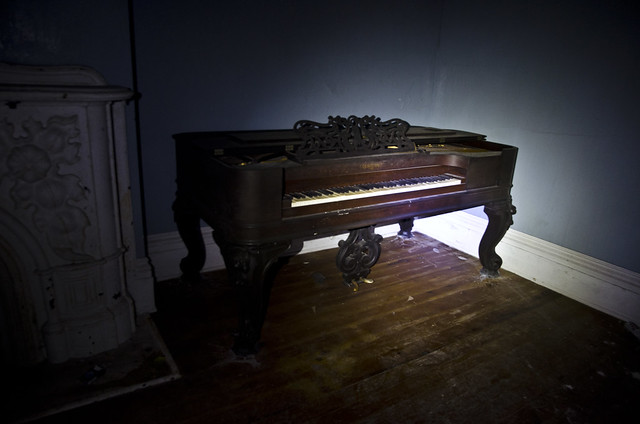
Here is an image of the house when lived in and cared for –

And others –


If anyone else has images to share, please post them to a free image sharing site or blog and link back to this page so that others may enjoy as well…
Cheers! JH
LikeLike
Shocked and saddened to learn of the tragic fire only just today. Saw an update email on this thread last month titled “Sad news from Lake Washington” and did not open it. Frankly I’d had enough bad news about this fine house and just didn’t care to hear any more. I certainly never thought that the sad news would be the complete demise of the house by FIRE. Well – there you have it. Congrats’ Mr. Wiggins; your willful disregard of and abandonment of this important home has reached it’s conclusion. Hopefully the ruin will be preserved. Sheesh….
LikeLike
When I was a girl 10 years old, I used to go with my god mother Pearl, who was the housekeeper for John and Bonnie Cox. It was the most beautiful place you could amagin. Beautiful hard wood floors, big house, two sets of stairs, I remember 5 big bedrooms at least, sometimes I was scared. That was 40 years ago. I live in Texas now, but I was home last year, I went to see the house , I was heart broken. Looked through the window and saw the piano still in there. I wish I had the money to buy it.
LikeLike
Ok people, my sisters and I own the pink lake house across from Mont Holly. My husband and I walked on Thanksgiving Day and decided to walk around Mont Holly. It is in terrible shape with many windows broken, a back door open, a back porch roof collapsed and on and on! Won’t somebody find a way to restore it? I left there feeling so sad. It is a shame to let this beautiful place fall down.
LikeLike
Do you know who I could contacted for permission to metal detect the land around the house?
LikeLike
Is there a Lake Washington neighborhood group that could work in a concerted way toward a solution? I had heard the Greenville-Washington County preservation group was discussing what to do about Mt. Holly, and I assume that by now many people have privately urged the owner to either fix the place up or sell it to someone who will. If that’s true and it hasn’t worked, then I think the next step would be to go more public about the situation, which as you note is becoming more dire by the month. One way to do that would be to nominate Mt. Holly to the Mississippi Heritage Trust’s 10 Most Endangered Properties list, which will be announced with statewide press coverage next Spring. I know the website says that today was the deadline, but I’m sure they would allow a little leeway for a place as significant as Mt. Holly. The website is http://www.mississippiheritage.com.
If you don’t want to go that route, maybe the owner would at least allow a volunteer group to clean up and stabilize what can be stabilized, board the entries, etc.
Recalcitrant owners are some of the worst enemies of preservation. A similar situation is still going on in Natchez with the NHL Arlington, sitting vacant since a devastating fire back in 2002. They tried being nice (the Historic Natchez Foundation even put a new roof on the building and cleaned out what could be saved of the priceless book and antique collection), they tried shaming, they have tried taking the man to court, and they have even gotten the house listed on the 10 Most list–all to no avail so far. “You can lead a horse to water . . .”
Whatever you or any other group do, please let me know how MissPres can help–getting word out for fundraising or volunteer days or just moral support. It’s an amazing place that we need to save.
LikeLike
The Joint Greenville Washington County Historic Preservation Commission here in Greenville did do a nonimation for Mt. Holly to be put on the Mississippi 10 most endangered properties. Hopefully it will make the cut.
LikeLike
Mount Holly has made the Endangered Properties list. Now what happens to it???
LikeLike
Responding to post by Shirley Hartley: My husband thinks the plantation you are referring to is Linden Plantation. His mother was best friends with Nancy Mann D. Bridges who has passed away. I was told one of her children are living in the house and is restoring it. He thinks Mrs. Mann is her mother. They had a great dane in the early 70’s that lived in the house. He called it her house horse. Mrs Mann used to teach the kids card tricks. He also said Mrs. Mann was one of 18 children.
LikeLike
Thanks! I will check that out. It has been so many years since I last saw those beautiful old homes. Just wish I could remember more about the sisters. They were such small women. They had given my sister & I 2 ball gowns that must have been a size zero! I remember them telling stories of a tunnel under ground that lead to an island. It was used for slaves & ‘our boys’ during the Civil war.
How I wish I had written all that down.
Shirley
LikeLike
Mrs. Mann was Nancy’s grandmother.
LikeLike
Unfortunately, if an owner continuously ignores a historic property, there is only one absolute way to save that property: eminent domain. Unfortunately, eminent domain is often used against preservation (see every Urban Revewal campaign ever conducted if you need an example) but can be used to seize a historic property for protection. I highly doubt that eminent domain has ever been used this way in Mississippi, since there is such hatred for eminent domain and blinding love for personal property rights in the South. Although I cannot recall any specific examples at the moment, I am fairly sure eminent domain has been used in the Northeast and on the West Coast for preservation purposes. Until the law is passed restricting eminent domain’s use in Mississippi, it is the only way to protect historic property when an owner refuses to sell or maintain the historic property, like the owner of Arlington. I am not sure the Mount Holly owner falls into the same category as the owner of Arlington, since (judging from the comments) no one knows conclusively (or has checked at the courthouse about) who owns Mount Holly. The owner of Mount Holly may not be aware that they own Mount Holly. There is an antebellum house in the Muscle Shoals (Alabama) area that nearly collapsed because the owner lived in Florida and did not know she owned the house. She had been left the house thirty years earlier from some distant relatives and had never been notified about ownership. Since Alabama’s property taxes are so low (a legacy of the planter written and very regressive 1901 Constitution) and property is rarely seized for non-payment of property taxes, no one had bothered to contact her about paying her taxes on the rural property (which after 30 years were horrifyingly low, not even in the thousands). That owner sold the house after she found out she owned it. While Mount Holly is a different case, there are still ways to preserve a historic property, with the help of the owner (through their selling of the propery or their safeguarding of it) or without the help of the owner (eminent domain).
LikeLike
The closest thing we have in Mississippi, at least that I know of, is the “Demolition by Neglect” process that historic preservation commissions can initiate against owners who are essentially circumventing the preservation ordinance by allowing their property to rot away. Natchez undertook this process with the old Baptist Church and with Arlington, but as we saw in those situations, it can be a dangerous and often unsuccessful action to take. In the case of the church, it ended up being torn down, after the owner “proved” economic hardship. In the case of Arlington, a building in the upper tier of designated historic properties–a National Historic Landmark–the judge fined the owner for abandoning some vehicles in the yard, but completely ignored that he had also abandoned A HUGE HOUSE OF MAJOR SIGNIFICANCE. I think he got fined something ridiculous like $500, and that was after many months of work on the part of the Natchez commission and the local building inspector. It’s like finding a murderer guilty of illegally burying the body. It kind of misses the point.
Anyway, there is a preservation ordinance that includes all of Washington County and is overseen by the Greenville-Washington County Historic Preservation Commission. I’m not clear on all the details, but I suppose they could go through the process of Demolition by Neglect, and maybe if W. White’s scenario is correct and the owner is just unaware, that might get things moving in a better direction.
LikeLike
My parent’s sold the house to Matt Wiggins about 10 years ago. I don’t know why he has let it go. My parents bought the house in 1979 from the Methodist Church, the Cox family had donated it to the church. We worked hard on that house and my parents spent a fortune on it. It was a great place to live, I still remember walking out the front door on winter nights late and hearing the wind blow through the trees, looking across the lake in full moon light and hearing geese fly over. I have lots of fond memories of that home. I’ve written a book called “Delta Plantations – The Beginning”. I go into detail about Mount Holly and other homes and plantations around the lake area. It also has lots of pictures.
LikeLike
Hi Woody,
I just finished your excellent book, “Delta Plantations-The Beginning”. You presented so much history in an interesting and easily readable text. The pictures were fascinating. Would you be so kind as to allow me to email you directly? I had some specific questions that I know you will have the answers to. Thank you, Lucie
LikeLike
Lucie, I’ve sent your email to Woody so that you two can correspond directly without posting your e-mail addresses here publicly.
LikeLike
Where can we buy a copy of your book?
LikeLike
How much did your parents buy the house for, and how much did they sell it for? Just curious!!
LikeLike
Where can your book be purchased? Amazon says unavailable. Thank you.
LikeLike
Where can the book (Delta Plantations-The Beginning) be purchased?
LikeLike
Check ABEBOOKS on line for ANY books – they represent all used booksellers in the U.S and the U.K.
LikeLike
It’s available on Amazon in Kindle format. Seems that hard copy is no longer available.
Also check out Like Some Green Laurel: Letters of Margaret Johnson Erwin, 1821-1863 (Southern Biography) Hardcover – February, 1981 – also on Amazon.
LikeLike
Just a note to be sure to read through this comment string about the veracity or lack thereof of Like Some Green Laurel.
LikeLike
Agree, but having some first hand knowledge of having lived at Mount Holly when I was a child over 60 years ago, it makes for interesting reading! :)
LikeLike
If you can, track down John Y. Simon’s critique, author response and Simon’s response to the author in the Journal of American History.
LikeLike
Some info on Mr. Wiggins, reported owner of Mount Holly; worth reading for insight to the many questions raised about the fall of this wonderful plantation home.
http://www.houstonpress.com/2000-09-14/news/brawl-on-the-boardwalk/
LikeLike
What an interesting and long article! Apparently he had millions back in the early 2000s, which makes me wonder whether he’s lost them now or if he just doesn’t care enough about Mt. Holly to keep it up. Either way, I think it’s time for him to sell the property to someone who will love it and repair it and hopefully live in it.
LikeLike
http://www.houstonpress.com/related/to/Matt+Wiggins/
LikeLike
I made a general inquiry about what a community, individual or historical society can do at a free legal advice site and received an answer today. It is generalized info, as you might expect, but a start. If anyone is interested, will be glad to share this. After visiting Mt Holly this past weekend and seeing its condition, I wondered what I could do–even though a Bolivar County resident, I would like to see any entity make some steps toward preserving this home because clearly the owner is not interested. Does anyone know if indeed the house was put on an endangered properties list? That would be a start.
LikeLike
The house has been nominated by concerned citizens to the Mississippi Heritage Trust’s 10 Most Endangered Places list. That list won’t be announced until April 28th, so we won’t know until then whether it made the list, but I have to feel it’s a shoo-in, given the significance of Mt. Holly. Wally Morse (who commented up above) is involved with the Greenville-Washington County Historic Preservation Commission and I think y’all might want to talk about the advice you’ve received.
LikeLike
Are there any updates regarding Mt. Holly?
LikeLike
I now live in Texas, use to go to work with my god mother Pearle who was the housekeeper for the Cox ‘s who lived at Mt. Holly . I work about 3 miles from Kemah Texas where Matt Wiggins is in court about another property . I’ll see if I can contact him, that ‘s if he will talk to me.
LikeLike
Barbara, if you are able to communicate with him, that would be great. Let us know if he is responsive to our concerns.
LikeLike
Mt. Holly is certainly haunted. Was there Spring 2010 and experienced ghostly encounters. We even had orbs in the pictures we took that day.
LikeLike
Seeing as there are no such things as ghosts, I highly doubt that Mt. Holly is haunted. Except for the few quack, fringe scientists and the many superstitious people around, logical people do not believe in ghosts. If you heard things go bump in the night (or day), think raccoons, squirrels, or bats, not supernatural, noncorporeal entities floating around in nothingness.
As for the orbs, if you use a camera’s flash in dusty rooms, you will see orbs because of the light illuminating the airborne particles. You will also occasionally see larger orbs if you use flash near a mirror at the right angle of reflection.
There are no such things as ghosts.
LikeLike
From what I hear, Wiggins is basically a problem every where he goes. I live in the Kemah/Clear Lake area too and have yet to hear a good word about him. He is constantly involved in some sort of law suit and neglects most of the properties that he owns. As mayor of a small city, you’d think that he would be more respectable, but apparently he is not. Good luck Barbara in getting a response out of this guy. He is slippery, like a snake!
LikeLike
more info on Wiggins:
http://www.kemah-tx.gov/mayor_and_council.php
http://abclocal.go.com/ktrk/story?section=news/13_undercover&id=7945538
http://www.kemahwatchdog.com/blog/
LikeLike
These are not surprising new revelations about the owner since I knew this individual from high school. As I have stated elsewhere when I learned of Matt Wiggins being the owner of Mt. Holly, it was dismaying. Thanks for sharing the updates and it would be a legal, historical and aesthetic ‘score’ to wrest this beautiful property away from him and place it in the hands of someone or a group who will stop the decline/restore it. I just don’t know how to do that.
LikeLike
No word yet from Mr. Wiggins. I did send him an email two weeks ago.
It may seem to desperate to go by his house. I am sending a letter to him on Friday.
to ask him to meet with me, call, email, ect. We will see what happens.
LikeLike
Barbara-
I’ve been in touch with Mr Wiggins’ assistant today in fact, to begin discussion on purchasing the home. Who knows how much he’ll want for it, or if I could even afford it. We’ll see… if it works out, I’m sure I’ll be posting requests for funding available to help restore the house.
LikeLike
Good to hear of these efforts–keep us posted, especially if there is an asking price.
LikeLike
The asking price is confirmed at $750,000. Can anybody check out what he paid for the place in 2001? I wouldn’t mind going down to the courthouse, but its a little far from Los Angeles.
LikeLike
WOW ! That price really blew my mind, considering the condition of the property. I think he may be mad at us.
LikeLike
Check out these Court minutes from Oct 12th, #4 in particular
http://www.jgwchpc.com/minutes/minutes016.htm
and November 9th, #4 again
http://www.jgwchpc.com/minutes/minutes017.htm
LikeLike
Those are great minutes–and good to know they’ve notified Mr. Wiggins of the 10 Most Endangered nomination. Obviously, it would be best for everyone concerned, and of course Mt. Holly, if everyone could work together to save this place.
LikeLike
It’s not uncommon, unfortunately, for negligent owners to ask ridiculously high prices for properties that they haven’t put a cent into since they bought them. That’s really astonishingly high. What does an acre of farmland go for around those parts, I wonder?
LikeLike
One of our Historic Commission’s members (Emmett Smith), recently went into Mt. Holly, (back doors open) and commented on its rapid deterioration. He also noted that the large cistern in the yard was wide open. Considering the liability issues you’d think that the lawyer, owner, would do something with the property. From a legal prospective our Commission’s hands are tied.
LikeLike
You all are wonderful for trying to save Mt.Holly! Thank you so much. I have watched this house for years, it is such a shame for it and the Law house to go down. Will be watching this site to see the out come. GOOD LUCK!
LikeLike
who owns the law house?
LikeLike
We just left the house, yes, in horrible shape! Hope some good news comes up soon_would love to be apart of the restoration!
LikeLike
How I wish I had the money to buy this house. I love old homes and I can just see this home restored. Hopefully since I can’t afford it someone out there can and will purchase it and restore it. Such a shame to watch it fall apart like this.
LikeLike
The asking price 9 years ago was cheaper than that. I have the papers from a realtor some where. I will try to find them. I heard what he paid for it and was aggravated at my husband because I wanted the house and he wouldn’t let me have it.He said it cost too much and it was in need of repairs. At the time it was raining on the stair case in the kitchen. We purchased another and Mount Holly was cheaper than the one I bought and I didn’t pay any thing close to that price! My memory is not as fresh as it was back then, so I can’t remember the dollar figure.
LikeLike
He paid in the $300’s for it, he is now asking around $750k. He will sell it, but thinks its worth a lot as so many people wish to save it from destruction. I would put money on the idea that this was his plan all along, he never was interested in a B&B. He knew somebody would pay big bucks to save this place, and most likely one of us will…
LikeLike
Just a thought….but since Wiggins is behind on his taxes in Texas and has now been removed from office as the Mayor there with impending investigations by the FBI and State Attorney Generals Office, we may have a hard time getting anything out of this guy. He is in deep. But then again, maybe now is the time that he would be willing to sell for a reasonable price. He clearly has trouble taking care of his affairs. Strike while the iron is hot!
LikeLike
Wow! This thread of comments brings back so many good memories.
Back in the ’50’s (can’t remember exactly but I attended Glen Allan, MS elementary school – maybe 4th or 5th grade which would have put the time frame around 1950 or 51), my dad was the plantation manager of Mt. Holly! Me, my sister and my mom and dad lived upstairs, and Mr. Griffen (Cox’s father/father-in-law and who I thought owned the plantation) lived downstairs. My bedroom was HUMONGOUS, off the front of the home and just off the ball room on the 2nd floor! And yes, I do remember Pearl – the Griffen’s cook!
About 7 or 8 years ago, my younger son and I went back to Glen Allan and Mt. Holly to allow me to reminisce with him about ‘the good old days’. We were able to enter the home thru an unlocked back door and I was shocked to see how the home has deteriorated over the years – forgetting the fact that it had been over 50 years since I had last set foot in the place! And yes, there was a huge grand piano (albeit a bit weathered) on the main level!
I certainly hope that someone will buy and renovate this home, as it’s truly an Old South architectural jewel! I will watch this thread in the days to come in the hopes that I’ll learn that such will be the case.
Bob N.
LikeLike
Bobby , you probably remember me , I hope. We were raised at Glen Allen . My name is Jimmy Fortner .would love to hear from you. My tele. No is 601 398 7714
LikeLike
what is the update on the sale of this beautiful home. who has bought and who is fixing it up. since it a historical home cannot they (historical society) help with some of the funding – since they have strict rules about fixing up a historical home. at least that rule applies here in frederick, county maryland. sounds like the owner has some problems – poor baby. s.a.g.
LikeLike
The update is that no one has bought it because the owner seems unwilling to sell. On the rare occasions people have been able to get in touch with him, he has set such a high price (although not the same high price–it has varied) that it’s obvious he’s not living in the real world. Until someone pries it loose from him, it looks like no progress is going to be made.
LikeLike
There has been a Katrina cottage sitting on the property for quite some time now, and I had heard that whoever had bought the property from T. C. Woods was going to fix it up. The cottage has never been hooked up to power and I have noticed that the roof of Mt. Holly has been tarped and most of the windows and doors boarded up. I heard a disturbing thing today; I was told that in the last week some teenagers have been going into Mt. Holly because they heard it was haunted. I don’t think that this is true from the looks of the boards, but if kids are going down there and the cistern is uncovered, someone could get hurt! I kind of think the person who told me this rumor may have gotten Mont Helena (near Rolling Fork) and Mt. Holly confused, but don’t know for sure! I sure wish Mt. Holly could be restored! It was a lovely, old home and I went to a couple of wedding showers there back in the 80s when the Woods owned and loved that house!
LikeLike
James Erwin was the first cousin of my g-grandfather. He was previously married to Anne Brown Clay, the daughter of Henry Clay, which may very well explain Mt Holly’s resemblance to Ashland, the Clay estate in my hometown of Lexington, KY.
What a shame that this lovely and historic old house has been allowed to deteriorate by a clearly irresponsible and unappreciative owner…best wishes to those closer to the scene who are trying to save it.
Susan in Ky
LikeLike
i would be willing to live there and fix it up if i could get a hold of him.
LikeLike
His assistants name is Dale Hammaker, Dale’s email address is dalehammaker@sbcglobal.net
Here is the response I received when inquiring about a purchase, “That property is Mt. Holly. The house is 15,000 sq ft built in 1836. The property is 30+ acres and he is asking $750,000.00.”
Good luck; I hope when you say ‘fix it up’ you mean restore everything in it, not replace everything in it.
LikeLike
Did he really say “1836”?
LikeLike
yes i meant restore, sorry. if infact i can find all the things from that time period. it would be ALOT of work but really worth it
LikeLike
If anyone has any history or past information on the Susie B Law home please contact me via email. I would love to get as much info on this home as possible. My email is ldarlin64@yahoo.com. Thank you very much!
LikeLike
The owner’s name is Jean Tonnar-Seale of Madison, MS. Her e-mail address is jtonnar@juno.com She is the great granddaughter of Susie Law.
LikeLike
my husband , my son and i went to mt ho;;y this past weekend and walked around. they have boarded up every window but the top one and u can not see anything inside. hard to see with even a flashlight. the big mirrors in the hallway are broken from what we saw and the house is getting more and more trashed the longer it stays empty. i really wish matt wiggins would let my family live in this house.
LikeLike
has anyone been in contact with mr wiggins lately. i have seen cars there recently and just wonder if anything is being planned for the house?
LikeLike
i sent his assistant an email but havent heard anything back from him so far.
LikeLike
What is Mr. Wiggins contact information. I believe he is in Houston. I live in Katy, Texas just 20 miles west of downtown Houston. If I have to, I will go to his office.
LikeLike
I found out about Matt Wiggins. It is not good. See the following link and you will know why!!!!!
http://abclocal.go.com/ktrk/story?section=news/13_undercover&id=7945538
LikeLike
This link got me a “No page” notice. Could you check it and see if it’s correct? I did see some other stories on the same news site about Wiggins being voted out as Kemah mayor.
LikeLike
That is strange. I copied the link into my browser and it pulled up the story from the abc station here in Houston.
LikeLike
If things could be worked out with the state of Mississippi, the folks who restored Lakeport Plantation from Arkansas State University would love to get their hands on Mt. Holly. I think they tried to contact Mr. Wiggins several years ago about doing something, but also had no success in getting any kind of response from him. If nothing else, seems like the government could take some sort of action since it is (or once was) on the National Register of Historic Places.
LikeLike
Lakeport Plantation is interested in working with anyone (MS state agency or others) who acquires the home for restoration. We could learn so much from that house!
LikeLike
I happily stand corrected
LikeLike
Sadly since Arkansas State put up the money for Lakeport Plantation, with Mt. Holly being in a different state the school might not be able to spend the type of money on bricks and mortar projects. At least that’s the way it was back when I was in school. Might Mississippi State be encouraged to take on the project with Arkansas State’s program at Lakeport being its model?
The National Register doesn’t give any power to any level of government. Only if Federal funds were being used to fix the place up or tear it down would the government have a say, or review process for the building.
LikeLike
Yes, I think Arkansas taxpayers would frown upon spending money in Mississippi; but Lakeport & Mount Holly’s histories are intertwined and we would like to help with anything. Maybe we should hit up Kentucky, since the Johnsons were from there…
LikeLike
Blake, perhaps if all of you historians, architects, etc. from Arkansas, Mississippi, and Kentucky get together on a proposal showing the historical significance of Mt. Holly, maybe its restoration could become a joint effort.
LikeLike
I think I am going to contact the reporter that reported on Matt Wiggins. I don’t know whether it will do any good but it is at least worth a try.
LikeLike
The problem has been and continues to be that there’s no legal way to make Mr. Wiggins sell the property, so until he does so, or doesn’t pay taxes for enough years that it goes to auction, all the states could get together on as many proposals as they wanted, and it still would sit unmaintained. I still haven’t figured out his deal, but I wish he would just let go and let all of us who love the house, especially the people who live in Lake Washington, get moving before it gets too much worse.
Arlington in Natchez is in almost the same boat and it’s very frustrating to see these exceptional historic properties rotting away when so many people with means are ready and willing to do something.
LikeLike
Right
LikeLike
I know, I know — just wishful thinking. It just makes us cry every time we visit to see it deteriorating more and more.
LikeLike
can anyone email me some info on the Susie B Law House right down from Mount Holly? my email is barn_bum93@ymail.com. I just recently visited the house and cant seem to find any history or background on it.
LikeLike
I can tell you this………It is NOT a Sears Magnolia nor is it any Sears house.
LikeLike
Hi Rachel I am curious why you said that the Susie B. Law house is not a Sears House? I knew Mrs. Susie B. Law very well and both of her sons and they all told me that her husband Mr. Sidney Law bought the house from Sears Roebuck.
LikeLike
I was there a day ago. It made a sick feeling in my stomach to see the condition of the house. I had stayed there in the 90’s, when Ann Wood owned it. A small group of men was there working on an outreach
project she had going on, an abandoned school building in Glenn Allen. It is in better condition than this historical home. So much beauty wasting away.
LikeLike
I remember my cousin taking me to see all the beautiful houses on Lake Washington back in the 1980’s and I was always enthralled by Mt. Holly. I know it was occupied back then and it is heartbreaking to hear it is in such sad shape. While I was in the service I used to take a special trip from visiting family in Indianola just to go look at it from the road.
LikeLike
I have enjoyed reading of everyone’s passion for this home. I am thrilled that there are so many people interested in our history. I am a genealogist and history is my passion. I would think that with an open sistern there may be other EPA violations that would cost Mr Wiggins quite a bit of money in either fines, repairs or both. it seems that until this house forces Mr Wiggins to “pay” he won’t budge. Just a thought.
LikeLike
Over the summer I went to Mount Holly to check it out..have driven by it numerous times and I love the old plantation homes in the delta. It has been boarded up pretty tight but you can still enter it through a hole in the back porch. The cistern in the back yard is true, basically a brick hole in the ground and drops about 20 feet into a huge tank full of water. No way out and is very dangerous to be open like that, it isn’t very noticeable. A group of teenagers I know went in there before it was boarded up, supposedly when they were leaving the girl behind the group was pushed down the stairs by “something” and when she screamed they went to check on her. She was bleeding and had 5 finger claw marks down her back.
When I was in there (late at night b/c I didn’t want to get caught trespassing) I heard a loud noise and felt something grab my arm. I was in the upstairs bedroom to the right of the main hallway if you’re facing the lake. It was a creepy encounter, but regardless I love the house and it’s design. Would love to see it fixed up before it falls into a state where it is impossible to restore. I heard there was a fundraiser going on to at least try to repair the roof to stop the internal rotting.
I am also curious about the Law Mansion…I can’t find any record of that house anywhere other than a few pictures. It is now also boarded up tight..I’ve never been inside the house but it seems to be in better condition than Mount Holly if you cleaned up the vines. I’m positive it is not a Sears house b/c a Sears house is usually cheap built, the Law home is pretty well designed. I have also heard stories that one of the 2 houses has a basement and still has shackles on the wall where they chained slaves? Never saw evidence of any basement perhaps the person who told me that confused it with another house.
I will graduate from MSU in a year or so and once I get my business going if I have the money I intend to buy Mount Holly and fix it up. I don’t care if I have to pay 750k. I would also buy the law mansion if I have the funds… restoring Delta antebellum homes would be a great hobby of mine.
LikeLike
You need to do more research on Sears houses! They were NOT built from cheap materials.
LikeLike
have there been any new findings on the beauty?
LikeLike
I took a peek at it back in July. It’s only getting worse.
LikeLike
Anyone thought thought about approaching Ole Miss about developing a project to purchase and restore the home? Would make an awesome project for the school and the property could then be used as a museum w/historical tours etc. A proposal to buy the property would carry more weight coming from the university than from most of us and might just prompt Wiggins to sell or even donate the property to the university. Just a thought :)
LikeLike
Ive been reading this page and comments for a while now, from the pictures this is still a beautiful home and such a shame to see it waste away. I have never been to the home but would love to, but it is located several hours away from me. I love old homes like these and was wondering how do y’all come across homes like these? I live in south Mississippi and am interested in purchasing a home like this, with history and this type of style, how do I go about finding homes like these? Thanks
LikeLike
On the front page of the blog under the “links” section there is a heading called “Historic Real Estate” which has links to two different sites. Those sites specialize in all kinds of historic properties for sale. Happy hunting!
LikeLike
We are here at lake Washington now and this place saddens me deeply. I am from Mississippi and a history freak and this stuff just makes me sick to my stomach. Whoever has it just don’t know what they have !!
LikeLike
Stumbled upon Mount Holley about 1 1/2 years ago, while driving through the area. Have never forgotten about it. What a gorgeous home you have in the Lake Washington community. It is truly a shame to see this historical beauty falling into shambles. Are there any updates from it’s owner or on it’s current condition?
LikeLike
There is a solution out there somewhere and I hope we find it before this once-majestic structure falls total victim to the irresisible and inevitable pull of gravity and decay.
I really like the idea of the University of Mississippi getting the property and using it, maybe through its college of southern culture, to the betterment of this area and UM as well.
LikeLike
Just went by Mt. Holly on Dec 28th while on vacation to see what little family I have remaining in the area. There are actually TWO open cisterns on the property and the back door is wide open. There is now a small temporary home on the back of a trailer of some sort in the front yard. It has some furniture and basic ammenties in it, but does not appear to be in use.
Does anyone know its purpose? Has someone possibly acquired the property and planning to restore it? If not, I’m researching ways to do it myself.
LikeLike
That little trailer house has been there for about 2 years; no I don’t think anybody has ever used it or been in it. Last we all heard, Wiggins (the owner) was having financial trouble and possibly in foreclosure- would be worth checking with the city to see the tax status on Mt Holly. I have posted his assistants email address above, whom I was in contact with a few years ago- not sure if it still works. At that time he wanted in the 700k range for the place.
LikeLike
Here is a website that you can use to check on property taxes in Washington County.
http://www.deltacomputersystems.com/MS/MS76/plinkquerym.html
I just searched the last name “Wiggins” and saw to properties. One being at Lake Washington. I don’t have the exact address to the house to be able to see the exact property.
Such a beautiful old place!
LikeLike
I notice Belmont Plantation mansion just up Highway 1 in Wayside is for sale for $20 million. Maybe some of the inquirers of that property scared away by the price might consider Mt. Holly as an alternative that’s less-expensive (at least until the restoration starts)
LikeLike
1.1million is the asking price for Belmont
LikeLike
I also closed one of the sisterns that was open last summer after we got a racoon out of it.
LikeLike
I saw two prices online for Belmont. $20M and $7M. Wonder why all the difference: Furnishings? Other parcels?
LikeLike
Scott, they are currently down to $750k asking I believe- you can get updates on their facebook. Unfortunately this place needs a lot of work, but you’re right- I’d prefer to restore Mount Holly than Belmont. Still, I plan to go and take a look at it in a couple of weeks
LikeLike
I really doubt that we will get anywhere with Matt Wiggins on this property. From what I have read and from what I hear from people who know him, is that he is basically laundering money thru buying properties. He doesn’t care about Mt. Holly…it is just a good place for him to hide some cash. I imagine the IRS will catch up to him eventually…..but until then…..we can only hope.
LikeLike
I have been doing research on the Civil War in the Delta for many years in conjunction with my former adviser at Ole Miss. We have visited Mount Holly the past two summers in efforts to find the few remaining antebellum homes in the Delta and like so many of you, we lament its condition. In 2011 the windows on the second floor were boarded up, but our 2012 visit revealed that some of them are now open to the elements. The restoration of the Burrus House near Benoit shows what can be done to revitalize a property, although it has undoubtedly been an expensive proposition. It helped in that case that it remained in the family. I would love to see the Center for the Study of Southern Culture at UM acquire Mount Holly, but doubt seriously that they could raise the kind of funding required for first buying the property and then properly restoring it. Perhaps the only way to really save it would be a joint private-public endeavor. On our trips we also noticed the large vine-infested home near Mount Holly. Is this the Law Mansion some of you reference? I assume that it is not antebellum, but imagine that it was a showpiece in its day. Does anyone know where photographs of it exist that would show it before it was abandoned? I plan on coming to the Delta next month and will swing by Mount Holly and document its yearly deterioration. Very sad.
LikeLike
yes, there are pictures of the law house as it use to be. just google it on lake Washington and you can find several. we were just down there Saturday and I googled several pictures to compare the before to the now I was seeing in person.
LikeLike
Christopher I believe the vine infested home you are speaking of near Mount Holly would be the Susie B Law home…if you email me at ldarlin64@yahoo.com I can send you a picture of the home before it was such a mess.
LikeLike
Hi Lisa:
I am sorry it has taken me a few days to respond to your message. I would love to see the Law house before it was one big vine! Here’s hoping that Mount Holly can be saved before it entirely crumbles. Best wishes for a relaxing and blessed Christmas!
Thanks,
Chris Losson
LikeLike
Can you send me your email addy so I can send you a pic Chris? you can send me an email and I will reply back with the pic.
ldarlin64@yahoo.com
LikeLike
Lisa, I sent you an email asking to see the picture also!!
Karen
LikeLike
Hi Karen…I just emailed photo to you. Have a great day!
LikeLike
In your yearly documentation of mt holly. Do you have any pics of the interior. Thanks.
LikeLike
Jack:
I have never felt comfortable entering Mount Holly even though it is accessible. In general it’s dark in the interior although with some of the window coverings upstairs now missing I presume there would be some illumination up on the second floor. My guess is that other people in the area (adolescents, for example) probably do enter the house on occasion, none of which would be beneficial to its preservation.
Chris Losson
LikeLike
I do have some, where do you want me to send them too..
LikeLike
Would be great if you would upload them on-line so anyone can see them. Like ELMalvaney, I recommend Flickr for this purpose, it’s FREE and they give you TONS of storage. Here is the link to my page if you are interested to see what it’s like; https://www.flickr.com/photos/regulusalpha/ ; and here is the sign up page to get started;https://www.flickr.com/marketplace If you have any questions about using the site just drop me a note on my page and I’ll be happy to help you. Thanks in advance for sharing..
LikeLike
The IRS has finally caught up with the owner of Mt. Holly (Matt Wiggins in Kemah, Texas). If you google his name you will see that the FBI and the IRS recently raided city hall to obtain documents pertaining to his property purchases in Texas. We can only hope that this property is seized and auctioned by the irs for back taxes…..
LikeLike
Crossing my fingers–can we do anything to move that along do you know?
LikeLike
Bill, EL- If you guys get any info on this at all, please pass it along. I have made several posts here and been in touch with Wiggins and his assistant, as previously noted. I do have the expertise, desire, and funds to restore this house, so I’d love to be on top of any events that occur between Wiggins and the State (or town). Unfortunately the property taxes are minimal, so I don’t expect it will come up for sale through Mississippi- hopefully the IRS angle will work out though…
Joshua
LikeLike
Joshua, I am hoping this will work out for you. You do have what it takes to restore Mt. Holly and it would again be awesome.
Pat
LikeLike
Thank you Pat, I’d love to do it. Hope to see you over the Holidays! Steven and I are coming down on the 17th and stay for two weeks
LikeLike
Joshua, as a former resident of the home back in the ’50’s and as upset as everyone else seems to be re the home’s condition, I’m hopeful that you can/will get engaged to restore this jewel to what it was “in the good ole days”!
LikeLike
Woohooo!!! Someone with vision, passion, and funds to restore the fallen beauty!!! Josh, please keep us up to date with any new info!
Thanks,
Karen
LikeLike
Josh, we have a very active historical group in the Lake Washington area. There are many volunteers who would be willing to do whatever necessary to help save Mount Holly. Good luck.
LikeLike
He has put the property in his sons names. He paid 250-300k for the house and then purchased land surrounding it for a total of 40 acres. He is a textbook sociopath. That is why he won’t sell. Sociopaths want to possess things that others desire and play ”keep away” with them. He owns a total of 4 large historical antebellum homes in addition to hundreds of other properties across the country worth 10’s of millions of dollars. He takes care of ZERO of them. All are in some state of disrepair. Oh, and for those who think he cares, let me explain it to you…. He DOESN’T. He is a litigious, SOB, life ruiner. Stay away from the man unless you yourself are worth millions, have the patience of Job, and a damn fine lawyer. May the good Lord help you if you do not heed my warning.
LikeLike
We bought Mount Holly in 1979. At the time it was in about the same shape that is now. Our family lived in a mobile home while we restored it. I moved the carpenters that worked for me into the home for a year while we worked on it. We had to clear the grounds,repair the exterior and all of the interior. We replaced all of the plumbing, wiring and h/c systems. we installed 5- 5 ton central units. As you can imagine, the drapes,wall paper and floor coverings cost a fortune. We replaced over 100 window panes. The roof is an original standing seam copper tin made in Va. You can still see mfg,’s stamp on some sheets. I know so much about it, that it would take a book to tell. I know every inch of her from the roof to ground underneath.When we sold her the house was a showplace! We let a 1832 square grand Chickering and son piano go with the property along with two matching 12′ pier mirrors. We bought these from Mainhiem Gallaries in New Orleans. They had belonged to his aunt. We spent thousands on the place and understood that Matt Wiggins was going to continue operating a B/B there. WRONG! It saddens my family to see Mount Holly in such disrepair.I try not to drive past it. TC WOODS
LikeLike
Mr. Woods:
How tragic this must be for you considering all of your efforts to preserve Mt. Holly. The good news, if you read back in the thread, is that the long, horrid decline of the house might soon be at an end. One thing is for sure, there is a special place in hell for this Wiggins clown for using this very special house for his nefarious purposes, and willfully allowing it to rot away.
I have made an appeal previously in this thread for those who possess photos of Mt. Holly, both interior and exterior, to post them on-line and provide a link to the posted images here in this thread so that those of us who are deeply concerned about this house might enjoy seeing further details of the house; as well as their acting as a reference in documenting the neglect and decline of the property during the Wiggins ownership. I suggest using the image sharing site FLICKR, as it is FREE, and allows almost unlimited space for storage, and sharing of images. If you would be willing to share your images of Mt. Holly, and aid in the effort to see it preserved, please consider doing so…
There is a picture of the piano you mentioned here: http://www.flickr.com/photos/27346140@N04/8487463111/in/photolist-dW1t5T-9gvJyL-dW75kC-dW73t7-eEbGef-eGmzp8-8jiLDz
I have posted a picture of the SPECTACULAR pier mirrors you mentioned on my own FLICKR page here, (image clipped from the internet was without attribution): http://www.flickr.com/photos/regulusalpha/12889920355/
I have also created a gallery of Mt. Holly images from other photographers here, (see the gallery description for a guide to viewing the additional images): http://www.flickr.com/photos/regulusalpha/galleries/72157641775036524/
If you would like to send scanned images to me, I will be happy to post them myself..
Hope you are willing to share… J Hillenbrand
LikeLike
Were the gasoliers chandeliers original to the house? And was the rail for the staircase rosewood? Thank you
LikeLike
Mr Woods,
a previous reply said that none of the original furnishings were in Mt. Holly. In the few pictures that have been posted, several show brass gasoliers. Were the chandeliers and gasoliers original to the house? Would love to see you post any inside pictures you may have of the house.
LikeLike
I am very interested in Mount Holly. I own a wonderful historic house in Natchez that I have restored and refurnished and am starting a similar project in Brooklyn, NY. I would seriously consider purchasing and restoring Mount Holly if it were for sale at an appropriate price.
LikeLike
An update and some answers… Several of you have asked about the original lighting and other elements inside Mount Holly, which all seems to be original-yes. However, sometime over the last year thieves and vandals have broken into the house and absolutely destroyed the interior. Several of the lights and the original rosewood balustrades were ripped out and taken. The rest of the chandeliers are smashed to tiny pieces, every single window was smashed, most of the original interior doors were split in two with a sledge hammer, the wood fireplace surrounds suffered the same, all of the interior spindles are broken, original plasterwork was destroyed, and the two original pier mirrors in the entryway were obliterated. These vandals also have strewn their beer cans all over the house and left burning candles inside, as well as cigarettes. The house is lucky to have not caught fire.
Outside, the old oaks have started growing onto the house and pushing off some of the original woodwork and roofing/eave material, and there are many holes in the roof where water floods the house as it rains. There is an immense amount of mold, and holes throughout the ceilings and floors. All in all, I would say that they have done about a million dollars worth of damage- some of which is irreparable.
LikeLike
Just horrid.. Looks like this one is doomed to ashes and rubble. Whatever local government institution in charge of security in this area should be swathed in shame for allowing this to happen to such a fine historic property. This house should have been seized from it’s loser owner, stabilized, and protected YEARS AGO! Makes me sick…..
LikeLike
I agree, this is sickening news, but the blame lies with Matt Wiggins. He is the property owner, he is negligent, and since this property is in the county, not a city, there isn’t much law to back up a seizure or even fines for allowing the property to go down like this. Wiggins seems to enjoy playing games with people, using his wealth to destroy rather than to build up. It’s too bad he is the one who got ahold of Mt. Holly. Just a few years ago, it was still completely liveable, and his weirdo obsession with owning and destroying historic properties brought it to this point.
LikeLike
As a former resident of this home in the ’50’s (my father was plantation manager during which we lived on 2nd floor above the Griffens), it makes me ill to see this treasure both ignored and neglected by the current owner! What a shame!
LikeLike
Does anyone have interior pictures of the home when she was in her prime?? I love this beautiful home, it is heartbreaking to see her in this condition.
Thanks in advance!
LikeLike
I’d love to see pictures from back when as well. My husband and I went to see her recently and I took lots of interior pictures as well as exterior if anyone is interested.
LikeLike
Yes, I would be interested in seeing the pictures. It is such a shame when such a house is allowed to go this way. I don’t know why he just does’t sell it. Who would buy it now. Several years ago. But, now? Such a shame…
LikeLike
Since you have taken pictures can you post them on here. Think we would all love to see the inside. With that being said I often would love to fill my days wondering around an old beauty but entering a home in that shape would only add to its destruction. Not knowing when someone could come along a rescue Her from demise you are leaving her open to the weather. One little opening can lead to many little openings. Keep dreaming of what the inside of one of these beauties looks like but also be careful not inivertaly add to her destruction. ☺️
LikeLike
Why doesn’t the State of Mississippi just expropriate this gorgeous house from its owner? I own a wonderful house in Natchez and would consider buying it, perhaps together with a friend who currently lives in New Orleans but is from the Greenville area and visited the house as a child. Its not too far gone yet. But we all have to act as fast as we can.
LikeLike
To be honest, the whole back of the house is open to the elements. I just stepped over the threshold. I tried very hard not to change anything or be destructive. Even in her state of disrepair, she is lovely.
LikeLike
I would be happy to share pictures on here, but I’m not sure how. If someone could share, I will put them up.
LikeLike
The best way to share photos in comments is to upload them to your Facebook or Flickr or Google drive and then post the link here. WordPress doesn’t allow us to insert photos directly into comments. My concern about Mt. holly interior pictures has always been that having them out on the internet would encourage people to enter and steal or vandalize, but from what I hear, that’s been happening without that, so might as well show it in its earlier glory.
LikeLike
Hope your photos predate the recent destruction. It would be a great service to the ongoing documentation of this house if you would PLEASE post them on-line. Like ELMalvaney, I recommend Flickr for this purpose, it’s free and they give you TONS of storage. Here is the link to my page if you are interested to see what it’s like; https://www.flickr.com/photos/regulusalpha/ ; and here is the sign up page to get started;https://www.flickr.com/marketplace If you have any questions about using the site just drop me a note on my page and I’ll be happy to help you. Thanks in advance! Jeff
LikeLike
Rebecca, would you mind emailing me some of the picture you have taken??? codyadkins34@yahoo.com
LikeLike
I photographed this house yesterday. It’s in horrible condition!!!! Almost all of the windows have been boarded up so it’s almost impossible to see in the rooms without having a flashlight! Vandals have definitely left their mark! So many parts of the house are dangerous and just falling in. It is an absolute shame this beautiful home has been left to deteriorate!
LikeLike
New book out on Amazon for Kindle, Delta View, fictional but based on well known mansions, Indian mound cemetery and Civil War history to present day.
http://www.amazon.com/Delta-View-David-Allen-Aultman-ebook/dp/B00TJ4YR0M/ref=sr_1_1?ie=UTF8&qid=1424126976&sr=8-1&keywords=delta+view
LikeLike
I would love to photograph this place, Is it safe to go there? Let me back up…. I am a photographer and I have been looking for an abandoned type place to take a portrait of my daughter, in searching for this I stumbled across this about Mt Holly. I also stumbled across the fact that my husbands family The Foote’s are somehow connected to this place? Imagine my surprise when I saw my last name and my husbands great great grandfather’s name as a builder of this place! Any info on this place or maybe a meet up at this place would be amazing! Thank you, Angie Foote
LikeLike
Glad you have tracked down this ancestral home, and that MissPres played a role in helping you. Mt. Holly is private property, so if you do decide to use it for photography, please be careful and don’t go inside. If you read down this comment thread, you’ll see the ownership issue is complex and contentious. You would probably be ok if you just used shots on the exterior, but there’s no guarantee. Good luck!
LikeLike
Thank you so much! Yes I am very excited just at the chance to see this place. If I do get some interesting shots I will definitely share. I am also excited about the town/community that is or at least once was known as Foote Ms.
LikeLike
The Footes lived at Mt Holly later and did not build it or have it built.
LikeLike
Exactly, I have found that Hezekiah(Henry) William Foote acquired Mt Holley in the early 1880s. He and the Foote that we are related to, Henry S Foote, were cousins and and seemed to have served on the MS senate around the same time. I am having fun finding all this out and being able to share this history with my daughter is wonderful.
LikeLike
One story for who did build Mount Holly comes from Shelby Foote–which is probably the only reliable one to surface. If you come across anything in the family tradition, I’d like to know about it.
LikeLiked by 1 person
A recent writer, Angie Foote, expressed a desire to see Mount Holly. I fear the visit will be disheartening. I went by Mount Holly on Valentine’s Day 2015. On previous visits I never entered it, but on this occasion a front door was open. I had naively brought a broom, thinking that if there was a relatively small amount of debris and the interior was accessible I could clean it up. As the photographs attest, the interior is a shambles. In one room there are a couple of stacks of old law books; I retrieved some of these from the front room and placed them with the others. Much of the interior is dark, and only my camera flash revealed one room with pink walls and another with wallpaper that is falling off. There was no way I was going to attempt to navigate stairs in the dark to go upstairs. The house has declined greatly since my initial visit some years ago and it is hard to imagine it being saved. The cost would be enormous, and that does not include whatever purchase price Matt Wiggins would demand. A couple of beer cans I found give evidence that people do go inside. Knowing that this is a significant antebellum home in the Delta (plus its association with the Foote family) makes its deterioration all the more saddening, but I fear that this grand old lady will simply continue to erode until it crumbles. Saving her will entail someone who can wrangle it away from its present owner and has tremendously deep pockets to finance a thorough restoration. On a related note, the Law House down the road a little ways is similarly in peril and could also use a savior. Below is a link to some of the pictures from that visit.
LikeLike
Thank you for your contribution.
LikeLike
The inside is dark and not very safe! It would not be a good idea to try portrait photography inside. Now the outside has many areas suitable for portraits. On the back area of the house on what I guess may have been a storage area, there is a window with no glass and you can see straight through to a wooden door on the other side! It would make an excellent portrait area! So many possibilities on the outside!
LikeLike
Thank you Marsha, I am probably going to just photograph the outside. If it is really dark and scary I wouldn’t want to put my daughter or myself in any danger. I can’t wait to see the property though : )
LikeLike
I haven’t read each of the posts in this thread, so forgive me if this has already been covered but it would appear that Louisiana State University Press have been back at the Kool Aid. The following article, from a year ago, is well worth a read,
http://www.theawl.com/2014/04/the-faulkner-truthers
as is Jack Elliott’s Confabulations of History published in the current issue of the Journal of Mississippi History.
LikeLike
Hello All,
You’ve seen me post many times here due to my interest in saving Mnt Holly. Sadly we have not been able to make any progress on that front, however we did just recently purchase Belmont Plantation just north on Lake Lee. We are currently starting the long restoration process as she has been somewhat altered on the interior and has really started to decline in the past years that she has been sitting vacant. We have started a facebook page so that everyone can view our progress and provide input on the restoration and its very likely that we might request some volunteer help here and there if anybody would be up for it! Of course we are trying to stretch our pennies so that we can do Belmont justice and complete everything that needs completing!
https://www.facebook.com/BelmontPlantation
Hopefully, down the road, we would still be able to save Mount Holly before the delta takes her back…
LikeLike
congratulations on your purchase! I look forward to tracking the progress.
LikeLike
Can you tell me how I can get involved with the presentation group in Meridian?
Sent from my iPhone
>
LikeLike
On this day June 17, 2015, we lost our beloved, beautiful and historical Mt Holly due to a fire that at this time we do not know how it was started. Its beautiful structure and its beautiful design has been destroyed. I am saddend and disgusted that this has happened. My heart is truly broken. However this fire was started or however it happened I hope the truth will eventually come out about it. I loved this home and my whole family and my children are heart broken. 😢
LikeLike
This is indeed devastating news, especially as it seemed the hard-working Lake Washington group might have been close to a deal with the negligent owner to sell the property to someone who would bring it back. I’m so sorry.
LikeLike
This truly breaks my heart…It was a beautiful home and I enjoyed the times we went there to look around and just imagine the history that has occurred in there over the years.
LikeLike
As a former resident of the Mount Holly mansion in the early ’50’s (my dad was plantation manager and we lived on the upper level), I have many good memories of that place – of the home itself and also of the plantation and Lake Washington! I’m saddened to hear that the home has been destroyed by fire but quite frankly it doesn’t surprise me given the neglect and lack of protection of/by the owner! Seems that he didn’t care about the place – at least not as much as those of us in this forum! If he’d shown any interest, it likely would have resulted in a restored and beautiful piece of history to be enjoyed by future generations!
LikeLike
Bob, do you have any pictures of Mount Holly or the area from when you lived there? I have worked on the history of the Lake Washington area and the homes for 30 + years and I am still researching. My email is kc5zji68@yahoo.com.
Thanks Stacy Childress
LikeLike
Stacy, I don’t think I have any photos of Mt Holly as I’ve moved around quite a bit during the past 60+ years but I have a few locations/boxes I can search and if I find any, I’ll scan/email them to you. Thx.
LikeLike
It seems there is a kind of person who has the goal in life of buying an ante-bellum manor, abandoning it, watching it fall into disrepair and then presiding over its destruction. Who are these people?
LikeLike
Rest in Peace Mount Holly; I tried to save you but it was beyond my reach… Looking forward, perhaps you can still be restored based on photographs and Oxford’s Ammadelle- if I could ever raise enough funds I would certainly try.
In the meantime, I hope that everyone pushes local law enforcement to determine what happened and hold somebody accountable
LikeLike
This is such sad news! I was there a couple of times back in the spring and took photographs. It breaks my heart that this once stately, historic home was left to ruin! I am extremely sick about the thought of the old piano in the front room being destroyed. It was the one thing left in the house that wasn’t damaged by vandals! Now I’m so glad I have my photographs!
LikeLike
A few photos here http://lakeport.astate.edu/2015/06/17/mount-holly-burns/
LikeLike
I had so hoped the next major post about Mt. Holly would be good news about its new owners. My condolences to all on this comment thread who worked so hard. She was worth it, though, wasn’t she? https://misspreservation.com/2015/06/17/sad-news-from-lake-washington/
LikeLike
Words of hope and encouragement that I can offer at this time are ones that encouraged me after Hurricane Katrina; We are devastated but not destroyed. With the walls standing and a will to see it happen Mt. Holly still has a fighting chance.
LikeLike
Anything is possible with will, dedication, and of course, money. Both the 1610 Parliament Building of Brittany in Rennes France and the La Fenice opera house in Venice Italy burned to the walls and both have been restored magnificently. Closer to home, Central Synagogue in NYC, a Gothic/Moorish gem from 1870, almost burned to the ground in 2000 and is now more beautiful than ever. All of its original stencil work was restored to perfection by Evergreen Studios. So there is hope.
LikeLiked by 1 person
Closer to home we have hundreds of regular folks who rolled up their sleeves post Katrina. https://misspreservation.com/2009/09/03/katrina-survivors-regular-people-saving-their-history/
LikeLike
The tragedy at Mount Holly highlights an issue that’s plagued this particular historical property since the early 2000s, and has also affected other landmarks in the United States — this whole phenomenon of a disinterested, absentee owner who purchases a historic property for mere financial speculation and then holds the property ”hostage” while it deteriorates and while it’s vandalized to the point where it can’t be saved. That’s exactly what happened here. A man presented an offer to the Woods family in the early 2000s, misrepresented that he was planning to operate a bed & breakfast, misrepresented that he was planning to undertake renovations, misrepresented that he intended to be an interested, engaged owner of Mount Holly. But clearly, from the very beginning, his intention was to purchase the property for say, $300,000, and then hold it “hostage” while it deteriorated, sitting in his office in Texas and demanding $750,000 from various Mississippians for its salvation. He knew that interested preservationists from Mississippi would attempt to raise the funds the funds to save Mount Holly — and of course several people unsuccessfully did try to regain control of it. (How I wish it could’ve happened!)
To me, this is an issue that needs to be addressed by state governments. There should theoretically be an ordinance that stifles this type of “hostage-taking” speculation. When a property that’s been listed on the National Register is allowed to sit vacant and deteriorating with no renovations being undertaken for a certain period of time (say, five years), a mechanism should be in place that forces the neglectful owner to forfeit the property to the state, at which time the property can be auctioned off to potential buyers who are interested in saving it.
This “hostage-taking” of historical properties isn’t unique to Lake Washington, or to the Delta, or to Mississippi — it goes on all across the United States. And I think all of us who are interested in preservation should maybe contact our lawmakers and indicate our desire to see this disturbing practice halted. Once we lose our history, we lose everything.
LikeLike
Great post! Perhaps you should share your proposal to your elected representatives – maybe they would sponsor legislation along the lines you suggest!
LikeLike
The only ”danger” I see in such a statute is the potential for abuse (the state taking private property from a person who’s having temporary financial difficulties and auctioning the property as a money-raising venture for the state). But let’s be honest — something like that wouldn’t happen in Mississippi. We tend to respect each other’s property and mind our own business — until a situation becomes flagrantly out of control like the Mount Holly disaster.
I never heard a peep about Matt Wiggins’ stewardship (or lack thereof) of Mount Holly during the first four or five years that he owned it. I suppose everyone gave him the benefit of the doubt and assumed that he was busy renovating another property, that he had some long-range plan for the mansion that he hadn’t yet begun to implement, or that he was simply “moth-balling” the property until his cash flow position improved. That was certainly the case with me; I assumed that Mount Holly was his business, not mine, and it wasn’t my place to question his judgment, although I certainly wasn’t pleased with what I was observing during his initial five years of ownership.
But by about 2008, people were starting to talk about it all over the Delta. All of us who routinely passed on Highway 1 noticed the complete lack of maintenance and the severity of the property’s decline. By about 2010, when this particular blog post first appeared (as you can see from the 250+ replies generated here) it had become a very serious issue that was being discussed far outside of the Delta. By that time, I think Mount Holly had crossed the line from suspected “demolition by neglect” to a flagrant example of an absentee owner who had taken a historical property hostage and was holding it for a ransom in order to fund his upcoming retirement. And sure enough, right on cue, Wiggins started tossing out his “ransom demands”, various amounts that always included at least a 100% “holding and deterioration commission” above his initial purchase price. And I honestly think he expected to follow-through with a sale — which would’ve been a wonderful financial deal for him, to purchase a property that the majority of people in the Delta feel sentimental about, that has a great historical value, that’s filled with history and tradition — and then demand an exorbitant ransom just before it reached the point of collapse. He just waited a LITTLE too late to collect his ransom. And this is the type of behavior that we shouldn’t tolerate. Not very many buyers or investors engage in this type of behavior with historical properties, and the ones who do can usually be sniffed-out pretty quickly. Especially when they operate as obviously and as callously as Wiggins did with the beloved Mount Holly property.
LikeLike
Mr VanDevender you are right on with all of what you say; my personal experience in this is a testament. What could have been done in this situation (and what can be done in most areas where this is happening), if more of us had a sense of urgency, would have been to petition local elected county officials to deem the property a cultural monument. Then the property could be found to be under “demolition by neglect” by the owner, then the county (or city depending on the location of the property) can make emergency repairs (ie roof, structural brick, etc) and invoice the owner. When the owner doesn’t reimburse the county/city/etc then a lien can be placed on the property and it can be seized and sold for the amount of the lien. In my opinion in this circumstance, that did not occur because of the litigious nature of this particular owner and the fear of being tied up in a lawsuit for who-knows-how-long…
Personally, I can say I am filled with regret about the entire situation and I so wish that I had been more active and more vocal in trying to obtain this piece of our collective history to save her from destruction.
LikeLike
Mr. Cain, you’ve made excellent points. (And I’m aware that you were a potential purchaser.) In hindsight, perhaps what we SHOULD have done five or six years ago was organize a 501(c)(3) foundation — a Shelby Foote Museum or something — raise the funds, swallow our pride, met Matt Wiggins’ ridiculous ransom demands, purchase the property, and then enter into a 99-year lease with someone like yourself to manage and oversee the property. I had honestly never considered the possibility of a fire; I could only see years and years of continued neglect under the ownership of the litigious “steward” of the property. If I had understood the absolute urgency of the situation, I wouldn’t have been as silent or as restrained as I was about the deterioration. I’m absolutely heartsick over the result.
If you’re the recent buyer of a nearby property in Wayside, let me congratulate you! The new ownership of that particular property is the ONLY bright spot I see in this whole terrible ordeal.
LikeLike
Yes sir, that is me. Belmont Plantation will be restored & I am so thankful that I was able to buy it. The timing worked out perfectly before nature and the elements inflicted too much damage. Hopefully once the structural work and the new roof is done we will be able to host an open house for the community to come and enjoy the mansion and the fruits of our labor. If you click my name (here in blue), it will take you to the page where you can watch our progress and posts during the restoration. I have to thank Mount Holly as my love of that place led me to Belmont and started this whole adventure…
LikeLike
Congrats, Josh! I knew I’d been seeing some positive things going on around Belmont! I think you’ll be very happy with your new property, and you certainly acquired it at a great time, before it could enter an irreversible state of decline.
The preservation of those three structures — Belmont, Mount Holly, and the Burrus House near Benoit — have been very important to me during the 25 years I’ve lived in the western part of Mississippi. Never, at any time since I’ve lived here, have all three of them been in good condition simultaneously. One would be in good condition, and another would go into decline. Suddenly a decline would reverse in one of them, and the third one would go to hell. Right now the Burrus House is looking very good, Belmont is in good hands again, but now there’s the awful loss of Mt. Holly.
The only positive thing I can draw from Mt. Holly (other than the resolve to never, EVER let this happen again) is that maybe there’s a chance the exterior brick walls will turn out to be stable. (Doubtful, considering the improper mortar between the bricks that we can witness in the pictures above. No telling what the heat from the fire did to that already tenuous situation.) But if the walls do turn out to be stable, perhaps there’s a SMALL chance that something can be done with it in the future. Due to the poor condition of the roof, we’d already lost much of the ceiling and much of the flooring, and who knows what condition of deterioration the interior walls had fallen into. So much of the ornamentation on the exterior was lost to the elements. Vandals had already seen to the destruction of the interior doors and the stairs. Virtually ALL of the windows had been broken. Those verandas were rotten and decaying. When you boil it down to the most basic aspect, what any purchaser of Mount Holly would have been acquiring (before the fire) were the exterior walls. And they’re still there. Maybe if they’re stable, there’s a slim chance that some type of rebuilding can occur around them again in the future.
LikeLiked by 1 person
Weighing in here…there had been much serious negotiation between a group of hard-working Lake Washington community members who helped form a 501c3 organization for the purpose of acquiring Mt. Holly in order to save it. These negotiations took several years just to initiate a dialog with MW, as I’m sure many people who failed at that can appreciate. Getting the local landmark status requires a county historic preservation group, which no longer exists, so we were in the process of forming a new group which has to meet a number of requirements and then be recognized by the Board of Supervisors. We were very close to being able to have everything in place to acquire Mt. Holly, and no one is more disgusted than those dedicated people who worked countless hours to see it all literally go up in flames. Just wanted to let everyone know there was a serious, concerted effort underway in the Lake Washington community at the time of this loss. Thanks to all who loved her. Thanks to all who still do.
LikeLiked by 1 person
Dr. Coleman, thanks for the efforts that you guys were undertaking. I know that it was a long, hard journey, considering the many obstacles that you were facing each step of the way and the difficulty of negotiations with the owner. But you guys were on top of it, and that’s what matters!
LikeLike
On my last visit to Mount Holly in February I was worried because there was unfettered access to the structure. My guess was that water would prove her undoing, but certainly the distance from the house to the road made a fire undetectable until the house was fully ablaze. As many of you have noted, this was a preventable tragedy, and that one of the relatively few antebellum homes in the Delta suffered such a fate is incredibly sad.
LikeLike
Lovely old home.
LikeLike
The outcome of mount holly is very tragic. In researching mount holly, I have never seen a reference to why it was named Mt. Holly. Would love to hear why the name if any one knows the story. I have looked everywhere for the book delta plantations, but have had no luck. Any suggestions would be appreciated. Any interior pictures of mount holly from its glory days would be appreciated.
LikeLike
Amazon has a Kindle version of Delta Plantations. The print edition is no longer available per info from the author.
LikeLike
Very sad to hear of the loss of this fine antique home. Really very sad, the whole sorry tale…
LikeLike
Good news that the City of Clinton has finally caught Matt Wiggins on 1,400(!) code violations and forced him into a plea agreement. Too late for Mt. Holly, but my hope is he doesn’t meet the terms and finally gets the prison time he deserves. http://kingfish1935.blogspot.com/2017/02/clinton-property-owner-pleads-guilty-to.html
LikeLike
Good. Whatever Wiggins gets, he deserves.
LikeLike
Prison Time?
LikeLike
My grandparents were the owners before it was bought by Mr. Wiggins. I speant many of my childhood years there in the late 80’s/ early 90/s. We were very upset with the sell and devastated by the fire. My grandparents were downsizing and unfortunately left some beautiful historical possessions in the house that burned in the fire.
LikeLiked by 1 person
Leigh, sorry for the loss, we love that house too. We have some small pieces from the house if you would like them?
LikeLike
There WERE no ‘beautiful historical possessions’ in the house at the time of the fire. If you were ‘upset’ with the sale, you should have let your grandparents (or heirs) know of your interest in the place.
LikeLike
Well DON, as a matter of fact there were some lovely pier mirrors and an amazing chickering piano. Lovely for sure. So why don’t you fuck off….
Xoxo
LikeLike
What a lovely comment. But, you’re wrong. I have a fishing camp not half a mile from the place and know the owner well. The place was empty.
LikeLike
C’mon Matt; we know this is you. LOL
You should have capitalized NO and not WERE.
LikeLike
Yes, at 12 years of age I should’ve told my grandparents not to sale the house?! But I will say, years later I “snuck” on the property…. just like every other teenager in the vicinity… and yeah, they left some stuff. But I’m glad you made sure nothing of importance to you was left before you burned the place. Fuck off, Don.
LikeLike
In addition to being a bothersome, annoying bitch, you have a nasty mouth. Glad you don’t live anywhere near ‘our’ lake today. Please stay gone.
LikeLike