

Vaughan, Mississippi, with an older aerial image showing the depot/museum just to the right of the intersection and along the railroad bed.
Recently I decided to take the Vaughan exit off I-55 to see how this little hamlet was doing. It’s been a while since I was through, maybe 2004 or 2005, but even then it seemed like things were slipping away. Vaughan was never a big town–maybe it would have qualified as a “village” back when that designation was still an official one. Vaughan’s primary claim to fame was the train wreck that killed engineer Casey Jones and that was made famous in “The Ballad of Casey Jones.” The wreck, which happened in 1900, occurred about a mile north of the Vaughan downtown.
Wikipedia actually has a detailed account of the accident and its aftermath.
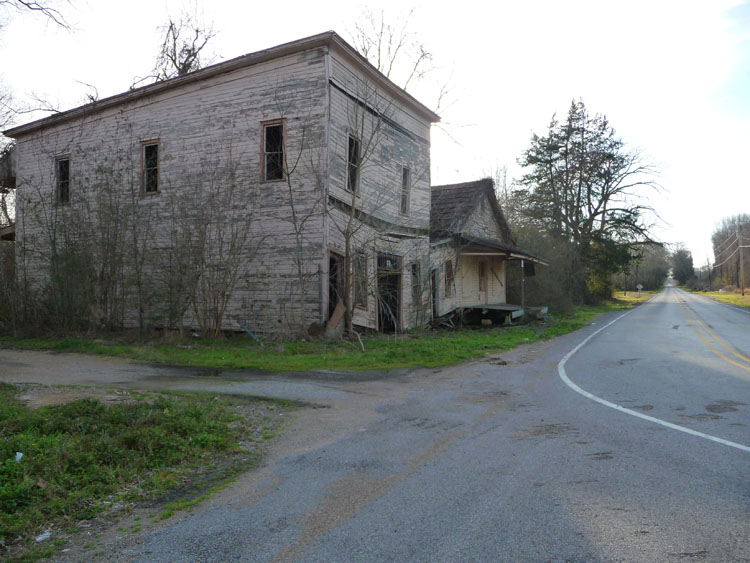
Downtown Vaughan, once the home of the Casey Jones Museum (located to the left of this picture)
After the wreck, Vaughan continued as a small-time railroad stop and later Highway 51 hamlet, but it was the opening of a museum dedicated to Casey Jones that kept it as a going concern until the twenty-first century.
According to Elmo Howell’s helpful Mississippi Home-Places: Notes on Literature and History,
In 1980, near the site of Casey Jones’s wreck in 1900, the state Bureau of Recreation and Parks opened a museum in a restored train depot moved to the Vaughan site from Pickens, Mississippi. Vaughan itself is a ghost town with only a store, post office, and a few vacant buildings. The state has restored a large commercial building across from the museum.
Howell’s book was published in 1988, so obviously the museum wasn’t even enough to keep the few “downtown” buildings going if he was already describing it as a “ghost town.” I’m not sure how successful the museum was, since Casey Jones’ hometown, Jackson, Tennessee, has its own Casey Jones Museum. Not to be left out, Water Valley, up the mainline, has a Casey Jones Museum too, housed in a reconstructed railroad building on the old railroad line in downtown.
The Vaughan museum, like several other historical state parks such as Florewood, was closed in 2004, and whatever chance Vaughan’s few buildings had withered away. In 2008, the town of West got a grant to have the depot moved up the tracks to its downtown, where it stands today as a visitor center. By my count, this little intrepid depot is now in its third location–is that a record? You can see a picture of the depot when it was at Vaughan here.


While the two-story building in downtown Vaughan is clearly too far gone for realistic hopes, the one-story old post office may still have a few years of life left in it, and at least two older homes still stand in varying stages of abandonment within a few steps of downtown.

Abandoned nineteenth century house in "downtown" Vaughan still could be fixed up.

Another abandoned house in downtown Vaughan
From my brief observation, it seems that the recycling bins across from the downtown buildings are probably the main draw for people to stop here anymore.

Usually I end posts in the “Abandoned Mississippi” series with a call to action. This post may be more of a remembrance and an elegy. Vaughan, like many many Mississippi places once full of life–a particular kind of agricultural and railroad life–is slipping away. But its passing should not go unnoticed; it should be pondered. We can’t stop moving toward the future, but Mississippi will be different when all the places like Vaughan and Hot Coffee and Rodney have rotted away and disappeared back into the forest.
Categories: Abandoned Mississippi, Demolition/Abandonment, Depots, Historic Preservation, Urban/Rural Issues


The old hotel is owned by West, Ms. as well. I’m sure there are some material in it worth salvaging. If nothing else, but to say where it came from.
LikeLike
I think these losses are SO SAD–
LikeLike
I was there with my girlfriend about a year ago . We stopped and wandered as you did. I thought at the time that there was a lot of ‘energy’ in that area , who owned the buildings and what someone could do with the salvaged wood. It was kind of ‘weird’ at the time , all the feelings that seem to persist. thanks
LikeLike
I remember well as a young boy, attending the big celebration and bar-b-que at Vaughan when the historical plaque commemorating Casey Jones’ wreck was installed. Jones’ fireman, Sims, was in attendance. It was a big day in little Vaughan! Every time I visited the town after that more deterioration was evident. Even the historical plaque disappeared. The loss of the Vaughan Post Office and the closing of the Illinois Central main line were the end of the town. The town was named after my great, great grandfather, Major Henry Vaughan, one of the largest landowners in the area and a signer of the Mississippi Succession Ordinance.
LikeLike
He is also my 4th great grandfather. I have always wondered where Mandalay Plantation was located in Vaughn. Possibly by the cemetery that still has the name?
LikeLike
My name is Clint Vaughn (the (a) was removed by my father) descendent of Henry Vaughan. When I read this article I was more interested in the platation years instead of Casey Jones. But a good read anyways.
LikeLike
Hi, Clint, I just ran across your note from 2017; my great-grandfather was Henry A. Vaughan, Batesville, MS; I can’t find his ancestor, and thought since yours was also Henry there may be a connection. I’m Suzanne Lea, my paternal grandmother was a Vaughan (Vaughn, as some spelled it). If you have an idea where I could trace Henry Vaughan’s family, I’d love to know it. Thanks for any information.
LikeLike
Suzanne, did you ever get a response to your question? I am Mary (Lupold) Vaughan. My husband is Charles Wm. Vaughan. We live in S.C. His cousin Linda is quite the historian. The Vaughan’s are from Wales and there is still an active Vaughan castle there. His son’s middle name is Henry and his grandsons first name is Henry. The Vaughan’s are quite the military family. All of the Vaughan’s with the last “a” in the name are related. My email is mcvaughan65@gmail.com
LikeLike
Hi Suzanne
Just wondering if this Henry Vaughn was a slave owner as I believe that my Great Grandfather x5 may have been his former slave.
LikeLiked by 1 person
Dear Jackie, I hope you get an answer to your brave question. Best regards, Melissa
LikeLike
Did anyone answer Jackie from September 29, 2020? My maternal grandparents, Peppers, lived in Vaughan beside the Methodist Church that burned down. I believe they descended from German immigrants who never owned slaves. But this has got to be the elephant in the room as we discuss our ancestry. Melissa (Lissa)
LikeLike
Hello. My name is Sultania Burns and my 4x great grandparents were Vaughan’s. And they were slaves. As a matter of fact, my grandmother was born in Yazoo City on Green Hill
Coincidentally the name Henry Vaughan had been passed down. I know after emancipation slaves took the last name of their former owners, but I just wanted to know if there was a blood relation.
LikeLiked by 1 person
Hello, Sultania Burns. In answer to your question, I don’t know whether there are any blood relations to your family on this blog, but I don’t know that your 4x great grandparents, who were Vaughans, were important builders of our shared ancestral memory
LikeLike
Hello, Sultania Burns. In answer to your question, I don’t know whether there are any blood relations to your family on this blog, but I do know that your 4x great grandparents, who were Vaughans, were important builders of the town and are part of our shared ancestral memory. As slaves, their stories are not often told. If you have any of those stories, I would like to hear them – please contact me at melissaholland57@yahoo.com
LikeLike
Im on a true realistic mission to discover where I came from to know where I’m going. I pray I get somewhere on my quest. I believe I will find something about both sides of my family. Everyone I loved is deceased now. It’s left up to me to find my way. No one talked about anything at all. That’s what hurt the most Never knowing who you are!
LikeLike
Hi,
Do you have information about Major Henry Vaughan? I just found a book that was dedicated to him, a travelogue of Europe published in 1860 written by a Philadelphian named E.K. Washington who later settled in New Orleans. If you have information about Major Vaughan, please email me. My email address is my last name at bu.edu.
Jack Beermann
LikeLike
Major Vaughnan is buried on land now owned by my wife and I on Hicks Road in Yazoo County. The cemetery has many of his relatives also.
LikeLike
Take pictures of the head stone. Please.
LikeLike
I would love to know more about my families history..Charlie M Vaughan was my great grandmother..please feel free to contact me at maandpaws@comcast.net
LikeLike
Major Henry Vaughan is my great-great grandfather. I would love to visit this cemetery. I live in Yazoo County, but have never been there. Since it is on your property, can I visit the cemetery?
LikeLike
Henry Vaughan is also my 4x great grandfather – would love any information.
-Leslye Lyles Anderson
LikeLike
ALL YOU SUCKERS ARE RELATED!
LikeLike
do you know Ellen Mosby? I work for her, she used to live in Vaughn. Her parents were Sim and Vesta
LikeLike
:(( So Sad to See Houses that once had Life, people, children, Love, Gone. But that is what is need to bring it back !
LIFE, PEOPLE,LOVE,AND CHRIST !
LikeLike
Do you know how much Florewood brought at auction?
LikeLike
Wonderful job that your doing!
LikeLike
Are any of the remaining properties for sale ? Does anyone know who owns them?
LikeLike
Henry A Vaughan is the son of Henry Clader/Braford Vaughan, plantation owner of Cherryvale Plantation in Sumter, SC. He was born on that plantation on 31 Mar 1800, Cherry Vale Plantation, Stateburg, Sumter County, South Carolina and died on 13 Dec 1870, Madley, Yazoo County, South Carolina. Family oral history says I am a direct descendant through the slave Thisby and Henry Clader/Bradford Vaughan.
LikeLiked by 3 people
Thank you for sharing Kendra, your post really help out a lot. Peace and Blessings
LikeLiked by 1 person
**Helped**
LikeLiked by 1 person
Thanks Kendra. I am a descent of Henry Vaughan as well and looking for information/connections. My email is lillian.potter@gmail.com
LikeLiked by 1 person
Thanks to Kendra for filling out the real history, going back over 200 years.
LikeLike
Has anyone ever visited Ellison Methodist Church, which according to googlemaps is located near the intersection of Vaughn and Brown. The picture on googlemaps shows a cemetery. I have old photos from my grandmother, who was one of the daughters of James Anderson Ewing, which show a stained glass window that they donated to Ellison Methodist Church. I’d love to go and see it.
LikeLike
Tori..Ellison church is a beautiful church less than 10 min off I-55..you should go see those windows..you’ll probably run in to someone you’re related to!…Its still a great community….my family is from there and I pass it often…Dave Deason
LikeLike
Thank you so much, Dave!! I plan to visit this summer.
LikeLike
Dave,
My Aunt Lizzie Dixon Pepper was my father`s oldest Dixon sister. I grew up in Ellison Methodist church.You and i are related . Who are your parents, Doug Deason ? Lessel Deason and I were first cousins.
Best ,
John Robert Dixon
LikeLike
I spent some summers in Vaughan as a child between 1956 and 1967. My grandmother was Sallie Exum Rey. Every summer, when I was there, we’d go by a visit a family named Pepper. Lem Pepper is the name I recall. Several summers we stayed in my grandmother’s house, which is the “another abandoned house in downtown Vaughan” referenced above. The old drugstore building was owned by my grandmother (and possibly the post office building next door). I presume that you are related to Tot Dixon. I remember walking down to Tot’s store.
I am writing a history of the Exum family for my children, and I’d very much like to hear from you.
LikeLike
Mr Hammond-do you remember any davis people that may have rented 1/2 of your grandmothers house-my husband said his family lived in one side of Ms Sally Rey’s house-he said there was a porch that extended around the house-was that her house in “another abandoned house” in Vaughan?
LikeLike
Thank you for your response. I do not remember the name Davis, but I was only in Vaughan in the summers in the years 1956-1967.
LikeLike
The message above is regarding the same white house with the green grass out front. It belong to the Presley family who lived there for some time. The Presleys were from Pickens and only one remains there at this time 7/28/2025, Marvin and Brenda Presley. Marvin was the son of one of eleven children from David B and Burnie Presley.
LikeLike
I work for ellen Dixon Mosby. Tot’s daughter! ( she is 86 and now has alzheimers)
LikeLike
John, in research the Exum family in Vaughan, I came across a newspaper article about your Aunt Lizzie Dixon Pepper. It quoted from a memoir, which she wrote, about what life was like in that area when she was a child. She was a contemporary of my grandmother Sallie Exum, who grew up in Possum Bend.
The snippets in the newspaper article that quoted from her memoir were very interesting. Do you know if her memoir was ever published?
LikeLike
Hi Herbert
Lizzie Dixon Pepper was my great great grandmother. Do you have a copy, or could you point me to, the article that quoted her memoir? I would love to read it.
Thanks,
Lindsey Deason Minton
LikeLike
Do you know a Diane Dixon? She is my client’s niece, her brother SJ’s daughter
LikeLike
I visited my grandmother, Sallie Exum Rey, who lived in Vaughan and later Jackson every summer between 1956 and 1968. She was a member of the Ellison Methodist Church and I went to Vacation Bible School. Many members of my grandmother’s family are buried in the Ellison Cemetery.
LikeLike
Hi Tori, Herb Hammond, Sallie Exum Rey’s grandson. I visited Ellison Methodist Church as a child–1956-1967 when visiting my grandmother. Went to Sunday School and Bible School there. Most of my branch of the Exum family is buried there in the cemetery.
LikeLike
I lived in Vaughan from 1959 to 1961. My father, Clint Cummins, was section foreman for the Illinois Central Railroad there and we lived in the section house (now demolished) located not far from where these photos were taken. The “abandoned nineteenth century house” photo is a picture of “Rose Hill” the home of Ms. Nineta Brewster and Ms. Virgin Reed. These sisters were little girls at the time of Casey Jones wreck and were the resident historians on the wreck at the time we lived there. Ms. Nineta was a poet and Ms. Reed was an artist (as I recall). They said that they actually carried food to the workers who cleared the wreck. Their mother ran Rose Hill as a boarding house for railroad men in 1900. Their story can be found in the book “The Choo-Choo Stopped at Vaughan” written by former postmaster Massana Jones. The second house is I believe the home of Mr. and Ms. “Tot” Dixon. I may have this confused with the former home of Mr. Sam Phillips. Mr. Tot ran the Dixon grocery store in Vaughan which was the town center for all practical purposes. I remember his store well and how good the cheddar cheese smelled when he cut it from the cheese “round” in his store. Vaughan was indeed a busy place in 1960. Dad leased land and grew cotton (hiring many in the neighborhood to help him) and had it ginned at the cotton gin located and operating in Vaughan at the time. Passenger trains travelled through Vaughan (although stopping only at Canton and Pickens) several times a day and you couldn’t keep count of the freight trains that passed through. I remember well the Wilson family, the Dixons, Clarence, Mary Ester, Joe Louis, and many others who were good friends to us while we were there. Thank you for a wonderful online surprise and bringing all these memories to me. Bill Cummins
LikeLike
Bill, there is just one correction I’d like to make, the house that Ninetta and VIrgie lived in and ran as a boarding house, is called “ROSE REST.”
These ladies were cousins to my grandfather, John Henry Fowler, who lived just a few miles past the Vaughan Road Ellison Church, off of Fowler Road. John Henry Fowler was my mother’s father.
I spent the night once or twice in the old house, ROSE REST, while there I heard delightful stories from my cousins, who delighted in showing me and all my cousins, their albums filled with pictures, letters, and articles pertaining to Casey Jones and his wife, and the ‘accident’…the sisters did walk right up the road to see the results and I am pretty sure they told me that they saw Casey’s body. There were, after all, just a few steps away. My grandfather also went to the scene to see the aftermath. This story has long haunted me, being brought up and raised in Canton, to which Casey was racing with the mail, when the accident occurred. He had almost made up the 95 minutes of lost time, when the tragic accident took place. He had been filling in for another engineer who was SUPPOSED to taken that mail run to Canton, but the other engineer became ill and Casey got called in. I firmly believe that in the foggy mist and darkness, that Casey did miss that signal to stop the train! I have a signed copy of Massena Jones’ book, The Choo-Choo stopped at Vaughan…given me by my aunt the late Susie Maie Fowler Wilson, who was a resident of Vaughan all her life.
What always intrigues me, is Casey’s Whistle–which he could make sound just like a whippoorwill…they said that even when he was miles away, everyone that heard that moanful sound knew when Casey Jones was at the throttle!
There has been a stamp made for the USPS with his likeness on it. If you ever were in the museum you would have seen his portrait, that the stamp was patterned from.
LikeLike
Thank you for the correction Nina. I think you are correct that the name of the house was “Rose Rest.” I believe an article in the Illinois Central Historical Magazine has helped me understand how the accident could have happened at all. According to that article, Casey knew when he left Goodman, MS of the congestion on the rail lines at Vaughan because he received train orders telling him that there would be what was known as a “saw by” at Vaughan allowing him to pass three trains all of which were too long and obstructed the main line. Casey was travelling southbound and would have assumed that the trains were arranged so that he could pass the northern most switch without difficulty and then “saw by” the obstructing trains at the southern most switch. This assumption is not without merit because I believe that railroad rules and procedure would have dictated such an arrangement in order to save time in accomplishing the manuver. However, due to a malfunction in one of the trains Westinghouse brakes, it was the northern switch that was obstructed, shortening the distance of Casey’s scheduled stop considerably. As you indicated, he had been running fast and had made up most of his time by the time he reached Vaughan. However, he had slowed to about 35 miles per hour at the time of the impact. I think he was able to accomplish this because he was already slowing down as he approached Vaughan for the “saw by.” If he heard the torpedo at all, he could have reasonably mistaken it as a warning of the obstruction at the south switch (which he anticipated) rather than the north switch (which would have come as a tragic surprise). The follow up report of course placed all of the blame on Casey Jones and the railroad made certain in its report to note that Casey had been cited about 10 times in his career for various infractions, several involving speed. They did not, however, indicate that he had also been promoted to the Cannonball for that very reason, his ability to make up time and bring in his trains on the “scheduled.”
Thank you again Nina for your comments on what to me is a cherished footnote in personal and local history. I enjoy the dialogue.
LikeLike
Hi Bill, I know it has been at least a year since your post was written, but just wanted to ask you about any old grave sites or cemetaries in Vaughn. I am the gr gr granddaughter of Norman Birmingham and his wife Mildred Davenport Birmingham. Norman was the owner of the stage line that ran from Vaughan’s Station to Yazoo City and up to Rolling Fork. His wife died in 1870 and he died in 1882. I have read in his obituary that he was laid to rest in Vaughan next to his wife. From your experience living there all of those years, do you know of any cemetaries in the area? I have explored one on some property that is now a horse farm just down the road from “downtown”, but other than that do not know where else to search for their graves. Thanks for any info! oh yes. One of Norman and Mildred Birmingham’s granddaughters was named Ida Norma Tucker, ( my great aunt) remembered the night of the Casey Jones wreck and used to tell me about it when I was a little girl. She was 15 years old at the time and I found it fascinating to hear her stories! Lourene Stebbins Johnson
LikeLiked by 1 person
Hi Lorene, I wonder if you have any information on Vaughn Station as it pertains to the Civil war. I am researching a Dr. Humphrey Peake who was at the “hospital” at Vaughan station in Oct 1862.
Thanks,
Christina Joslin tinacastle13.cj@gmail.com
LikeLike
Hi Christina,
A year plus
Later, I am just seeing your reply! Sorry!! I do not have any info on Vaughan’s Station pertaining to the Civil War. It sounds very interesting!! Have you found anything since you posted this? Thanks!!
LikeLike
Christina hopefully this isn’t too late to add a footnote to your inquiry. I heard that the old section house I lived in at Vaughan stood at the time of the Civil War and may have been used as a hospital. I also understand it was used again as a hospital during a yellow fever epidemic in the 1870s. All of this is antenatal however and I have no documented proof. A picture of the old house appears in Masanna Jones’s book “The Choo Choo Stopped at Vauhhan.”
LikeLike
Mr Cummings: I was born in Canton (closest hospital) in 1943 and my family lived in t h e second house shown. Earl Presley w a s owner and the Presley family is still owners. VEarl Presley was one of 11 children of David and Burnie Presley of Pickens, MS. There were 2 girls, Lula and Hattie Beth and 9 boys. My daddy was D.B. I was the youngest child of D B and Jean. We left Vaughan approximately 1952/3, moving to Memphis, TN.
I be happy to tell you more, please email me.
LikeLike
Dear Ms. Latham. It is good to hear from you. I recall that a gentleman named Presley owned a car dealership in Pickens. My dad bought a truck from him when we lived at Vaughan. My grandfather, Joe Cummins, was section foreman at Vaughan when you were born.
Yes, it would be good to converse with you via email. Feel free to contact me at bwclaw2634@gmail.com.
Respectfully, Bill Cummins
LikeLike
I remember Tot’s grocery store.
My mother, Sallie Rey Hammond, donated the land on which Messana Jones established the Casey Jones Museum
LikeLike
I went work for the Illinois Central on December 2, 1959 as a mail handler during the Xmas mail rush. Thought I would be there for 30 days or so. Turned out to be more like 16 years.
I was trainmaster of the Tennessee division at Memphis from mid 1969 to mid 1971. Later on ran part of the Traffic Department.
I was a very young 28 year old trainmaster. Most were in their forties and fifties. There is a good chance I am the last living IC trainmaster. Now live in Elgin, Illinois west of Chicago. Just as a coincidence our daughter lives outside of Memphis in Collierville, TN so I get to the Memphis area four or five times a year.
Richard (RJ) Burin
Sent from my iPad
LikeLike
Do you know if anyone lives in Tot’s house now? I woek for his daughter
LikeLike
Looks like an awesome place to metal detect. I would love to get out there and use my F75 to locate some lost history. I live in New Albany and donate all my finds to the Union County Haritage Museum. If I found anything it would be donated to a museum as well. I don’t care for the value of my finds, I just enjoy finding stuff and learning about our history.
LikeLike
Please remember to always ask for written permission of a landowner before visiting an archaeological site on private property. Never take anything from a site or disturb it in any way unless the landowner has given permission and you know how to keep a careful record of what is removed. It can be a trespassing violation to gather artifacts on private property without the written permission of the landowner.
Digging disturbs evidence and destroys part of the scientific value of a site and its artifacts. Refrain from digging at archaeological sites. The locations of artifacts and other fragile archaeological remains are evidence of the behavior of the people who made them. Only through careful, scientific excavation can the archaeologist recover and interpret this evidence. Archaeological sites are considered “non-renewable resources”: once a site is excavated or disturbed in any way, the information the site contained is no longer available and cannot be gained from another source.
If you are going to dig it is very important to keep good records. You should mark each of your sites on an accurate map, such as a USGS 7.5’ topographic map, USDA soil maps, or a highway map. Keep artifacts from different sites separated. Label each of your pieces in a way that will tell you from which site they came. For example, mark your own site name or number on artifacts with indelible ink.
It might be worth contacting the archaeology division at MDAH before visiting a site.
LikeLike
I spent every summer in Vaughn from 1973-1986. My Grandparents, Grady and Clora Kuhn spent their entire lives there farming cotton. I can still remember the amazing smell from Mr. Tot’s store and have told my family about that store many times. Vaughn Mississippi holds the best memories of my childhood. It truly hurts to see it slip away. I have many pictures tucked away I need to pull out now.
LikeLiked by 1 person
please share the pics! I work fir Tot’s daughter Ellen, she has alzheimers, it would be great for her to see her childhood home as it was
LikeLike
I would like to visit with Ellen. Have left her a message on FB Messenger and left my telephone number, I look forward to hearing from her.
LikeLike
I spent every summer in Vaughn Mississippi from 1972-1986. My Grandparents, Grady and Clora Kuhn spent their entire lives there farming cotton. I remember Mr. Tot’s store well and can still remember the amazing smell of his store. Vaughn holds the happiest memories of my childhood and it truly saddens me to see it slip away. I have so many pictures tucked away I need to pull out. Thanks for this article!
LikeLiked by 1 person
wow, just found this; Clora and Grady Kuhn was my aunt and uncle………… I spent my childhood years here. Sad to see it disappear, but very happy years spent here.
LikeLike
I spent some summers in Vaughan as a child between 1956 and 1967. My grandmother was Sallie Exum Rey. Every summer, when I was there, we’d go by a visit with Grady and Clora Kuhn and I remember visiting some folks named Whitington. Grady and Clora Kuhn rented acreage from my grandmother and, after her death in 1968, from my mother.
I am writing a history of the Exum family for my children, and I’d very much like to hear from you.
LikeLike
I spent some summers in Vaughan as a child between 1956 and 1967. My grandmother was Sallie Exum Rey. Every summer, when I was there, we’d go by a visit with Grady and Clora Kuhn. They rented acreage from my grandmother and, after her death in 1968, from my mother.
I am writing a history of the Exum family for my children, and I’d very much like to hear from you.
LikeLike
Major Henry Vaughan was my 4 or 5X grandfather. I find all this stuff very interesting and know many things about my familys history but would always like to know more! Are there pictures, that anyone knows of, of Maj Henry Vaughan or Madely (Madley) Plantation? Or any pictures of my ancestors? My dad is Reece Vaughan, my papaw was William Lee (Bill) Vaughan.
LikeLike
Would you share info with me? Henry Vaughan was also my 4x great grandfather. Very interested.
Thanks –
Leslye Lyles Anderson
LikeLike
Guess we are all related on here..also searching for family history..would love any info you have
LikeLike
Hi Josh. Major Henry Vaughan is also my 5x grandfather..my great grandmother was Charlie Vaughan..have researched a bit on family..found grave site and some pictures I’d be happy to share..you can email me at maandpaws@comcast.net
LikeLike
Hey Cuz! I have a picture of the Major and his wife Emma Rees on my mantle at home. They were my 3X grandparents. I’d be glad to get you a copy if you like. My Dad has done some extensive research and has a ton of info on our family. He found where Cherryvale plantation was in Sumter Co SC. I wish we had a picture of the home at Madley. If anyone has one please let me know. Dad described it in detail to me and I also have a letter that talks about it. Sounds like it was an amazing place.
LikeLike
Hugh (& others!),
I feel like I just hit the lotto with some info on Major Henry Vaughan. I believe my husband is a possible descendent (which makes my son a possible descendent too). I’ve been trying to find when he moved from SC to Mississippi. But I’m very interested in all that exists to help fill in some gaps of family history. would you be so kind as to email me the photos/letter/stories you referenced above? we would so appreciate it!! thanks!
Email: lkgeneology(at)gmail.com
Ps: @ = (at)…trying to avoid spammers ;)
LikeLike
Hi,
This is related to your recent post regarding the Vaughans, I just thought I’d relay to you some information about my own family at Vaughan! My mother was born and raised there, later married my father and moved to Canton, raised four daughters, of which I am one.
My grandfather was John Henry Fowler–if you have ever noticed Fowler Road (off the Vaughan Road and just a few miles from Linwood) …just off that road named for him he had land and the family raised their own crops, cattle, hogs, etc, and I spent many years of my youth there visiting my grandmother, Perrye Brister Fowler and my grandfather John Henry Fowler, and my aunts, uncles, and cousins!
John Henry Fowler was born in 1874, Died in 1960. (Married my grandmother Perrye Lee Brister in Holmes County in 1908.)
His father, Henry H. Fowler was born in Georgia …came to MS at some point –I am presuming early 1900s–and died on the family farm in 1913. (Married Sarah L. Jefferson cCormack in 1867.)
Many of my family members are buried in Ellison churchyard–including the Hargons–you may recall the murders (which occurred in 2005) of Michael, Rebecca, and their little son–James Patrick Hargon. (Michael was my second cousin–he was my mother’s sister’s grandson.) And my first cousin, Dan Haywood Fowler–also murdered, in 1995 in his store that later became Michael’s house. These tribulations can not be expressed in a mere email so I won’t try, but suffice it to say those deeds really took a toll on everyone in the family, and the community.
I just thought I would share some of my history and Vaughan background, because the community out there was basically my second home–after Canton.
When you are in Ellison cemetery–you might note the tombstone of my uncle–Dan Haywood Fowler, he was my mother’s youngest brother who sadly was killed in April of 1945 on the USS HANCOCK while serving in the Navy, he was buried at sea but I often visit his gravestone there to pay honors to him.
Nina
LikeLike
Know this well. Grew up in Ellison Methodist Church and know the Hargon family well, and Fowler road . John R. dixon
LikeLiked by 1 person
Hi, John R., bless you for writing. this comment. I remember many of the Dixon family although it’s been a long time ago since I was able to visit the Vaughan area. I think of all my loved ones every single day, my Aunt Perrye Fowler Hargon, my aunt Susie Maie Fowler Wilson–they used to speak of your family members a lot when I would visit them. Your name is a well-known one in the region. My Uncle Buddy (J.B.) Fowler and his wife Mary lived in Aunt Perry’s home for many years. We lost Uncle Dan Haywood Fowler in World War II, sadly, I wrote his life story and it is on the USS HANCOCK web site along with some family pictures I uploaded, I try hard to keep his memory alive. He was their younger brother and was killed April 7 of 1945. His gravestone stands in Ellison cemetery–although he is buried at sea..I used to visit the cemetery any chance I got, I would put a flag alongside his stone…I am sure that little flag is long gone now…I wish I could come back down and see ‘him’ again. I have photos of him all around my apartment along with his mother, my grandmother–Perry Brister Fowler–I used to stay out at Vaughan with her and my grandfather a lot. I sadly have lost most all of my Vaughan relatives now except for my dear cousin Katherine Hargon Alexander, and her husband Bill, and their sons and families. I truly do miss everyone there! I hope one day to be able to come back to Mississippi for a visit. Thank you again for letting me know your relationship with the Hargon and Fowler family. Vaughan folks are the best foiks in the world! My best to you.
Nina Cresap
LikeLike
Hi Hugh,
Henry Clader Vaughan 1738-1810, Major Henry A. Vaughan grandfather, was my Great
Grandfather X4. My mother was a Vaughan and I have been doing family history research
on the Vaughan. If it would be too much of a bother, I would love to a copy of the picture of
the Major and his wife.
LikeLike
Hello Terrell. Not a problem at all. Can you provide me an email address to send them to?
LikeLike
Hey cuz email me that photo as well please. To joshvaughan@kw.com.
LikeLike
I would love copy of photo and any information on family history..maandpaws@comcast.net.
Thank you
LikeLike
Hugh. Hello. I too am a descendant of Major Vaughan. Could you please e-mail me the photos of Major Henry Vaughan and Emma? I understand that there is a family member who has an oil portrait of Henry, but I do not know who that is and I have not seen it. I have done research on Henry when I visited Yazoo City, and have been told that no photos of Madely exist. Have you ever seen any? It is hard to believe that there seemingly are no photos, paintings, or drawings of the house, especially considering that it was a 32 room brick mansion. I have been to the site where the house stood, but virtually nothing remains except several cisterns. It is not too far from the cemetery where he and Emma are buried. Do you know when Madely burned and whether Henry owned it at that time? I would appreciate any other info. on Henry and Emma that you might have. Thank you.
LikeLike
https://polldaddy.com/js/rating/rating.jsHugh. I am also a descendant of Henry Vaughan. Jack and Effie Hicks are my great great grandparents. Frances Elizabeth in my great grandmother who is still alive in Vaughan, Ms. Would you mind emailing the picture you have of Henry and Emma please. I would love to see it! Thank you so much. My email is tcm181@msstate.edu
LikeLike
Hugh, do you know who to contact to go see the old cemetery? I think a hunting club has it leased. There’s now a gate up where I believe the cemetery entrance is. You can text me at my cell number below.
Josh Vaughan The McDowell Team of Keller Williams Realty 601-664-8219
>
LikeLike
Josh and Hugh,
Do either of you know who owns the oil portraits of Major Henry Vaughan and his wife Emma? I would be delighted to see them in person and learn something about the artist, if known. Thank you.
Henry Frierson
LikeLike
Would love to see the picture you have. My dad is 87 and has never seen a picture of the Major. He is my dad’s 3X great grandfather. Would love any information on the family.
LikeLike
Teri, can you provide an email address for me to send the picture to?
LikeLike
Hugh,
Could you please send me a picture also (hff@virginia.edu)? Please see my note above on Sept, 28, 2016. Thank you!
Best,
Henry Frierson
LikeLike
Hi, Teri Lyles Tanner is my mom. Not sure if she got back to you with an email. But if possible can you send it to me tmbadmat@yahoo.com. She has passed not long after she posted the above comment. Any information would be great. We are from Henry’s daughter Mary Smith Vaughan Guion.
LikeLike
I would love to have copies of the pictures of the Vaughans.
Sfernie44@gmail.com
Thank you,
Susan
LikeLike
I have been asking and looking for pictures for years now with no response…would love to talk .ore and exchange information
LikeLike
Hugh, I am also a descendant of Major Vaughan. He is my 4x great grandfather. My line goes Major Vaughan – Mary Smith Vaughan – Hugh Reece Guion – Fannie Guion – Thomas Moore Campbell – Charles Thomas Campbell – Erin Campbell Pope.
I’m on ancestry and have done the DNA tests as well. I would love a copy of the photos you have. Please email to erinpope27@yahoo.com . I’m on ancestry as EECPope if you’d like to look at the Vaughan / Guion / Frierson info I have.
Being a member of the DAR has given me a lot of access to some great genealogy records, seminars, and researchers. I would like to share a story about Major Vaughan that was related to me from one of his great grandchildren in possession of the oil portraits.
The story goes that during the Civil War that a Union Calvalry group came upon the plantation at Vaughan. The family was not there (possibly in South Carolina or New Orleans at this time)
However, the Union soldiers were angered when they realized they wouldn’t be capturing Major Vaughan. (They knew he supported secession and had represented Yazoo Co as the largest slave holder in the state of Mississippi in 1861)
Being angered, one Union cavalryman rode his horse onto the plantation porch and into the home. He dismounted and took his sword to the oil portrait of Major Vaughan. He sliced it down the front.
Now, as this story is related to me via email – the oil portrait is still in possession by a Vaughan descendant and has been repaired. However, you can see the seam on the portrait where the sword sliced it.
Anyway, it’s a neat story and I thought I would share it.
-Erin
LikeLike
Erin, since my grandmother Sue Dixon was a Campbell, it would be interesting to see how we tie in. I have quite alot of information available .
Thanks,
John
LikeLike
John my Campbell line goes from me to my father, Charles Campbell, gf Thomas Moore Campbell of Benton, ggf Clem Campbell, gggf William Edward Campbell, and then ggggf Marcus Lafayette Campbell. I can’t trace beyond him but they all lived in Yazoo County. Interesting detail – Marcus Campbell (ML) is buried at Vaughan Cemetery so I’m guessing my lines knew each other before they were related. I know for sure my Campbell’s are not related to the Bull Campbell’s is Yazoo.
LikeLike
It is interesting that you should mention Clem Campbell. Last month, at Benton Farm Supply , I ran into the son of Clem Campbell . We had quite a long talk. I believe he is in his late seventies. Can`t remember his name . JR
LikeLike
Hi Erin. It seems we are cousins. I am a descendandt of Major Henry Vaughan also. My line is
Major Vaughan – Mary Smith Vaughan – Emma Guion – Walter Scott Lyles – Edwin L. Lyles – Teri Lyles Tanner – Michelle Smith Badeaux. My mom had started looking for information right before she got sick – she was not able to get to much information before she passed away. I would love info you might have on the Major or Mary Smith Vaughan. I am also on Ancestery as tmbadmat. My email address is tmbadmat@yahoo.com.
LikeLike
Hey Josh
I think I met your dad this week at my dad’s funeral. Would be happy to talk more with you about family history!
-Amy Vaughan Van Hecke
LikeLike
Is this the Bill Vaughan that was married to Margie Everett. Wesley Everett was married to my Aunt Erline. The reason that I was even looking at this was to see if a friend of mine connect back to Mary Vaughan. Married to John Guion. Probably married in 1840’s or so. Julia Moseley Coleman(my g-grandmother) was her granddaughter. Just wondering if we have a connection. Just noticed this post was 2014.
LikeLike
Just to clarify, the email is Lkgeneology (sometimes the L is mistaken for an i). thanks!
LikeLike
Would love pictures or any information on Vaughn family. Also looking for information on Charlie Vaughns husband Taylor.Charlie was my great grandmother.
Thank you for any and all info.
Maandpaws@comcast.net
April
LikeLike
To Lauren: Trying to send a personal email, but gmail keeps changing the spelling of the word ‘genealogy,’ so can you please reply to this Email for some information I would like to share with you regarding my ancestors and family residing at Vaughan, beginning in the mid-1800s era. Thank you! ninacres@gmail.com
LikeLike
The perfect Segway to raise an alarm as to the possible loss of another Mississippi landmark in Crawford; not by neglect, but by deliberate design to accommodate the wishes of the Lapeyrouse Grain Corporation, which operates a grain elevator near the M&O RR section house. In the past two years, Crawford has lost two historic landmarks: Both The Wayside Inn and the old George Hairston Commissary Building were destroyed by arsonist(s). The identity of the Wayside Inn arsonist is known to the Lowndes county DA, but he walks the streets of Crawford, today. In January of this year, by happenchance, I discovered that two parcels of property were deeded to the Town of Crawford by Wells Fargo after a foreclosure. One parcel consists of the section house located on 1.9 acres. I inquired as to the future of the section house and was told that the Mayor of Crawford had already concluded a “done deal” with Lapeyrouse to convey the 1.9 acres in swap for “something of equal value.” The intent of Lapeyrouse was to demolish the section house. I appeared before the Crawford Town Council at its May meeting and told the mayor that certain protocols–Notice of Intent– that must be followed before public property can be conveyed to private ownership. The mayor said that he would “list it in classifieds.” The board members sat there and said nothing. I cannot say if they were aware of the “done deal swap.” A member of the Commercial-Dispatch staff was present at the May town hall meeting–Slim Smith.. as was the town council legal advisor from a Columbus law firm. She offered no comments. I followed the advice of Mulvaney(not his real name) and filed a Notice of Intent with the MDAH. At the June town hall meeting, I informed the Mayor that I had filed a Notice of Intent with MDAH. His only comment was to say, “It’s time to move on.” I pushed a copy of the MDAH form towards him at the table; he, nor any board member, reached out to examine the form.
I have been all through the section house and even into the attic. IMO, it is in pristine condition, in part because the exterior was covered in vinyl siding that had protected it from the elements. An asphalt shingle roof protected the roof framework. The original floor plan is intact. The family that occupied the house–my in-laws– lived a Spartan-like lifestyle. I will post photos this coming week.
http://www.msrailroads.com/Towns/Crawford.htm
LikeLike
I awoke this morning realizing that I had misspelled segue. It’s a word I hardly ever use and I cannot explain the error.
LikeLike
My grandfather is Jessie James vaugh out of Statesville Mississippi my sister is trying to put the piece together my name is Kenneth Vaughn and my sister is Brenda Vaughn my rmail is mr.kvaughn@yahoo
LikeLike
Well, everyone above should gather and compare photos and have a movie or documentary made about this area and its relationship to the Rail Road. I’m a northerner living in Texas and I would really enjoy hearing and seeing more about southern history. We often have illusions about the South. It would be really wonderful to hear more about real people’s lives at the turn of the century in rural southern communities and about the people who worked and worshiped there. I found this site by searching photos of Canton, Mississippi because of a folk artist from there, Lisa Cain. Her charming folk art illustrates a depth and breadth of rural southern life that most folks I know aren’t aware of but would be enriched by. It looked like a real and vital life in a slower moving time. With corporations owning everything we use today, separating us farther and farther from landlords, store owners, even ministers in mega churches, it is soul lifting to hear about these kinds of communities, of the past, owned and operated and enjoyed by the people who lived in them.
LikeLike
I loved your comments. I would love to share one of my true stories about the early years of Vaughan, MS. Our closest town for home needs was Canton, Ms.
Best ,
John R. Dixon
LikeLiked by 1 person
Spent summers from 1955 to1965 in Vaughn with my grandparents. John P and Maggie Rainer. Kin to Ewings, Peppers,Chesters and God only knows who else. Trying to finish a song about my home place called Rosedale Plantation.’
Mike Rainer
Mrain240@gmail.com
LikeLike
i did a video for the rememerance of john luthar aka casey jones with the music end of the line would love to post it
LikeLike
These buildings are declining fast. I just posted a picture on my facebook page I took a year ago. My father was born in Pickens just north of Vaughn. My facebook address is https://www.facebook.com/britt.maxwell1
LikeLike
I never received pictures of any of my relatives…I just did a DNA from ancestry..Has anyone else done this or are you on any ancestry sites…Would love to connect..Email is Maandpaws@comcast.net..
LikeLike
John, I was born in the David B. Presley house which was located on the road north in 1941. When the Presleys’ moved to Pickens, we stayed here until about October of 1951,
I would like to receive a copy or photo of you layout of Vaughn as mentioned in your remarks below.
LikeLike
My names is John Robert Dixon,born in 1950,youngest child and only son to Jim and Sadie Dixon. and I grew up in Possum Bend comminity, “suburb” of Vaughan, Mississippi.I have retired and as of this August my wife and I will be returning to live at my old home site at 41 Jim Dixon road, Vaughan, MS,My home site began as a wedding present to my Grandmother Susan Campbell when she married John Tackett Dixon in 1881. There are four cedar trees still standing in the yard today that were planted by Grandma Sue in 1882,which she dug up from the surrounding woods. Granddaddy`s old barn still stands but has my tractor under it instead of filled with horses and mules.I have recently toured Vaughan, and it is really bad shape, except the old Rose Rest hotel, which can still be salvaged.
I too grew up in Tot Dixon`s store , and have watched thousands of trains pass through as well as actually riding backwards through Vaugnan on AMTRAC one time to a MSU football game in Louisisna. ( Was on my bucket list to do)
My father, Jim Campbell Dixon was born the middle child of JT and Susie Dixon in 1895.He told me the first thing he remembered in detail was rididng to Vaughan with Poppa in their buggy to see the train wreck and Casey aka James Luther Jones, covered with a sheet and lying on the train depot.Daddy would have been 5 years old in 1900.
One of my hobbies is writing short stories about growing up in Possum Bend as well as just beginning to enjoy a much slower pace in retirement after 45 years in our food industry. Being a part of processing millions of pounds of food daily versus being a part of slaughtering two or three hogs after the second killing frost each fall on our farm was a great expansion for me.
I could go on for hours about stories and my love of that community and Ellison Methodist Church .I have throughly enjoyed reading all of your comments posted ahead of mine, and I have definitely learned alot from them. I have also seen many names pop up that I know from distant past.
I used to go with my Aunt Alice Dixon up to visit Cousin Virga and Ninetta Brister when they lived in the Rose Rest hotel and explored many corners of it, inside and out, as a youngster.
If anyone would like to discuss Vaughan , etc anymore, give me a call at 919 344 3342 , jrdixon701@aol.com or come by and visit me at 41 Jim Dixon road in this September. I always have an extra hammer available or a cold drink and a huge porch with rocking chairs, where we can sit, tell stories, and watch the grass grow.
A very large number of people in that area will trace their lineage back to my grandparents, JT and Susie Dixon. ( I actually grew up in the OLD and Original Dixon home that had been increased from an original one room log cabin .
With the help from a very aged cousin, I am actually doing a pencil drawing now of the way Vaughan was laid out pre 1950. Have already framed one of our old home place and the way it was laid out pre 1950 which will hanf on my outside porch . I always use barn wood from the original homesite for my frames.
Best to all out there who love Vaughan, Mississippi. I look forward to hearing back from you and sharing our stories.
John R. Dixon.
LikeLike
John,
Your grandfather was the brother of my great grandmother, Margaret V. Dixon. I still have many relatives in the Yazoo City area. Do you have any more information about the Dixon family?
Thanks,
Ken Monk
LikeLike
Yes, Ken, I do have quite a bit of information on the Dixon family since their arrival in the New World in 1640 in the North Carolina area. We migrated down to and thru New Bern, North Carolina.
Currently, I am not close to those records back in Mississippi, as I am in Scotland , where we have a second home. While here, I plan to do more research on the Dixons on this side of the pond. My hope is to trace us back to Richard Keith. Keith Clan originator, from who history says the Dixons came being interepted as Dick-son of Dick being short for Richard “Keith.” .
I will be back in Vaughan, Mississippi at 41 Jim Dixon Road the very end of November.
I look forward to connecting and sharing information.
John
LikeLike
Nina, thank you for your quick and informative response., Katherine Alexander has been a close life long friend of mine and still is. Bill and I are related since his Grandmother Mable Moore Dixon was one of my Dad`s older sister.
I have always held Dan Haywood Fowler`s grave site in Ellison Methodist Church cemetery in awe, not only because of his dedicated service to our country in WW II, but his burial at sea.
My son, Cooper Dixon,is a Marine, with tremendous respect for all military service members.Your comment about no American flag at Dan Haywood Fowler`s grave has spurred an idea we will present to the decisison makers at Ellison.
Cooper and I will propose creating a data base of all military personnel buried at Ellison which captures history as well as becomes a perpetual record going forward. He and I also will propose purchasing and giving to the church a large enough quantity of American flags to permantely honor every service member buried there now, as well as extra for those military members to follow. (Yesterday, I quickly listed, just from memory, about 20 Military members who are already buried at Ellison.).
If the Church will approve our plan, since I will be returning to 41 Jim Dixon Road this September, I anticipate executing this plan and placing a new Flag at the gravesite of all present service personnel interned there.
Any thoughts from you or anyone else will be appreciated.
Regards,
John R, Dixon
LikeLiked by 1 person
God Bless the Marines…and God bless Cooper for his service! I will say prayers for him. What you are planning to do for the military members at Ellison is the most wonderful thing! I am very excited about it, and please keep me posted as things go along. What a beautiful idea! My first cousin James Patrick Hargon, Jr. is an Air Force veteran, he is buried at Ellison Cemetery as you are aware. I was not aware of the number of military veterans buried there, but now that I know I will be rooting for you and the board members to make the right decision to honor all military members who made those sacrifices for their patriotism, for love of country and family. All family members of my mother, the late Lillie Belle Fowler Cresap (although she is buried in the Canton Cemetery) all others of her family are buried at Ellison–all the way back to my great-grandparents (Brister & Fowler names), Hargons, Wilsons, Westbrooks, and others–who are all my aunts, uncles, and cousins. I know that you knew all or many of them, and I appreciate your letting me know of your relationship and friendship will my family members. Vaughan, MS was my favorite ‘stomping ground’ as I was growing up, I am sure I must have seen you you at Ellison church services when I was young. I miss Vaughan! I’m praying for your success in the military project planned.
Fond regards,
Nina
LikeLiked by 1 person
We already have the proposed plan on paper and ready to send down to the preacher and committee. I say down, since I am still residing in Montgomery, Illinois, 40 miles west of Chicago . But homeward bound to 41 Jim Dixon Road the end of this August. Once they have approved it, I will share it on this web site.
Take care ,
John Robert
LikeLiked by 1 person
I was back in Vaughan last weekend for the funeral of John Kelly Moore, my oldest first cousin.101 years old. His Mother, Mable was one of my Dad`s older sisters.
The Minister there at Ellison ,Pastor Frank, assured me that it appears that our plan for the flags is a “Go”
I anticipate executing this plan for American flags at each service members grave in September,when I will be there for a whole month.Now, one more will be added to the list already of 20 plus, since JK Moore was a WWII veteran..
I will post pictures once this is achieved.
John Robert Dixon
LikeLike
Thank you, John, for all your caring compassion and diligent work towards the flags for the veterans buried at Ellison. On behalf of my families–the Fowlers, Wilsons, Westbrooks, and Hargons–we are all appreciative of these efforts by yourself and Pastor Frank. I wish to extend my deepest condolences to the family of John Kelly Moore, and to all the Vaughan community. I fondly remember John Kelly as the dearest man–he always graciously welcomed all us of the Cresap family any time we saw him at Ellison. Again, many thanks and much success with the project of honoring our beloved veterans.
Nina Cresap .
LikeLike
The John Kelly Moore Veterans Memorial has been approved for honoring all veterans buried at Ellison Methodist Church Cemetery, We are in the process of gathering specific information about each veteran .Flags are on order, and will be placed at the head stone of each veteran for 7 consceutive days for Veterans Day and Memorial day recognition.
Anyone knowing of or having any information about any veteran buried at Ellison please contact me at JRDixon701@aol.com.
Thanks and God bless our veterans,
John R, Dixon
LikeLike
Update on John Kelly Moore Veterans Memorial at Ellison Methodist church, :
The JKM is in full force now. Cooper and I explained its origin and purpose to the Ellison Church body last Sunday.Since I will be in the UK through the month of November, Cooper has agreed to be the person responsible
Thank you,
John Robert Dixon
LikeLike
Anyone ever heard of the Seay family living in Vaughan? I recently found a record that says my Great great gandad was born in Vaughan, MS in 1911. I think his family later moved to Pickens.
LikeLike
Sure do. I personally knew Cliff, Doyle, and Ellis Seay. Cliff and Doyle are buried in Ellison Methodist Church cemetery. Doyle was a Veteran as I discovered when gathering information for the John Kelly Moore Veterans Memorial recently established at Ellison. Cliff , I remember as a mere child, a good friend of our Dixon family, literally wore a wooden peg leg, and started every sentence with the phrase,” As you say,” …………If you are interested in learning more, I can direct you to contacts in the community who knew all three of them more closely than I. Will be glad to help .John
LikeLike
Today ,12/26/2018, I left the restoration contractor doing work at my old family home at 41 Jim Dixon Road, Vaughan, Ms 39179, and “went exploring.”I went by Thornton Methodist Church in Madison County, Way Bluff, Visited the cemetery to pay my respects to a dear Pepper cousin who had passed away at 99. Thornton was on the same circuit as Ellison Methodist Church , which was my church, so I visited there many times as a child, until 1968, when I went off to college. I remember the original structure more than I do the latest one.
I next went to the original location of the Allison Wells Resort, Way, which I had visited several times as a child and remember when it burned in 1963. Was pleasantly surprised to tour the grounds of the Gray Center and to learn more history as to the location of Way and its relationship to the Civil War.
Then, still in an inquisitive mood, I went over to Camden, Ms . Had not been there since early 1950s. I was looking for any remains of the old boarding school that once flourished there. My father, Jim Campbell Dixon, born 1895, used to tell me stories of crossing Big Black River at Vaughan, on a ferry on his way to Camden to attend school. I was very pleased to meet some very helpful folks in the Paul E. Griffin – Camden Library located there who told me the recently renovated community center was actually a part of the original boarding school structures which Dad attended. There is a really nice Baptist church there which was established in 1885. Also a US Post Office which houses the Masonic Lodge on the top floor.
Then my wife called from Scotland and abruptly reminded me she would be arriving in two week, so I decided it better if I returned home to see how the renovation work was coming along.
If anyone has any additional information about the old boarding school in Camden, I would really appreciate learning more about it, and its services. I am guessing my dad would have attended in the early 1900s, since he was born in 1895.
My son and I will definitely be returning to these locations , especially Camden, to learn more about the history of that area and specifically where his Grandfather attended school.
Thanks,
John R. Dixon
LikeLike
Have pics and thumbnail history on the old Camden school in camden, ms. Pictures include shots of the old boy’s and girl’s dormitories, home economics bldg, and the grammar school bldg (still standing being used as a. Visitors center). These and many more old structures with histories are included in my book “old structures of north Madison county” published in 2016. My father finished high school there in 1929. Robert h. (Bob) CAUTHEN.
LikeLike
I have a photo of this from July 1989. We were traveling to Texas to visit my grandmother and family (also Vaughan). We stopped to take a break and saw the sign. Shame it’s gone. If anyone knows how to post a picture for this site, let me know.
LikeLike
It is exciting to see the railroad tracks through Vaughan being refurbished and the entire line being made ready for freight traffic as soon as the track`s new cross ties have been installed. Believe the line will then be open from Memphis down to Jackson, MS. I look forward to hearing that lonesome whistle sound as it travels through Big Black River Swamp again.
My daddy could tell when the river backwater was rising by listening to the different echo of the train as it made its way through that swamp.
As kids, we used the train to determine North and South so as to find our way from the swamp after having coon hunted half that night with Mr. Bill Chapman. No doubt about direction or time of night.
Casey Jones won`t be at the throttle this time,but the trains will definitely pass directly down the section of track where his fatal wreck took place in 1900.
Sadly, only one single metal post still stands on which a sign identifying the particular wreck location used to hang.
John R. Dixon
LikeLike
How exciting–to know the tracks are being refurbished and freight will move up and down those rails once again! J.R. your daddy was really sharp–to calculate that echo and determine the water’s rise on Big Black! I can almost ‘hear’ in my mind the sound of Casey Jones’ whistle—piercing the air on his night run to Canton blowing that haunting whippoorwill sound–a time when everyone for miles around knew that Casey was at the throttle! Casey’s story should be recalled often and passed on down to all next generations for an eternity.
There is a book titled “Casey Jones” by Stephen Krensky that is a wonderful read…pretty sure it can be found on Amazon or other book selling sites.
I wonder if the ‘lost’ marker, denoting the place of the wreck, could somehow be replaced by some historical organization in the state of Mississippi? It might be a tough sell, reasons for such a sign would have to be carefully detailed and documented–but perhaps someone or some group in the community could retrieve an application and apply for such a replacement sign..how exciting would it be if this landmark project could be accomplished and that former sign replaced at ground zero in Vaughan.
Nina Cresap, former resident of Canton.
LikeLike
I am in Scotland right now, spending time with my wife here, while we have explored many historical sites both in Scotland and lower England. One site visited again is the village of Douglas and particularly the Castle Douglas, where recorded history details the Dixon line actually has its beginning with Dixon having the meaning ,”Son of Dick, Dick being short for Richard as in Richard Keith . Hence the Keith clan castle here in Douglas and my continuing interest .
My plan, once I return to Vaughan from this trip, is to resurrect a project entailing the erection of a Casey Jones sign at the actual site where the wreck took place. Having done some preliminary research before I left on this trip, it is my belief that I have located the local person who actually owns the piece of land where the Casey Jones sign has been located on previous occasions, the site of the actual wreck.
It was disappointing when I talked to various workers who were reopening the section of railway running through Vaughan to find that not any of them had any knowledge of the Casey Jones wreck. Hopefully with the new sign erected , we can use this as a catalyst to inform and help preserve history.
John Robert Dixon
LikeLike
John, My name William Sullivan. I am presently in town Coleraine in N Ireland. Live mostly in MS. But in the late 60s and early 70s I frequented Mr. Tot’s store in Vaughn Mississippi. My father Bryan Sullivan who was born in 1918 in Mississippi was good friends with Sam Dixon. My father and Mr. Sam were close to the same age. Mr. Sam was likely a little older than my father. My father was from Sullivan’s hollow in south central Ms and moved to Jackson as a young man. We would often go out to the gin at Lynwood. But most often would sit in Sam Dixon’s office and chat. Mr. Sam was a heavy drinker and would often be inebriated but my father enjoyed sitting and talking with him anyway. My father always seemed to worry about Mr Sam and his drinking. I have eaten many a slice of red rind hoop cheese on crackers at Mr Tots store. I miss the pace of life that allowed old men to travel a piece just to sit and talk. I miss Mr Tot, his horn rimmed glasses, and Vaughn MS.
LikeLiked by 1 person
Hi William, I work for Tot’s daughter, Ellen. She will be so happy to hear of someone who knew her parents who is still living ( hopefully, this is a response to a 6 year old comment, hope I didn’t come in too late!
LikeLike
my name is Jessica McCalip, I forgot to introduce myself in the first comment and this site seems rather outdated and dysfunctional as ai cannot edit the comment.
LikeLike
Hi. I am a descendant of Henry Vaughan. We are planning a visit to Vaughan this summer while on a road trip. Could someone tell me whether it’s possible to visit the old family graves and whatever remains of the Madeley Plantation? Also, I would be very interested in connecting with any of our relatives in the area who might have information about the Vaughans, Madeley, or the many enslaved persons who lived there. Thanks, Lillian
LikeLike
Lillian,
I visited this area several years ago, searching for information on Henry Vaughan and Madelay.The graves of Major Henry A. Vaughan III and his wife Emma Rees Vaughan are located just off Hicks Road in Yazoo County, MS. At the time that I saw them, the cemetery was in terrible condition, as there were only a relatively small number of gravestones in the woods off the dirt road. Not far away in the woods off Hicks Road were several cisterns—the only remnants of the once very large and grand Madelay home, which had burned sometime long ago. Despite my attempts I was never able to see a photograph, painting, sketch or plans of the house. I believe that both the cemetery and the house site lie on private property. I am sure that there are Vaughan relatives in the area, but I did not have the chance to meet any of them at the time of my visit.
Henry Frierson
LikeLike
…if there is anything that makes southerners distinctive from the main body of Americans, it is a certain burden of memory and a burden of history…. I think sensitive southerners have this in their bones, this profound awareness of the past.”~ Willie Morris
Morris is right on our collective ancestral memory, but his claim that there was “overwhelming testimony of eyewitness accounts and fingerprint evidence on the rifle found at Evers’ murder scene is erroneous.”
That grey Plymouth Valiant parked at Club Katherine, which Waller charged belonged to Beckwith, actually belonged to a Memphis truck driver who was a boardinghouse tenant that stayed near the crime scene.
There were no fingerprints found on the rifle “left” in the grassy grove, only a “partial” fingerprint on the scope that did not link Beckwith to the “found” weapon.
The late (August 2016) Mississippi Chancery Judge Chet Dillard claimed that Beckwith did not do the crime and that the assassin’s true identity would be revealed after his death.
Of course “writer” Willie Morris knew that “if he ever wanted to work in this town(NYC), again,” he would have to become a “team player.”
LikeLike
As I have noted that many who write in are descendants of Major Henry Vaughan, I thought the following info might be of some value to someone–although I have no knowledge as to whether access or admission to the site is possible but directions found online state: “Going east on Hwy 16, (about 12 miles) turn right on Hicks Road. Go 1.6 miles and turn right at the curve. Cemetery is back off the road.” One can conduct an online search by Googling “Old Yazoo County” cemeteries and check the directory for Hicks, aka Medley, and/or Vaughan or ‘Vaughn.’
Also, one may go online to “Find-A-Grave,” register to become a member, and conduct a search for Maj. Henry Vaughan, Sr., 1800-1870–in Hicks Cemetery, Yazoo County; there is a close-up photo of that particular gravestone there along with some family (ancestral) information. Also there is the gravestone of his son, Dr. Henry Vaughan (1835-1884). It is nice that you can ‘visit’ these gravestones online and can even leave a ‘flower’ in their memory.
LikeLike
Hi,
Thank you so much for the article. It was wonderful to reminisce. I remember playing on the engine when I was a kid and my dad took me. I wasted to take my son now, but the last time I was through Vaughan was about 2000-2001 and I remember I could see the engine, but I couldn’t get to it. And the museum seemed abandoned or at least closed and unkempt.
I guess I have 2 questions. What is the current location of the engine that was there for so many years? And did it actually have anything to do with Casey? Or did it just happen to be an old train engine they put out front for the kids?
LikeLike
Hello Nick. This post is 6 years late but the depot is, of course, at West, MS and the engine is on display at the old IC depot at Taylor, MS. The engine had nothing to do with the Casey Jones wreck. If memory serves me correctly, it came from Texas.
Bill Cummins
LikeLike
Several of my Gentry family members worked the railroads, including the M&O(ICG). I lost my brother-in-law to a rail accident at Moss Tie Co. in Columbus on 23JAN1980.
My father lived just 200 yards from the M&O Section House in Crawford and heard those “Wallace Saunders” made-up songs mentioned in the newspaper link. I cannot remember all of the song’s lyrics, but it went something like this…On a cold, frosty morning, down on the tracks, all the darkies has gathered, with axes on their shoulders and not a shirt on their backs.
Thanks for the folks at MDAH for saving the Crawford M&O Section House that was set for demolition by Crawford Mayor Tolon and the Crawford town alderman three years ago.
https://www.newspapers.com/clip/35488225/cayce_jones_and_madeup_railroad_songs/
LikeLike
The Genesis of how Wallace Saunders’ made-up song morphed into the Casey Jones ballad. I wondered just how “we’ll be dead when we get to Frisco” entered into the lyrics. That would’ve been one giant leap in railroad legendry.
https://www.newspapers.com/clip/35490685/the_genesis_of_the_cayce_jones_ballad/
LikeLike
My grandparents lived and died in Vaughan, and I grew up knowing so many of the folks named in these comments – or as my grandmother said, “visiting with” them. Haven’t seen the place in nearly 50 years. The Pepper house, with a wide porch on 3 sides, burned down decades ago, and so did the Methodist Church next to it. Miss Virgie and Miss Ninetta painted landscapes for my grandmother (a Brister), and these are still in the family somewhere. My grandfather heard the crash of Casey Jones’s engine and saw the aftermath. My Uncle Massena started the old Casey Jones Museum, now moved elsewhere. Memories of Vaughan and the beauty of the countryside and the stories of the panther in the Big Black Swamp and the passel of cousins and neighbor kids to share secrets with – these memories are warm and but also painful. Pain of nostalgia I guess, of time passing. Pain, too, I’ve come to realize, of seeing the hurt we did to people who didn’t look like us. That haunts me every day, and I don’t know what to do with that. Maybe put it to use to help those we hurt, or their children? I live pretty far away from Mississippi now, but if anyone knows of local charities or other ways to help, please, please let me know.
LikeLiked by 1 person
Hello, Melissa,
My grandmother was a Brister, perhaps we are related! I have posted my background in the past, my growing up years in Vaughan, as my mother and her brothers and sisters were all born there. My grandfather was also at the rail site where Casey Jones died, Ninetta and Virgie were his cousins, I have visited in their home, Rose Rest, more times than I can remember. I also worry about this beautiful past, that is now seemingly fading away, all too swiftly. Where did it all go! I often wonder. I also live in another state now, and wish I could travel again and visit Vaughan, I still do have first cousins there and friends who have been such an important part of my past. My grandmother, who is my mother’s mother, was Perrye Lee Brister Fowler. Her parents were Ben Seay Brister and Susie Dixon Brister. My grandmother Perrye (Brister) married my grandfather, John Henry Fowler, in Holmes County in September of 1908, then settled in their home on the farm in Yazoo County, just up the road west of Deasonville. The Volunteer Fire Department building at Deasonville was named for my first cousin, James Patrick Hargon, My roots that stem back to Vaughan, on my mother’s side of the family, almost from the day of my birth. All my mother’s folks are buried at Ellison Church cemetery.
LikeLiked by 1 person
Dear Nina, What a lovely response! I wish my recollection of people and names were so vivid — but my sister and cousins will recall our links to exactly the relatives you mention. The Dixon, Deason, Fowler and of course Brister and Pepper names echo clearly from my childhood visits. Do you remember our grandmothers (mine was Miss Bea, Mama Bea) walking together in their gardens and talking flowers? They were splendid botanists – knew hundreds of plants and varieties and the nuances of cultivation. In fact, I’ve never seen flower gardens as dense with color and form as were the front yards of Vaughan. I guess the painful part for me is remembering who lived in the falling-down shacks down the road, who worked the fields for us, whose memories are not filled with flower gardens and good food. That’s what haunts me.
LikeLike
Good evening Melissa,
There are so many memories, too many to count! I well remember my grandmother, Perry Brister Fowler, doing so much for me, as I spent so much of my childhood years in hers and grandaddy Fowler’s house. One thing my grandma Fowler did for me that was so special, she put together a photo album with so many family photographs–she began with me in a bassinet the year I was born…and brought it forward, page after page of me, my parents, my sisters, aunts, uncles, cousins, all in the pages–in fact I had my album out all this week, going through the multitudes of memories these photographs bring. Yes, all the names you recall I also know all of them, they all were sweet people, friends of the Fowler family and who I remember from the Sunday services I attended with my Grandma and aunts in Ellison Church, not far up the road from Grandma’s house. My grandma cherished our meals–huge spreads laid out on a big table–the menfolk would be hungry when they came in from working in the fields or baling hay! Delicious meals then were composed mostly of the homegrown vegetables the family grew on the land and meat when available. I loved walking through the gardens with my Grandma! There were fruit trees also, and I remember plum trees…you’d pick ’em and eat ’em…right off the branches! I remember the fig tree just outside a window on the south side of the house, those were yummy to pluck and eat right off the tree! I remember that Sunday dinners were as a rule, might be composed of a chicken–that used to be strutting out in the yard–somehow that thought nowadays frightens me–but back then it was the normal thing to do…and it surely did fry up well! I remember Sunday dinners on the ground at Ellison Church. One of my first cousins when she grew up played the piano for the Methodist hymns sung by the congregation. I still remember the words to most of those hymns! One of my favorite things Grandma used to do was ‘help’ me set up ‘housekeeping’ out in a side yard…even afforded me a broom to sweep all that dust away…put up me a little table and chair so I could sit and have my little tea party, I might have even eaten a ‘mud pie’ or two! Grandma would save little empty perfume bottles and cream jars for my ‘dressing room’…now thinking back, all that was just as good to a little girl as having a pot of gold! We were knowledgeable of the shacks you mention, some of those who lived there made great neighbors that we knew, and back then, it was a part of life–and those neighbors were sweet and good, I recall, and I remember that everyone in Vaughan did what they we could when opportunity presented itself, to share, and help as much as possible. I remember Vaughan residents being just that way. I could tell stories about those neighbors sitting with my Grandma and aunts and cousins, during times of sorrow and even family tragedies. I guess we all just did the very best we could back then. I wanted to ask–you spoke of Mama Bea…the only Bea I know of is a beautiful lady who’s daughter married one my first cousins! Do you by chance remember your Bea’s last name? and whether she had a daughter who lives on Deasonville Road? One more person I remember fondly is lovely Miss Royal who ran the Post Office at Vaughan. She was the sister of Miss Beulah, a sister-in-law to one of my uncles by marriage..his last name was Wilson. Perhaps your cousins and sister might remember them. I spent a lot of time with the Wilsons also as one of my mother’s sisters was married to the gentleman I mention. I am thankful for each and every one of these memories you’ve helped me recall. I miss Grandma’s and Grandaddy’s old home place! I also live far away now, would love to travel down that way again, perhaps one day I shall. I’ve enjoyed sharing some beautiful moments of my life with you.
LikeLike
P.S. To Melissa: Did your uncle happen to write “The Choo-Choo Stops At Vaughan?” I have this wonderful little book–given me many years ago by my aunt Susie Maie (Fowler) Wilson! It’s right beside me now in my bookcase..what a wonderful job Massena Jones did, if he is the one you mentioned…such a great true story, photographs and all!
LikeLike
Hello, Nina. My goodness, what a wonderful recall you have! Yes, My Uncle Massena did write “The Choo-Choo Stops at Vaughan,” and he also set up the first Casey Jones museum right there in town. He actually was not a Mississippian but rather, he married one — my Aunt Mavis, my mother’s half-sister and first daughter of my grandmother, Miss Bea. Uncle Massena became so captivated by Vaughan, its people, and its lore that after retiring, he and my aunt moved there and he wrote that short, sweet little book. He wanted to disabuse the world of the impression that Casey Jones crashed in Virginia, and he wanted my grandfather Pepper’s memory of that wreck to be preserved. Mavis and Massena had 3 children and 2 of them, my cousins Sonny and Carol, have settled in Mississippi. Thank you for remembering!
LikeLike
Dear Nina – I reread your post. Your images of playing house in the yard are so precise yet so simple. They show a grandparent respecting a child’s world enough to help her build it. That’s how it was then. The past isn’t just about names and places and lineages, right? It’s about relationships – that’s what we risk losing, and that’s what you write about so well. Think about writing a story. Rural Mississippi has stirred some the finest fiction in this country, after all.
And the language – Oh lord, you’re bringing it back. The past is also about how we talked and it’s the easiest thing to lose. Please bring back more of that and put it in your story.
You asked about Miss Bea — my grandmother, Beatrice Brister. Her first husband died of scarlet fever and she married Everett Pepper. They lived on Vaughan Road, west of and not far from the intersection with what’s now called Upshaw Road. My sister remembers that Mama Bea was best friends with Miss Beulah, sister of Miss Royal. Grandpa Pepper didn’t like to go to church, so if Mama Bea went (she didn’t drive), it would be with one of her friends. Both grandparents are buried at Ellison Methodist Church.
You described the Sunday dinners. For my grandparents, too, it was from their farm to their table. My mother and aunts, try as they did, never matched Mama Bea’s fried chicken, biscuits, and butter beans.
What I find in your posts and not so much in the menfolks’ is the intangible past of language and connection – the rich past. If you write a story, you may find that fiction as a form best taps your memory for the metaphors and ways of talking back then. It might give you distance to create characters from memories of people so precious and close to your heart, they are hard to write about.
Even if you don’t write a story, you’ve awakened me to a past that I think I’d closed off before reading your posts. I am grateful to you.
LikeLike
Having been born in Vaughan on June 2, 1941 and lived in the Presley house from then until late 1951. I am surprised in reading all the posts their was no mention of David B. Presley and his large family of 9 boys and 2 gals. Oven the past 20 or so years I have ben through Vaughan many times to see the Presley farm as I call it and how it continued to deteriate.
LikeLike
Anyone familiar with the open Mississippi countryside, knows that this time of year it is so easy to locate either a current house site or certainly an old home site, many years long abandoned, by following the blooming trail of the Yellow Jonquils.
So far, I have collected at least thirty clumps from thirty different sites.And I am not through collecting yet. Many of them will be from locations directly representing the Vaughan area.
My intent is to plant a bed of these flowers at my home site on Jim Dixon Road, either in the shape of a V for Vaughan or an E for Ellison Methodist Church .
A way of preserving the past while saving it for the future.
Once established, hopefully folks will visit this site.
John R Dixon
LikeLike
I love this idea, Mr. Dixon.
LikeLike
Hello all,
I have some Vaughan resources to share and would love to be in touch with everyone. My father, who passed away last week, was very interested in our family history, and loved to share it with me. He traced our family back to Charlemagne (although that is on his mothers side, not the Vaughan side). He was born and raised in Vaughan, lived much of his life in Canton, and travelled to South Carolina to trace the line and visit Cherry Vale, which is now under a Walmart parking lot. I also worked on it some with him for my DAR application. We are from Henry Bradford Vaughan, Maj Henry Anderson, William Reece Vaughan… and so on.
I am on ancestry as Amy Van Hecke, and the tree I have worked on is called “Vaughan Van Hecke Tree.”
I have photocopies of the portraits of Maj Henry and Emma Vaughan, showing the sword mark mentioned above. My mom and I visited these portraits and took the photos, but now we cannot remember whose house we saw them at! lol. My mom thinks it was a house off Scotland Road in Vaughan. If anyone knows who has them, I would appreciate that info. I also have the GPS coordinates of the Madely cemetery, if you’d like them, please contact me for more info. My dad also told me about Madely, that it burned maybe in the 1940s. He also said the Vaughan silver was sold during the Depression because they were “so poor they were eating dirt.” He told me about who he thought has it now. He was not happy with them, he also said they stole the Madely wrought iron cemetery gate that had a V on it, and took it up to Jackson to put in their garden. One day I’d like to try to track that down. I have attended services at Ellison Church and my children even went to VBS there. Lovely, wonderful people. There are also quite a few Vaughans buried at Black Jack Baptist Church.
I am curious as to the death of the first William Reece Vaughan, seventh son of Maj Henry. It looks to me like he married Ida King, quickly had 2 children, and died very young, within 2 years, aged maybe 20 or 21. My dad had a Vaughan genealogy book (“Bloodgames” by Terry Vaughan), and in it, he wrote on the margin, “Shot by LP King.” I believe this to be William’s wife Ida’s father. There must be a story here, of why a father in law would shoot his son in law! If anyone knows, please contact me. I wish I had asked my dad before he passed away. So much knowledge is lost each time someone passes.
-Amy
LikeLike
Amy,
Thanks for more information about Henry Vaughan. I am also a descendant and have commented a few times on this site. I have visited all of these properties and having grown up in SC am very familiar with Cherryvale. I would be delighted to know who owns the Vaughan silver as well as the owners of the portraits of Henry and Emma. I did not know that Madely apparently burned in the 1940s; perhaps then, there are some old photographs of the house, which I especially would like to see. Several years ago we met with a historian in Yazoo City who had some knowledge about Madely, but he was not aware of any images of any sort of the mansion.
Regards,
Henry Frierson
LikeLike
This is probably a far reach, but here I go. My grandmother (Marvelene Vaughan) grew up in Vaughan, Mississippi. She passed away a few years ago. I don’t know much of her family, as her dad had passed before I was born. I went to Vaughan a few years back, and its so sad to see nothing there but abandoned buildings. My grandmother often spoke about the train station so we did walk into the grown up area to see the tracks. I just figured that if anyone knew her, they would remember because her name is very unusual. She also had two sisters, Bobbie Vaughan (deceased) and Velma Vaughan (alive and well in New Orleans).
LikeLike
Ronald , your grandmother Marvelene was the daughter of William Reece Vaughan, I believe. Her father and my father, Aubrey Bennett Vaughan were brothers. I never knew much about Reece’s second family and he passed away before I was born. We live on the old homesite where your great grandfather grew up, Will and Mattie Bennett’s home. Her family lived up the road where my son’s family lives now. Reece was the oldest child in the family and Aubrey was the youngest, so I am only 74 and your grandmother’s first cousin. Would love to hear from you and learn more about the family we never knew!
LikeLike
No connection to the Vaughn of the Vaughn family. Was trainmaster of the Illinois Central RR Tennessee Division at Memphis 50 years ago, 1969 thru 1972. I was a very young trainmaster ( age 28 ) so I might be the last living IC trainmaster.
My son, Dr. Eric Burin, is a professor of America history at the University of North Dakota. One of his books is “Slavery and the Peculiar Solution”. It’s about the American Colonization Society who wanted to resettle freed slaves in Liberia. About 1600 freed slaves actually got there. A few towns in Liberia had Mississippi names. Example: Greenwood in Liberia.
Best
Rich Burin
Locomotive engineer/ trainmaster ( retired )
LikeLike
So intrigued by your contribution, Mr. Burin…as a collector of Casey Jones stories (engineer of Engine 382 on the Illinois Central) and memorabilia, I can’t help but write this brief comment, and say thank you to you for your service during those days in our rich and flavorful past! I always imagine I can ‘hear’ the “Whippoorwill” –applying his own special whistle as they say only Casey could create as ne neared towns or crossings. My grandparents and their offspring–the John Henry Fowler family–lived at Vaughan, really nearer to Deasonville…where my mother was born and raised, and where I spent most of my most memorable childhood. I would like to offer just a tip today–perhaps you might enjoy searching for a copy of a little book titled “The Choo-Choo Stops at Vaughan–A Vivid And Accurate Account Of Casey Jones’ Fatal Train Crash At Vaughan, Mississippi,” by Massena F. Jones (no relation to Casey). Two young spirited ladies pictured in the book, Virgin Reed and Ninetta Brister (sisters) were my distant cousins. They lived in their home at “Rose Rest”–which once served as a hotel for travelers–and was within walking distance of the site of the accident on April 30, 1900. Again many thanks for your meaningful contribution to the Abandoned Vaughan site!
LikeLike
Going through papers tonight and found a leaflet from the Casey Jones Museum of Vaughn MS. I stopped there with my parents while in high school or college. A side trip to our usual Memphis to Vicksburg route to visit MS relatives. There wasn’t really much to see, but I’m glad I got to visit. Sorry to hear that it’s gone.
LikeLike
Dear Pat,
My uncle, Massena Jones, established the Casey Jones Museum. I’m glad you had a chance to visit. My grandfather Pepper heard the actual train crash and walked down to the site to witness its aftermath. (Does anyone still live there?)
Best, Melissa (Lissa) Holland
LikeLike
Dear Melissa,
I’m very glad I didn’t simply “recycle” the Museum’s leaflet. What a connection you have to it! Your grandfather actually heard it and your uncle founded the museum. I’m very grateful to him for that. When we visited my father’s family in Warren County, we would go visit different places that I only mistily recall. My last trip back was 2019. My biggest shock was that the gateway for Marathon LeTourneau was gone. I remember my dad pointing out a bridge that he said was once on the main highway from Chicago to New Orleans. It was about wide enough for a car and a half or one medium sized truck (of the 1930s or 1940s). Lots of other things. We went to visit pretty regularly from when I was about age 3 til I left home for college. Lots of misty memories.
Thanks for letting me talk,
Pat Green
LikeLike
Richard Burin here. No connection to this with one exception. There is a good chance I am the last living Illinois Central trainmaster. Was trainmaster of the Tennessee DivIsion of the Illinois Central railroad from 1969 to 1971. The IC was a very conservative railroad and most full trainmasters were in their forties and older so all of them are most likely gone. I was a 28 year old TM and I’m now 80 and live outside of Chicago in Elgin, Illinois. I do get to the Memphis area now and than as my daughter lives their with her family,
Best to all and stay safe,
R. J. Burin
IC employee number 313216
Sent from my iPad
LikeLike
Hello, Richard Burin. As an Illinois Central trainmaster, I’ll bet you have stories to tell. And the Tennessee Division – that must have been a lot of trains to manage and a lot of lives to watch over. It’s a job to be proud of.
Best regards,
Melissa Holland
LikeLike
Dear Pat,
I remember that the seat of Warren County – where you visited as a child — is Vicksburg, where one of my uncles lived. He worked for the Army Corps of Engineers and surely knew and probably dealt with the Marathon LeTourneau Company. I resonate to your misty memories — There’s a richness there. Thank you for sharing them..
Melissa
LikeLike
Charlotte Fielder Henry
when I was 4 or 5 years old I lived in Vaughan. My dad was the station agent there. We lived in a house on the right within walking distance of the store and post office. It looked a lot like the posted picture. We didn’t own it.It was rented. We were there when the Casey Jones memorial celebration was done. I still remember it pretty well and have photos my dad took. I sent copies to the Casey Jones museum in Jackson,Tn.. The house we were in had cotton fields beside it. Mama gave me a pillow case and let me go pick when the workers were out there picking. They would slip handfuls of cotton in my sack when they thought I wasn’t looking and when I got to the general store I had enough to get ice cream. I went back a couple of years ago but couldn’t find anything recognizable.I was so disappointed. We moved from Vaughan to Pickens when Daddy transferred to the train station there and I started school there.
LikeLike
I am almost 81, born in September 1943 and lived in Vaughan until the early 50’s, around 1953. We lived in the house across the street from the train station (I believe is what it was called). It was a rental from the Presley family from Pickens family. What is your memory of such?
I look forward to hearing from you. If you wish to write direct, my e-mail address is lindah@brightok.net.
Linda Presley Lathum
LikeLike