
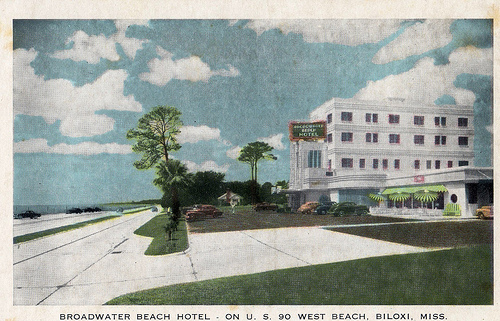
Post card ca. 1940
Only the tattered remains of an elaborate marina today mark the site of one of Biloxi’s largest and most famous resort complexes. The Broadwater Beach holds a firm place in the memory of many a resident of the area, but the site holds only the promise of future development today. Its history is one which deserves to be told, particularly as it portended the future of the Mississippi Gulf Coast as we know it today long before the arrival of legalized gambling. The hotel itself was the product of illicit gain, having been built by Pete Martin Sr., a well known gambler, rum runner and raconteur. His establishment was a modest hotel in the “modern” style we know today as Art-Deco. In those days, its clean lines and rounded front with glass block and overhanging eaves would have simply been modern design. As built, the hotel had only 66 rooms on four floors and in a handful of cottages scattered around the grounds. Martin built the “Beach House Pier” across the street, an ambitious 600-foot fishing pier with a dancing pavilion, barber and beauty shops, a snack bar and the inevitable casino with “sports results” to boot. While never exactly legal, Martin’s casino flourished until Estes Kefauver swept through the Coast in the 1950s. After that, some say the gambling simply moved across the street into the main hotel.

Post card ca. 1963 showing Dorothy Brown's additions
Brighter days would bathe the Broadwater in the bright spotlight that only money and imagination can bring. The money came from the new owner, Texas oilman Joe Brown, and the imagination came from his redoubtable wife, Dorothy, a native of New Orleans. Mr. Brown wasted no time in dying so that his wife could spend even more money on the property. Spend she did. Three million dollars alone went to build an elaborate marina which was built in 1963. Still more money bought a new face for the Broadwater and a sweeping concrete canopy marked the new entrance as one fit for celebrities. Mrs. Brown was intent upon creating the best resort on the Coast, surpassing everything in its wake. She added tennis courts, riding stables and later purchased the old Great Southern Golf Course nearby. The Sun and Sea Courses would be added in 1968 and 1974.
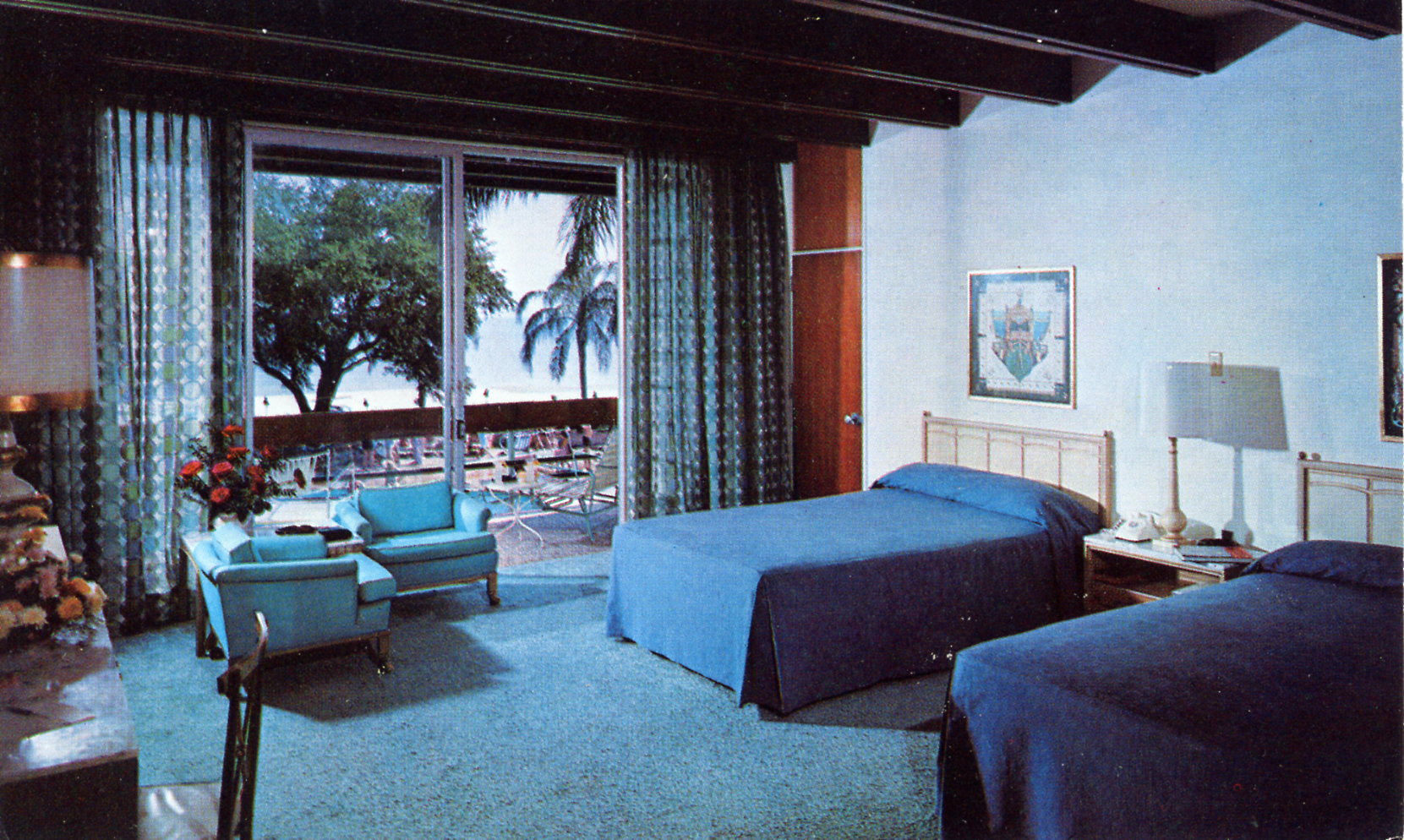
A Lanai Room at the Broadwater- mid-1960s
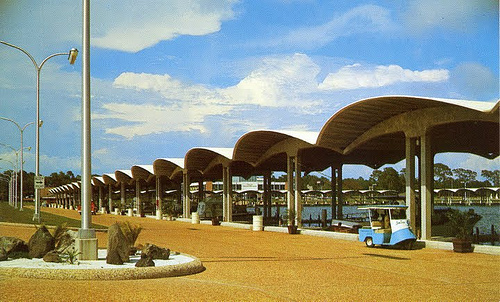
Broadwater Marina ca. 1966- post card- MDAH files
The main building was expanded with a grand dining room called the Royal Terrace which overlooked a swimming pool fit for Hollywood. The Lanai wing had the largest and nicest rooms and suites in the resort, but there were many other options. Cottages and apartment-like wings were scattered through the 260 wooded and landscaped acres and guests were ferried around in golf carts if they didn’t care to drive to their rooms. The playground atmosphere managed to continue right up through the late 1980s when the hotel began its first signs of decline. With the arrival of legalized gambling in 1992, the future of the Coast was set in stone, and the hotel was quickly sold to gambling interests.
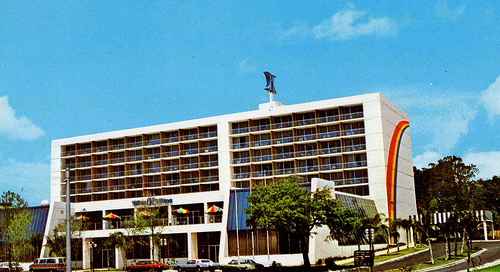
The Biloxi Hilton aka the Broadwater Tower
John E. Connelly of Pittsburgh and his company, the President Casino Corporation, bought the now slightly drooping hotel. Instead of improving the hotel, the new owners placed their resources into gambling, and lots of it. More rooms were needed, so they simply purchased the former Biloxi Hilton nearby and renamed it the Broadwater Tower. Nary a penny was spent on the hotel and its decline turned into freefall as ever more elaborate plans were bandied about for its eventual replacement. To her credit, longtime manager Leigh MacConnell, one of the first women to head a large resort of this type, held to her standards as long as she could. It was a losing battle and the Broadwater would finally close its doors for the last time on July 30, 2005. There wasn’t even a whimper of protest as much of the property had been obscured by years of renovation and expansion. In the following month, Katrina would do a little renovation of her own, leaving the property in shambles.
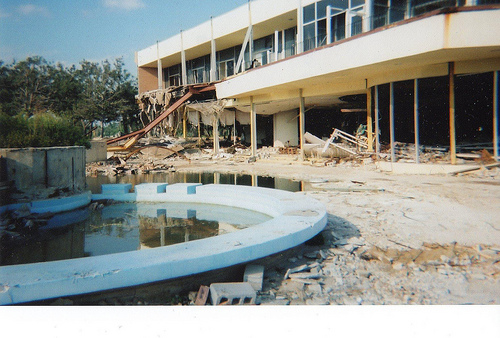
The pool after Katrina- adapted from an original photograph by John Beers II
The new owners, W.C. “Cotton” Fore and construction magnate Roy Anderson had even bigger plans than the failed “Destination Broadwater,” a poorly thought-out plan which was jettisoned by the Corps of Engineers in 2001. Their plan called for 3,375 condominium units, 1900 hotel rooms and a host of shops, restaurants and other entertainment options. This didn’t pan out either. Subsequent attempts at leasing the property to the Mashantucket Pequots or other groups also came to naught. The property is still owned by Fore and Anderson and one hopes that it will soon be home to something more than an empty lot.
On a personal note, I had never stayed at the Broadwater, but had visited several times for lunch at the Royal Terrace. My recollections of elegant china on crisp linen and waitstaff in crisp white jackets were jarred into reality when I visited again in the late 1990s. I was allowed to walk through what remained of the original Art-Deco section of the building, little more than a corridor of tiny former guest rooms which obviously hadn’t been used in more than a decade. By this time, the Broadwater was entering the terminal stages of its desuetude. I walked over to the former Hilton where I had been a guest before in its Hilton days. Opening the door to the lobby was like licking an ashtray. The formerly exotic swimming pool with its tented swim-up bar inside was a disaster area and almost cried out for the wreckers to come and put the place out of its misery. Indeed, the former Hilton/Broadwater Tower was demolished in 2006 for the Ocean Club, a condominium-hotel which occupies the site today. The Hilton, however, had been built for quick profit and had virtually no architectural features worth preservation. Buildings of every period deserve preservation, but the Hilton wasn’t one of them.
Was the original part of the Broadwater worth saving? It was certainly worth saving, but it must be taken into account that relatively little of the original structure had survived unaltered, even before Katrina. As with the Tivoli, had there been a will to preserve the building, it could have been accomplished. To the new owners, no doubt, an aging and decrepit resort well past its prime must have seemed an impediment to progress. To those who remember it, though, the Broadwater represented a vibrant slice of their history, a pleasure dome of nearly boundless proportions. The new palaces of pleasure may be bigger and glossier, but they are not always better- especially in an architectural sense. Decorum has been traded for convenience time and time again. Wouldn’t it be nice to see something just a bit like the old Broadwater rise from the site again?
Categories: Biloxi, Demolition/Abandonment, Gulf Coast, Historic Preservation, Hotels, Hurricane Katrina, Lost Mississippi
 Preservation in Mississippi
I remember after Katrina finally seeing the original Art Moderne section that had been hidden behind that screen. I hadn’t really realized until then that the older part was still there. I hated to see it torn down, but it was quite a mess. Structurally it probably could have been saved, if, as you say, there had been a will to do it.
LikeLike
Thank you so much for this article about the beautiful Broadwater that I practically grew up in during the early 70s and 80s. My father owned an independent telephone company in north mississippi and was also mayor of our town. The telephone convention would be held every year at the broadwater then we would go down the street to the Hilton for the municipal convention. I have been literally SICK that the Broadwater is now but a memory. I have cried and begged for information and more pictures from people on the internet. I would give anything for a picture of the rounded, pink restaurant. I can see every inch of the resort and I can even SMELL the elevators. Your descriptions were so accurate. The crisp linens, silver, the little train that ran throughout the property, the playground, cottages, golf carts……it was lightening in a bottle. Thank you, thank you for recognizing this Mississippi legacy. My heart breaks now just thinking of it……a part of me, my mother and daddy still sit on that property, even if it is now gone. I would love to hear more……..please e-mail me if you have any memorabilia or pictures.
LikeLiked by 1 person
I have one of the original wire bingo balls that they used in the 1950-s early 60’s that my daughters and I rescued after Katrina hit and before the building was demolished. It has the clear lucite handle on the end of the turning mechanism. It hangs on my wall now as a memento. As I was growing up in the 70’s, it always seemed like a dream and I wanted to stay there so badly, that when I turned 45 in 2010, my family reseved the bottom floor end room by the steps to the bottom pool with the waterfall for the weekend for my birthday as a surprise. How we enjoed our weeked! It was bittersweet because we knew it was being shut down in less than two weeks. i finally got my dream – and then Katrina took it forever!
LikeLike
I was able to save two of the paintings that hung in the hallway leading to the suites in the main building: The “Jean Baptiste Le Moyne” “Sieur De Bienville” and “Lapoocha”. They are beautiful pieces of art and history.
LikeLiked by 1 person
Perhaps you could donate/loan them to Ocean Springs for all to enjoy.
LikeLike
Lori, It is wonderful to be able to relive old memories of the days at the Broadwater. My father was in insurance and the Alabama Automobile Dealers Association too had great conventions where entire families gathered as a ritual to stay and enjoy all the hotel had to offer. I can recall my younger brother and me with all our friends (children of my parents friends and clients) running about the cottages, swimming in the pools late at night while our parents danced the nights away, walked to the beach and Marina to get our lunches… When I was a senior in high school, I was allowed to invite a friend along for our annual beach trip and remember how awed she was that we ordered whatever we wanted and just sign our room number to the ticket! We would order Shirley Temples and Roy Rogers and sit by the pool thinking we were real grown-up. We somehow took that life for granted. It was a different time then and children could roam free in a resort setting knowing we were safe because the staff all knew our parents and looked out for us or even looked the other way when we stole off in the golf carts for a joy ride. I would love to see pictures or hear any other reminiscences from others about the hotel, cottages, marina and wonderful restaurant where a pianist played live music for the “ladies who lunched” ha ha. Looking forward to emails from anyone with info or photos!
LikeLiked by 1 person
I’m delighted for this chance to tell of my love for the Broadwater Hotel, from 1956 on–. Most of all we loved going for dinner and dancing to the music of Leon Kelner. Leon came there from the Roosevelt Hotel in New Orleans. He always turned his head as he played the piano so he could see the folks dancing–and he always had a beautiful singer. It was our go to place for every occasion, and we loved taking our guests there. Loved going there for lunch just any time–it was just so special. My two children grew up in the Broadwater swimming pools. Those in front were so beautiful, but they also enjoyed the pool in the back near the cottages, which the Broadwater folks so graciously allowed locals to use. Can’t count the number of Mardi Gras Balls we attended there. I don’t think we’ll see the likes of such a beautiful, special environment on the Coast again. Unfortunately, my husband and I lost our Sunkist Country Club area home in Katrina, and relocated to Roswell GA to be near Brad and Rebecca, but our memories of times at the Broadwater are very special! Mrs Edward B. Childress (Clara)
LikeLike
My grandmother Jeanette “Jan” Seals played the piano there I was told. Her and Brownie, my grandfather would also go dancing there in the late 60’s early 70’s.
LikeLike
My grandmother Mickey Hunter sung there as well in the 60s
LikeLike
We went there often for dinner/dancing and listening to the music>…I’m sure we heard both, Carrie Sue, and David…….what a wonderful time in our lives!
LikeLike
Lori, I also remember the days of the telephone conventions at the Broadwater. Many fond memories of the bingo nights with the Seafood Safari buffet.
LikeLike
I feel the same way. My former husbands family owned an independent telephone co. as well Reserve Telephone. and we attended the conventions there! we passed there recently and i cried. such a great place! My New husband and I would really love to open a retro type motel Neon sign and all ! I have a framed copy of the broadwater’s neon sign in my home i got from the internet
LikeLike
As a child it what a lot of fun swimming under the waterfall and eating under umbrellas in the pool circa 1960’s with movies of Ma and Oa Kettle and golf carts. It best Disney..
LikeLike
Thank you for your kind comments. I’m happy to have rekindled pleasant memories for you. I will see what I have in my collection on the Broadwater. Let us hope that a meaningful development will take its place and perhaps carry on its distinguished history and name.
LikeLiked by 1 person
I, as others, am truly heartbroken at the loss of The Broadwater. SO many fabulous memories that are part of the shaping of the person I am today. From the first time I saw it, as a child, with my mother’s sister and her family, to later years, when my uncle moored his boat at the marina, it was a part of every summer for this south Louisiana girl. Later, my teen years brought me there, not only with family, but with friends and their families, who also utilized the marina. As a young adult, I stayed there for business. The cottages, apartments, play areas, and pools, especially the one with the waterfall, and beautiful landscaping, will forever stay in my heart and mind as the oasis I was awed by, even as a small child. So sad I cannot share this fabulous part of my younger years with my husband and children. After telling them so many stories of the feeling of serenity upon stepping on the property, I feel robbed of being able to see their reaction and joy, by bringing to life the stories I told of times spent there. I can still see the landscape lighting on the paths that meandered through the grounds, and feel the cool grass under my feet as I walked beneath the ages-old oaks. Sadly, there will never, ever be such a place as that grand lady on the Coast, again!
LikeLiked by 1 person
I am looking for an article like this an pics of the Royal D Iberville where the Pharmacy conventions were held in late 70s-90s. Any idea? Thanks so much for this article.
LikeLike
Thank you so much for posting this article. I have fond memories of visiting the Broadwater in the 1970s and early 1980s with my parents. My father worked for a lumber company in New Orleans and he attended a convention annually at the hotel. We always stayed in the Lanai rooms which as I recall were a pricey $65.00 per night at the time. We dined at places like the White Pillars, Trilby’s, the French Connection and of course Mary Mahoney’s Old French House. Our favorite time to be had was always at the Royal Terrace Room as my parents were much older and loved to listen to Leon Kelner and his orchestra. By referencing the dining room, you resolved a lengthy discussion that I had this past Novemebr with a friend; we tried for hours to remember the name of the room!
LikeLiked by 1 person
The Broadwater Beach Hotel holds many great memories for me. In the days when I was a student at Gulf Park College in Long Beach (1950’s), a lot of events were held at the hotel. One seemed to be more elaborate than the next, but everyone had a wonderful time. The Naval Cadets from Pensacola always showed up looking sharper than ever!!!!
LikeLiked by 1 person
It holds a lot of memories. There was shuffleboard, gulf carts and the Lanai Pool. We often had a room at the Lanai side where you could see the pool with the stones and waterfalls. I have pictures of my aunts, uncles, mom and dad at the swim up bar. There was a gift shop where I remember buying a key chain, that I still have. They don’t have classy hotels anymore, in my opinion. I also remember the Edgewater Gulf, which was detonated in late 60s or early 70s.
LikeLiked by 1 person
Thanks to all for the memories in story and pictures. As a construction supplier at The AGC conventions there when I was young, I know many of the states’ Architects, Engineers, and G.C.’s had many a fun weekend there helped along by our “Hospitality Room” and those supplied by others. Ours only suppied booze, (and a view of that incredible multi-leveled pool!)
LikeLike
My husband and I have many fond memories of stays at the Broadwater. While unpacking some boxes that had not see the light of day for many years we came across a small bowl that was used to serve peanuts in the lounge. We are trying to remember the name of the lounge; it had a horse racing theme. I also have albums from Leon Kelner!
LikeLike
I recall visiting The Trophy Lounge many times during 1970-1972. I heard many great entertainers there including Jimmy Elledge and others. There was a fantastic organist there; I think his name was Bobby Walters. I believe the cocktail waitress was Helen Mattina. And the walls contained so many trophies from horse racing……what wonderful memories…
LikeLike
The “Trophy Lounge” that was it!!! Thanks for the memory jog! We loved to lounge too but also remember dancing to Leon Kelner (sp?) in the big, old fashioned dining dancing venue.
LikeLike
My mother, Kay Summers sang and played piano in the Trophy Lounge in 1968 – 1970. I remember Helen also
LikeLiked by 1 person
Hello Sandra, the name of the lounge was the Paddock Lounge.
LikeLike
TROPHY LOUNGE.. The round RED glasses were used to serve the Daily Double drinks
Very potent! 151 proof run and some other alcohol!
I worked there in the 70-80s
NO!@!! Trophy Lounge with Mrs Brown’s horse racing trophies on the walls
LikeLiked by 1 person
that is a drink glass that had a drink called the “daily double” in it. you got to keep the glass after you finished the drink. i had manyif these glasses at one time
LikeLike
seems like the “daily double” recepe was writen on the napkins,would like to have that
LikeLike
Glasses: I would love to buy a set (4 or so?) of the red glasses! zzzemailbox [at] yahoo
Recipe: From a photo I found:
Cover bottom of “Daily Double” glass with Shaved Ice.
Pour 1/2 oz Lime Juice over it. Add:
1/2 oz Cointreau
1/2 oz Rock and Rye
1 oz Rum (151 proof)
Take a spoon and “muddle” the drink. Fill glass with more shaved ice and spray top with a dash of Brandy. Serve with two short straws.
LikeLiked by 1 person
Sounds quite potent!
LikeLiked by 1 person
The Trophy Lounge was its name
Had lots of Mrs. Brown’s horse racing trophies in the walls
Had a killer drink in a special glass called, A DAILY DOUBLE
I worked at the hotel from 1964 around 1980
Floyd Gerald
LikeLiked by 1 person
Hello Floyd Gerald. I remember you working at the Front Desk at the Broadwater Beach Hotel. I worked in Accounting on the third floor from 1966 till 1976 with a 2 year break in between. We had celebrity guests, Paul Newman and Joanne Woodward and family staying there in late March 1969. Jayne Mansfield was staying there at the time of her fatal auto accident near Slidell Louisiana. I remember the Bellman, Captain Stewart and all the girls in Accounting. Ms. Riddle worked with us too, after she left the Front Desk. We were in the area last month around this time and it was sad to see the empty space where the Hotel survived Katrina. I found a YouTube video of my husband and I and daughter Kim at the filming of Nashville on the Road in 1976 at the Broadwater Marina grounds. Great memories. Hope you’re doing well.
LikeLike
I have been searching websites for hours, trying to find something familiar in Biloxi.
My family vacationed there every Easter vacation through the 60’s and 70’s. I am so
glad to have found your wonderful article! I am so sad to hear that the Broadwater
is gone! I have wonderful memories of Biloxi! The Cabana Beach, Trader Vic’s, the
Buena Vista with a walkway over Beach Blvd, and the Friendship House…. The Broadwater Beach Hotel was such an imposing landmark and the marina was the most elaborate that I had ever seen! The first time that we drove up under that huge canopy at the hotel, I felt like a “princess”. It was the ultimate of “swanky”, “luxourious”, a modern “Grand Hotel”.
We used to fish off the end of the marina, and sometimes stay out there until dark to
watch the lighthouse come on. Then we would go play mini-golf and end up at Crispy
Cream (one of the original sites) for one of the most “sinful” donuts on earth! We took
our own motorboat out to Ship Island some years to fish and then watch the “huge”
waves on the south side of the island. If it got too warm, we went to the fort.
My brother and I would sit at the bar at Barachev’s and watch in amasement as the men opened oysters. My brother got pearls. They had the BEST seafood ever….
Other than Kessler, Mahoney’s and Beuviour, is any of the old Biloxi still there?
Mr. Barnes, thank you for your article and thank you for indulging my walk down
memory lane. I’m so thankful to have had parents that believed in family vacations,
and my father’s wanderlust!
LikeLiked by 1 person
Gail, you echo many of my memories of Biloxi of the 1950-60’s. As a child we ‘camped’ in cottages at the Methodist Seashore Campground. I fished off the Marina while stationed at Kessler in 1968-69. Paul Newman and Joanne Woodward docked in the Marina, spring of ’69. We met them playing at the mini-golf course. My time at Kessler was blown away by Camille, lost all from a rental house on Iberville @ Hiway 90.
LikeLike
I worked there in 1969 and met Paul Newman in the Hotel Lobby.
LikeLike
My father, John Burke, was the Executive Chef at the Broadwater from about 1966 through 1971. My parents were furnished a cottage across the driveway from Mrs. Brown’s home. The cottage had a large screened porch, and my mother and I would have coffee in the morning and margaritasin the afternoonand watch the tide (this was before the highway was widened). Ms. Leigh was alway so kind when my daughter and I visited, Nick Stuart was still living, and a great boutique in the lobby. Of course, my parents rode out Camille in a room on the backlot, but it was still sad to see the devastation, and what had been the cleanest beach on any coast be dirtied by whatever floated in from the storm, even two years later. Sad to see that the Grand Old Lady came to such a sad and ugly ending.
LikeLiked by 1 person
KNEW you Dad (I worked there at the front desk when he was Chef
LikeLiked by 1 person
My mother was the pianist /singer (Kay Summers) in the lounge at the Broadwater Hotel from 1969 through 1971. I have so many fond memories of Biloxi and the beautiful coastline. She loved every minute of performing there!
LikeLiked by 1 person
YOUR mother was one of the best entertainers WE ever had in the Trophy Lounge
LikeLiked by 1 person
My grandmother was Mikey Hunter did she ever play there??
LikeLike
Marina was designed by Ray Reasby of Galveston & Houston, with T. M. Dorsett as Chief Engineer. Meant to withstand hurricane-force winds. Planned in 1962 @ a cost of $2.5 million.
LikeLike
Ray Reesby is my father. He is still alive and an active Civil and Structural Engineer. He won many engineering awards for the marina and the hotel and went on the be a part of an award winning marinas like pier 66, Marina del Rey and the San Francisco Marina. On the Broadwater, he did the engineering on the whole property, made the Pool work what a headache. I still have his construction pictures. I was 6-12 when it was built. It was an amazing project and an amazing time to live there. Dad designed the marina and the hotel to withstand a hurricane twice as strong as the 1900 storm in Galveston. As the engineer of record of 2 extensions of the Galveston seawall, he had the data from the army corp of engineers to make it last. He cried when he saw what Katrina did to the Marina. The marina had withstood 7 design hurricanes. Although he has been in such projects as the roof on the Astrodome and most of what standing post Ike in Galveston, the Broadwater Resort is still his jewel. I still have a towel that says Broadwater Beach. Maybe the new owners or the paper would like to hear about the dream of the Broadwater. Would love to hear what become of Tommy Dorsett.
Thanks for the story!!!
LikeLiked by 1 person
Interesting. Thanks for making this area an attraction and a wall against the storms. Best I recall, Mr. T.M. Dorsett’s home on the west side of the hotel property was either damaged or destroyed after Hurricane Camille. I believe he lived in another rental property owned by family further east on 90 after the storm. Maybe the name will come to me or someone else may remember. It had Gray colors on the outside and was on higher ground. I will google about their places of rest, as I’m sure the Dorsett nephews have passed away.
LikeLike
My husband, Frank Middleton is from Biloxi and was best friends of Pete Martin, Jr. He loves to tell stories about the Martins and had some good things to say about Mr. Martin, Sr. My husband’s only brother is retired Dr. Robert Middleton, who still resides in Biloxi.
We were just there a few weeks ago and the beaches are beautiful again.
LikeLike
Mythology surrounded the remodeling of the Broadwater Beach Hotel and I’ve always wondered if it’s true. As the myth went, Ms. Brown was denied a permit to tear down the old BBH but was permitted only to remodel it. In response, she had a part — and I think a small part — of the original structure elevated four stories and accomplished her “remodeling” yielding the grand ballroom, etc, to which reference is made in the above article. With in the letter, if not the spirit, of her remodeling permit.
Might it also be true that Ms Brown lived at least for a time on the north bank of the Tchoutacabouffa river, just west of the old Hwy 67 bridge. As a lad boating on the river in the early sixties, I often saw a chauffered Limo at that site, and the conventional wisdom held that it was Ms. Brown.
Anyone know the truth of either myth?
LikeLiked by 1 person
Interesting. I never knew this about Ms. Brown living in North Biloxi. We lived off Big Ridge Road in D’Iberville in 1966. I always assumed she lived in Metairie Louisiana. We were in D’Iberville visiting last month and had to use GPS to get to Quave’s PoBoy place. It’s really changed where we lived on Church Street in 1969 during Camille. The Scarlett Pearl casino is a nice place to play. I would have never imagined playing there after all these years and devastating Hurricanes. Glad to see progress after Katrina.
LikeLike
As you travel North on old highway 67, as you cross the Tchoutacabouffa river, if you look down to your left, you will see Ms. Brown’s old house on the river’s north shore. It’s maybe 200 yds west of Hwy 67’s centerline. I distinctly recall when she lived there.
LikeLike
I will check it out next time we are in the area. Thanks. We rode our boat by the homes on the river back in the day.
LikeLike
Hi Harold. With regard to where Mrs. Brown lived, I am afraid I cannot help you. Local resident Anthony Kalberg might possibly know. You should have no trouble finding him if you look on the web.
As for the original building, I have been through the original and found the upper stories relatively intact. This leads me to believe that Mrs. Brown merely remodeled and expanded around what was already there. This, of course, meant that virtually nothing of the original hotel on the first two floors remained after the radical remodeling program of the 1960s. The building was never raised, as you will note in the post card views above. Mrs. Brown merely expanded the hotel around the existing structure. As for her being told she couldn’t demolish what was there at the time, it makes a great story, but I’d find it very difficult to believe that any city would have demanded preservation of the building in the 1960s. Recall that those were times in which all but the most historic and revered buildings were considered fair game if they stood on the path of “Progress.” It was most likely the simple expedience of keeping the hotel up and running which saved the original Broadwater. Mrs. Brown didn’t lack the funds to destroy it and rebuild from scratch. Had she done so, the hotel would have had to close. This is only a guess on my part and I would be interested to hear more from anyone with interest on the subject.
LikeLike
Hi Tom,
Can you tell me when they tore down the Buena Vista walkway over hwy 90? I want to remember how old I was when it was torn down ! Thanks !! Elaine (my gpa was Cosman Eisendrath from the Daily Herald paper)
LikeLiked by 1 person
I believe that the motel wing of the Buena Vista was purchased in 1996 by Steve Wynn and was demolished shortly thereafter for the Beau Rivage. The ruins of the hotel were not far behind in being demolished for parking. I think the bridge was probably taken down when the motel wing was converted into the Biloxi Belle in the early 90s.
LikeLike
My Father Owned a Millwork shop in St Bernard He and and his Brother Did work for Mrs Brown’s Boat house in New Orleans. She Liked the work so much She commissioned Him to build a Piano Bar for the Lounge at her recently acquired Hotel in 195? around the time her Husband Died. My Father and Uncle astounded her with the craftsmanship. He accepted her offer to assist in heading up her construction dept as was Basically the construction Superintendent for the renovation and. Room and amenities upgrades for the next 27 years. I also worked there in house keeping during the Summer and at the Marina the Summer of 70. The Broadwater was a huge part on our life!!!!!!
LikeLiked by 1 person
P. – the place was a major put of my life also! My dad, Bobby Blum, worked in the maintenance dept. starting in about 1961, for about 15 years – or some time after The Dorsett’s daughter took over management, after both her father and uncle had passed away. I’m not sure what year he was let go, anyway, Walter Johnston and his wife Grace were very good friends of our family. Walter helped my dad build our kitchen cabinets in the house where we lived. The house was (like many of Mrs. Brown’s trusted employees) a “perk” provided us by Mrs. Brown.
LikeLike
Knew and liked your Dad very much He was the night shift maintenance man… He saved me a LOT of times with his knowledge.. I managed the front desk during that time
LikeLiked by 1 person
I remember Mr. Leader being in charge of Maintenance shop when I worked in Accounting from 1966 till 1976. I did Payroll for a couple years, and there were over 300 employees for total facilities, hotel, 2 golf.courses and Marina. Best I recall, Mary Ann Mobley’s parents had a yacht at the Marina.
LikeLike
A Mississippian (Meadville) stationed at Keisler 1968-69, I fished at the marina many afternoons. Paul Newman/Joanne Woodward docked there in spring of 1969. Fishing we watched them land. Later that evening we played miniature golf with them down the beach. Camille hit the week I graduated from Communications Electronics Officer School. Fond memories and sad for her demise.
LikeLike
I think my husband James Nowlin taught school there or attended the course. Paul Newman went on a fishing trip on the Broadwater yacht. I wasn’t sure how they arrived for their stay, but they had rooms near the Par 3 in the garden area.
LikeLike
Hi Tom,
Do you know if the lot where the Broadwater sat is still empty? I’m writing an article that refers to the Congressional hearings about Hurricane Camille that were held at the hotel in early 1970; I note the fate of the hotel in Katrina but wanted to say whether something has been built there or not.
Thanks!
LikeLike
To the best of my knowledge, the lot is still vacant. I had heard that houses were to be built on the northern part of the property. I would like to know what further development may be planned for the site.
LikeLike
Thanks Tom — I appreciate the intel!
LikeLike
I was by there this morning and the property is still vacant. Part owner W.C. Fore has had several other “distractions” lately.
http://www.sunherald.com/2013/01/18/4414622/businessman-cotton-fore-arrested.html
LikeLike
Yikes!
LikeLike
Wow!. . . as usual, the comments are . . . fascinating!
LikeLike
I have a small, red glass bowl from the lounge at the Broadwater. The decor was all racing themes (of course!) and the bowl is decorated with race horses, etc. I cannot remember the name of the lounge. Anyone?
LikeLike
The “bowl” you refer to was a glass given to patrons of the Trophy Lounge. When you ordered the cocktail known as a “Daily Double” you were given the glass as a souvenir. We were part of a group of four couples that visited the Broadwater Beach Hotel and it’s golf courses for several years in the ’60s for a winter getaway. Had many wonderful memories! I somehow ended up with quite a collection of these glasses and had many a Derby party with these glasses filled with the “receipe” for this delicious but POTENT cocktail! Wish I could figure out now what to do with 50 red glasses!
LikeLiked by 1 person
Trophy Lounge and glass was what they served a DAILY DOUBLE drink in
I worked there during their hey day
Floyd Gerald
LikeLiked by 1 person
let me know if you want to get rid of the daily double glasses,i would like to have some for memories.cell 2282096676
LikeLike
TROPHY LOUNGE and the drink was the Daily Double
LikeLike
Would love to have a Daily Double Glass or bowl!!! Please contact me if anyone is interested in parting with this!!!
LikeLike
visited last month….still empty lot. so sad :( I would love to know if anyone has knowledge of what became of the Lobby Picture that hung from ceiling to floor? and also, of the train? Was anything salvaged after Katrina?
LikeLike
When the train was “retired” I got the engine for my daughter
She and I spent quite a few hours painting it RED ALL OVER
She loved the little train engine she had
I got it because I worked there during those years
Floyd Gerald
LikeLiked by 1 person
At one time they talked about putting a wal mart on the north side of the property, but that idea was abandoned. I for one, would like to see a zoo/amusement park take the area. The Broadwater Beach Zoo!
LikeLike
Just think, the exhibits and enclosures could all be named for Biloxi’s glory days!
LikeLike
Still empty last month. Sad.
LikeLike
I know it’s been said before, but thank you so much. As someone else posted, I too spent my spring breaks there during the 60’s and 70’s. I even came back in the 80’s with myour own daughter for one last vacation with the whole family. Being from the Midwest, we knew nothing about hurricanes first hand. I’ll never forget pulling into that drive at the front lobby and seeing seaweed in the light fixtures from Camille. Despite all the devastation we saw (they were still finding bodies months later in hotel wreckage) that really hit home. I remember eating the fried shrimp at the marina, Pops Ferry (best biscuits and jam I’d ever had), Mary Mahoney’s for an elegant lunch, the smell of the wisteria and those wonderful swimming pools.
I still have very vivid memories, and met one of my first true loves there. I’ve got to forward this link to my family members. Thank you so much for the memories!
LikeLiked by 1 person
Again, thanks for the post on a favorite memory from summers as a 6 to 12 year old. Like others I was exposed to the Broadwater during my father’s annual convention. For him it was work, for the four kids it was summer vacation. Two joining rooms toward the back of the property… just a short ride on the “train” which was never long enough for those my age. The pink cloth napkins in the dining room, the marvel of a swim up bar, and lush St. Augustine grass separating the smaller pool and shuffleboard court are vivid memories I can’t replicate now that the property is gone but hope to pass along something similar to my boys. Off to The Grand Hotel at Point Clear I guess…
LikeLiked by 1 person
Hello to All:
WYES,-TV, the PBS affiliate in New Orleans, will broadcast a one-hour cultural documentary on Biloxi that will showcase the Broadwater Beach Hotel. If anyone would like to share their memories, photos, and/or home movies of the hotel, we’d love to hear from you. We are also looking for people who would be willing to be interviewed on camera and talk about their visits to the Broadwater
I will be in Biloxi this Tuesday and Wednesday, June 4 & 5 to visit all the city has to offer.
Please contact me at barbarasillery@gmail.com. or post a reply on this blog.
Barbara Sillery, Producer
barbarasillery@gmail.com
http://www.barbarasillery.com.
LikeLike
Hello, all!
I have been fascinated by the discussion. During the 50s and 60s my family spent our vacations on the Coast at the White House (I’m glad to see that there is still hope for it), but starting in the late 70s we switched to the Broadwater. We always used to stay in cabin 305. In the early days we had to make reservations a year in advance! We remained loyal during much of the long decline, but it eventually just became too sad. Our last stay there was in 1989.
The grounds around the cabins had wonderful copper light fixtures shaped like flowers. At some point we talked the maintenance crew into giving us some that had been damaged and thrown in a corner. They have moved with us from Virginia to California and back again. We are still talking about getting them repaired 30 years later.
One year the Jerry Lewis MD telethon was staged at the BB while we were there. We enjoyed watching all the hoopla.
Another year our visit was scheduled right after the Coast had been hit by Hurricane Elena. We flew in on the first day the Gulfport Airport was open after the storm. One of the diversions of that visit was watching crews come in and take down some of the huge pines that had been damaged by the winds.
We were staying at the hotel the week that Mrs. Brown died. The staff put up black wreaths and draped her picture in black crepe.
Much of our vacation time was spent crabbing (and making and eating gumbo). Our favorite crabbing spots were the old Ocean Springs bridge, Cadet Point and the BB marina. All swept away by Katrina.
Seeing the hotel after Katrina wasn’t as heartbreaking as seeing what happened to it after it was purchased by the casino people.
LikeLiked by 2 people
I worked at the Broadwater in the summer of ’81. I was a cocktail waitress for the pool, and I would order and pick up the drinks from the Trophy Lounge, which was right down the steps off the pool. I went up the steps, around the pool, and down the other set of steps a hundred times a day taking orders and delivering drinks. The pool was beautiful, and I jumped in it more than once during my Mississippi hot shift. I also remember that the grounds were kept beautifully.
Many of the employees had worked there for decades, including 2 of the room service waiters who had to deliver drinks to the pool when there was no waitress scheduled. They had both been there for over 30 years, I think even before the Mrs. Brown era. We were allowed to order lunch directly from the kitchen, and I think I ate a turkey club sandwich every day all summer. Those sandwiches were that good.
I have a postcard of the Broadwater pool, and it breaks my heart to look at it.
LikeLiked by 1 person
Judy…Do you remember the bartender at the Broadwater Marina Bar…he wore sunglasses at night..had a dark complection , I have dug around hunting to see who he was …he was there for years…as near as I can figure…he might have been Richard Franklin Goff …I found an obit saying that he died in 1992 at age 51…was from D’Iberville…think that might be him…Mrs Brown would sit at the end of the bar at night…had a very raspy voice like a heavy smoker would have…very small woman…when I asked …who in the hell is that…he would say …shhhhh…don’t let her hear you…later I found out that it was Dorithy Brown… Did not look like she fit in at the Broadwater…but she owned it…
LikeLiked by 1 person
Jim,
I don’t have the answer to your question since I worked during the day, but one of my friends worked in the Trophy at night. She knew everybody, and she would certainly know who worked the bar at night. I’ll see what she says and get back to you.
I do remember the day bartenders. One was a woman named Marge (I think ) and then there was Bobby. He always had to get out of there exactly on time because he used to go to the dog track in Mobile. His moods were dependent upon how well he did at the track the night before. He hated making Pina Coladas.
Judy
LikeLiked by 1 person
Like many others have stated, our family “vacation” was the annual convention at the Broadwater. Going to the Broadwater in the late 60’s through the early 80’s was our idea of Florida. We loved it! When we weren’t staying in the cottages, we were in one of the front rooms in the Lanai wing, where we could walk out the back door and be at the pool. Once, we stayed in the back and didn’t like it. We thought the back pool was lousy compared to the fun, multi-level front pool. Plus, the front pool had the pretty lifeguards (lifeguardettes?). The cottages were quite spacious and also had plenty of yard outside. Ours usually backed up to the cemetery. I often wondered what the apartments opposite the Lanai wing looked like on the inside and thought how totally cool it would be to live at the Broadwater. When we weren’t in the pool, we were riding the train. I had dreams of being the “conductor” for my summer job during college! My sister and I preferred the grill at the marina while my folks went for the Friendship House. More than once, we ordered “room service” delivered to the pool. After supper, we’d walk around the marina, where my aunt’s brother kept his sailboat. Or we’d drive up and down the beach highway looking at all big beautiful homes that survived Camille. I also remember the golf shop and how my dad would take me there to “shop” even though he didn’t play golf. I think he liked it just because it was cool in there – literally. But one of my strangest memories of the Broadwater was hearing the loudspeaker call over and over “Paging DX34, DX34. Telephone call.” I must’ve heard that page 50 times a day to still remember it so many years later (and I wonder who that person – DX34 – was)!
LikeLiked by 1 person
DX 34 was the Bell Captain
DX 30 will Bill Dorsett, General Manager (hardly EVER paged him)
DX 31 was Jack Stanford, Resident Manager
DX 32 was the Assistant Manager Bill Frith
I WAS DX 35 as Front Office Manager
FOR MANY YEARS
Floyd Gerald
LikeLiked by 1 person
I knew your mother because I was working there while she was the Trophy Lounge entertainer
She was the only entertainer we ever had that NEVER took a break once she started
Jimmy Elledge had a clock that went off ever 45 minutes and even if he was in the middle of a song, he stopped and QUIT
When I first went to work there Bobby Walters and his wife Mickey Hunter were the entertainers
Your MOM was the best !
Floyd Gerald
LikeLiked by 1 person
Floyd my Great Aunt Merele Kelton worked in the Pro Shop at the Par 9 golf course for many years. I have fond memories of going to visit her there and then we would eat lunch at the marina. It was great and had to be the best flounder, fried shrimp, and stuffed crab, I’ve ever eaten.
LikeLike
I knew your aunt very well, It was a 9 hole course, in the back of the property with ALL the holes being par 3s …. MEMORIES back in the day
\Floyd Gerald
LikeLiked by 1 person
Can anyone tell me who DX34 was? I must’ve heard that page over the Broadwater loudspeaker 50 times a day whenever we stayed there!
LikeLike
So interesting to read all of these comments from past visitors to the Broadwater Beach Hotel. We all have our fond memories of the Hotel. All of those nights I remember in the Trophy Lounge looking out the window at the red neon sign reading…Broadwater Beach. And may our Memories of the Broadwater Live On!
LikeLiked by 1 person
I have truly enjoyed this article and reading of the many fond memories that people had of the
wonderful Broadwater. It was a part of my life. I lived with my Aunt who was Leigh MacConnell.
Ms. Leigh, as she was called started working there as a bookkeeper when she was very young & worked there till she retired just before Katrina hit Biloxi. I have so many fond memories of the Broadwater from my young days. I moved away from Biloxi in 1962 when I married. We returned frequently in the summers for vacation and usually stayed at the hotel. My children loved the place as well. We miss the hotel but most of all we miss my wonderful Aunt.
Thanks for the article and the pictures.
Myrna
LikeLiked by 1 person
After reading a comment about Leigh MacConnell, manager of the Broadwater Beach, she was very nice in letting me stay one weekend free at the hotel for a rendering I donated to the Hotel back in 1992. That was one of my best memories ever on the Coast. I will always remember her.
LikeLiked by 1 person
I arrived at Keesler AFB in September of 1951, I was an 18 year old fresh from a small town in Wisconsin gal. As a young single Waf, I loved living on the Gulf Coast. Many weekend afternoons were spent on the porch and at the beach of the White House Hotel—cold beer in a frosty mug hit the spot on a hot hot summer day. I had many serious sunburns from the long hours on the beach. So many memories, Gus Stevens, Fiesta Club, Bariciv’s Broadwater and was it Hugo’s Pizza (best I ever tasted, of course the first I had ever tasted) the USO on the beach offered the best shrimp boils. picnic’s at the River, drive in moviesand David’s Dress Shop provided this gal with many fashionable outfits to wear and unless one spent a weekend in New Orleans every few months one wasn’t living. I worked as a waitress at the Edgewater Hotel both in the dining room and in the Snack Bar, met so many nice people that spent their winters in Biloxi. I married a Mississippi boy, not a local and we rented a cottage from the Marvar;s they owned a shimp factory. We stayed in the Biloxi area for 9 years. Our oldest son was born in the Gulfport Hospital the day before Hurricane Audrey—June 26, 1957. The blinds in my room were thashing around, wind and rain were pelting the windows. I wanted to know what was going on, the nurse told me, ” to never mind, we were having a hurricane, but I was having my own– so just rest and not worry.” A few days later I went home. The beach was a mess, tree limbs were lying around and sand was piled high along Beach Blvd, all evidence that we had had a rather bad storm. I was in Biloxi on a gambling trip a couple of weeks ago, was able to ride up and down Beach Blvd and through the downtown area. Tears came to my eyes, familiar sites all gone, just hundreds of little flags that marked lots where people had businesses and homes. I had the worst feeling in my stomach. I couldn’t wait to tell my husband, my sister in law and brother in law that places we lived and spent time are all gone. But they are gone too–so the memories are mine–I turned to my scrap book and album and decided to connect on the internet and I have appreciated the pictures of old familiar places and the memories of many folks.
LikeLiked by 1 person
Thank you for sharing your memories–they are what make these buildings and photos come to life even when they are no longer there. I’m glad you were able to come back, but sorry so much has been lost.
LikeLiked by 1 person
Back in 1962 I was stationed at Keesler, AFB but unhappy with the GI’s life style around the base then I lucked out and found a real treasure. It was a small no name building to the east of the Broadwater Beach Hotel. Within the no name build was a no name club known to a very few and run by Reeba. She was the sister-in-law of Water Bill who worked at the Broadwater. Reeba and those she introduced me to have remained in my mind ever since. Each and everyone of their friends were the type you would want mom, dad and family to meet. A grand bunch of Southerners warmly greeting a Yank from Buffalo, New York. Thanks to one and all for the memories.
Yours truly,
Tom O’Brien
LikeLiked by 1 person
Why it’s best, sometimes, not to Go Home. I’ve not gone back since Katrina. My memories are still intact.
LikeLike
I have a Broadwater ashtray with the calendar year 1961 on it. I went through Camille three blocks from the beach in Gulfport and remember the helicopters landing in the Mississippi City Elementary Schoolyard and helped out in the food kitchen set up there. Moved away before Katrina but have seen the devastation online and hope someday to revisit. I miss the Gulf Coast very much and would love to retire there.
LikeLike
I am working on a companion book to the recent PBS/WYES-TV documentary “BILOXI Memories and the BROADWATER BEACH HOTEL. Does anyone remember a drive-in restaurant along Beach Blvd called either the U-All Drive In or the You All Drive In. I was told it was unusual it that the building was round.
Barbara Sillery, Producer
barbarasillery@gmail.com
LikeLike
My mother was a waitress at the Marina under John Soloman fromm 1977-1984.
I met my husband in the” snack bar” section (he was a busboy). We took prom pictures on the grounds, played frisbee, fished off the back wall and were married at the base of the lighthouse. All our class photos for the yearbooks were taken on the Marina grounds.
Sooo many wonderful memories.
LikeLike
Was the restaurant at the marina just known as Marina Restaurant or did it have another name?
LikeLike
For all the devoted fans of the Broadwater Beach Hotel, my book *Biloxi Memories* is available through any independent bookstore or on line at amazon.com. If you are looking for a DVD copy of the documentary *Biloxi Memories* go to the WYES-TV website wyes.org.
On Tue, Nov 29, 2016 at 11:18 PM, Preservation in Mississippi wrote:
> Charmaine Brown commented: “Was the restaurant at the marina just known as > Marina Restaurant or did it have another name?” >
LikeLike
My book, Biloxi Memories, is now available. Chapter 7, The Crown Jewel, is full of wonderful stories about the Broadwater Beach Hotel. Hope you all enjoy. I’ll be signing copies and giving an author talk on Friday, Sept 25 2-5 pm at the Biloxi Maritime Museum, and Thursday evening 5:30-:30 Oct. 1 at the Biloxi Visitor Center.
LikeLiked by 1 person
How would I get a copy of your book? I live in Texas. My father was the engineer of the renovations and marina. I was a little girl when they were all built, but I would be curious about your research and comments of every thing 50 years ago.
LikeLiked by 1 person
Biloxi Memories can be ordered through any bookstore or online at amazon.com, Hope you enjoy!
LikeLike
I have been thinking about my summers in Biloxi in the 60’s. There was an Italian Restaurant we always went to that had huge Oak trees coming up through it and was red and white. It was located right on the beach . Does anyone remember the name?
LikeLike
Angels
I worked at Broadwater 60s to 80s
Floyd gerald
LikeLike
My Grandmother was mickey Hunter I’m trying to find any old pictures of her
LikeLike
It was likely Angelo’s in Gulfport. It was located where the Island View Casino is now.
http://mdah.state.ms.us/arrec/digital_archives/series/cooper/detail/16812
http://mdah.state.ms.us/arrec/digital_archives/series/cooper/detail/20806
LikeLike
Angelo’s. Wonderful restaurant.
LikeLike
When I think of a restaurant in Biloxi with a huge oak tree, only Mary Mahoney’s comes to mind. Not Italian, it’s French but all I could come up with!
LikeLike
The disconnect here is that Angelo’s was in Gulfport, not Biloxi. It has been closed now for many years, but I’m sure it was the one remembered. I don’t recall Mary Mahoney’s having a tree in the dining room, but I could be wrong. We only ate there a few times, but Angelo’s was a must until it closed.
LikeLiked by 1 person
Bingo!
LikeLike
Mary Ellena,
YES! My husband was born in Gulfport and he said he too had fond memories of Angelo’s. Mary Mahones tree was in their courtyard, still is!!
LikeLike
Wasn’t Angelo’s in Gulfport near 49 or am I confused? I seem to remember a restaurant right there that fits the description so well.
LikeLike
Sorry. I just saw the previous comments!
LikeLike
So nobody know what ever happened to the TRAIN???!!!! We loved riding around the property as kids!
LikeLike
Don’t know what happened to the train, but many years ago my husband and scored some of the bronze flower-shaped lamps that were scattered over the campus for lighting. The Broadwater was in decline and many partially damaged ones were just lying around in the storage building. All we had to do was ask and they gave us as many as we could carry. We’ve moved those lights from Mississippi to Virginia to California and back to Virginia. We still plan to get them fixed “someday.”
LikeLike
Wow, good foresight on your part. What about a picture of one of the old lamps?
LikeLike
I worked there during that time
I got the engine when they discontinued the train use
My small daughter and I painted the engine red and it was in our yard for many years
MEMORIES…..
Floyd Gerald
LikeLike
Floyd Gerald,
Did you get rid of the Engine or is it still around?
LikeLike
I was stationed at Keesler from Nov 64 until Sept 65… I left on the Morning that Hurricane Betsy hit the Gulf Coast. While I was at school I had arranged with my commanding officer to make a little extra money by entertaining along the coast in some of the larger hotel lounges. I play an instrument called a Cordovox, looked like an accordion but sound like a B3 organ along with an electronic drummer or a real drummer named Bennelli. I played at the Broadwater Beach lounge and at a hotel I remember being set back from the beach past the girls school. I think it was called the Edgewater… it looked like a woodframed hotel in white southern style gingerbread… inside I remember all the white woodwork and green palm trees in the lounge… Loved playing both places…I left the morning of Betsy and remember that the roads were vacant and I drove really fast to Gulfport and then turned North on the old highway towards Hattisburg and then north to Ohio… I remember doing 90 mph trying to stay in front of the storm and no one being anywhere on that road to Hattisburg!!!. I still have pictures and mementos from that time and posters that were in frames in front of the hotel billboards with my picture advertising me playing at these places…Great memories!!
LikeLiked by 2 people
When I was just a kid back in the 60s, we came to the Broadwater every summer. We always stayed on the second floor overlooking the pool. My Uncle Sid and I would sit on our balcony and count VW beetles on 90. I remember the waitress bringing butter squares on ice at the marina restaurant. Sometimes at night we would sit on the colored lights in the kiddie pool letting the lukewarm summer pool water from the waterfalls run over our heads while watching cars travel by on 90 as the marina lighthouse shined it’s light. I remember walking around the marina looking at the yachts dreaming about owning one. One night during our stay each year we would make the drive to Ocean Springs to eat at Trilbys. I loved the fried shrimp. I lived in Jackson back in those days and the coast was my Hawaii. Now I live in Biloxi and it makes me sad that all my favorite places as a kid are no longer here.
LikeLiked by 2 people
Does anyone remember the singing group, 4 guys from Ole Miss who sang at the Broadwater in the 1950’s? What was the name of the group?
LikeLike
Does anyone remember the quartet who sang in the summer at the Broadwater Beach? They went to Ole Miss and earned money for school by performing in the summer months. What were they called?
LikeLike
The singing group from Ole Miss was Jimmy Weathery the singing quarterback. He was a HUNK!!
LikeLike
That was Jim Weatherly.
I tried to embed the YouTube link to Gladys Knight’s Midnight Train To Georgia … the song that he wrote. There is a YouTube link to Jim explaining how he came to write the song. Caught uo in the SPAM trap, I suspect.
LikeLiked by 1 person
The Gordian Knot.
LikeLike
In the 1960’s we would travel from Lafayette, La every year to spend a week at the Broadwater. This was in the days before the Interstate Highways and it would literally take all day to get there driving old Hwy 90. I still remember all of the businesses along old Hwy 90 between New Orleans and Biloxi. Many times my father would rent one of the cottages on the property and we would spend a lot of time swimming in the pools and fishing across the street. As a small child I would beg to ride in the golf courts with the bellmen on the way to the room. I remember one gentlemen they called “Catfish.” Of course Stuart always would help us and was very good friends with my parents. In 1980 my wife and I visited the Broadwater for the first time since I graduated from LSU. It had been at least 4 years since I was able to get there and Stuart instantly remembered me when I walked in the door. Luckily my daughter, born in 1991, got to experience the Broadwater and we have several pictures of her at the pool on the backside of the property. I wish I had more pictures of the place from over the years. My father had been assigned to Keesler AFB in 1945 and had been going to the Broadwater since that time.
I grew up at the Broadwater and certainly miss the place and all the people who made it great!
LikeLiked by 1 person
My Grandmother was Mickey Hunter and She is mentioned as an entertainer at the Broadwater.. I am researching her history as she past away young if anyone has any info please let me know.
LikeLike
Was this the Mickey Hunter of the She-Buckaroos?
Or this one:
https://www.newspapers.com/clip/34055887/is_this_the_mickey_hunter_of_the/
LikeLike
https://polldaddy.com/js/rating/rating.jsDavid dominguez im not sure but If I had to guess you are Robert’s son, or Bobby, I used to be married to Jim Dominguez, we divorced in 1998, Jim LOVED his mama, he talked about her frequently & how talented she really was
LikeLike
Yes I am .. were trying to hunt down a magazine she had
LikeLike
So many memories my Dad was a sailor we spent a lot of time at the Broadwater Beach. I can remember my Dad drying his sails on the green space at the marina. There where two small trees he would tie an end to each tree and the rest would blow in the breeze like a large tent my brother and I would lay under it. I remember the gulf cart that would take you to your room and the French toast in the front dining room. The waiters would bring a plate of buttered toast to your breakfast table with apple jelly. Oh and the front pool with the water fall loved that hotel!
LikeLiked by 1 person
Back in the Broadwater’s palmier days, we managed to get a small collection of the bronze flower lamps that were tucked into the landscaping here & there. They needed repair, but we never got around to fixing them up and installing them in our garden. Now we’re moving to a retirement community and are dispersing most of our stuff. If anyone would like a piece of the old Broadwater, reply to this post and I’ll point you in the right direction.
LikeLike
Hey Mary , My late father in law Bobby Blum worked at Broadwater from mid 60’s to mid 70’s. Was on site when Camille hit with wife and 3 children since he was a maintenance worker.
Would love to have some of them.
I live in Fairhope Al but am coming to Long Beach saturday.
home phone 251 928 1377 cell 251 610 4433
Thank you,
Anthony Bishop
LikeLike
Hi, Anthony,
We no longer live in Mississippi.
The lights are on sale at https://www.farmer-auctions.com/
FAR 505 – Generational Lexington, VA Collection
They are Lot #233, so you don’t have to wade through everything else unless you want to. They will arrange shipping if you are the lucky bidder.
Happy bidding!
LikeLike
Would love to have any piece of The Broadwater!
LikeLike
Hi, Dena!
The lights are on sale at https://www.farmer-auctions.com/
FAR 505 – Generational Lexington, VA Collection
They are Lot #233, so you don’t have to wade through everything else unless you want to.
Happy bidding!
LikeLike
Does anyone happen to have any interior pictures of the Royal Terrace Room they can share? If my memory serves me well it was dimly lit in the evenings and it was all pink and white decor in the late 70s and early 80s. Leon Kelner was the band leader at the time. We also have a couple of the red bowls from the lounge that have racehorses imprinted on them, but I’m not sure how to share the picture on this site.
LikeLike