
It is Summer in Mississippi, which is defined by one thing – the Sun. It causes the heat we are all used to, which gives rise to the humidity we all bear, which begets the mosquitoes we all loathe. Today, we spend every possible moment of the summer in (to paraphrase satirical filmmaker Kevin Smith) that pleasure, that rapture, that exquisite sin of central air conditioning. We move from air-conditioned environment to air-conditioned environment as fast as possible sealed in our air-conditioned cocoons. That was not an option for previous generations, even those who lived comparatively recently.
Historically, buildings in Mississippi and the Deep South were adapted to the heat and the sun through the use of wide porches, tall windows, and high-ceilinged rooms in arrangements the most conducive to maximize shade and cross-ventilation and reduce sun exposure and heat. While those building features waxed and waned over time as various styles came and went, a continuity of regional building design meant that residential architecture did not stray too far afield from what was needed in its specific location.
Modernism was a break with tradition, embodying through the International Style what Tom Wolfe coined as a “Year Zero” approach to architecture, with leading modernist architects advocating the abandonment and replacement of the old ways of building with new forms, new materials, and an entirely new idea of how a building should function. The modernist ethos that swept over America post-World War II was a sharp break with traditional and regional design influences, including traditional climactic adaptations. Yet, not all modernist architects fully subscribed to a one-size-fits-all approach to how buildings and climate related to each other and designed exceptions to the norm – structures that were more attuned to their local climates. But having abandoned tradition, how did the first generation of American modernist architects respond to climactic concerns, particularly in a place of climactic extremes like Mississippi? Answers to that can be found in the book Your Solar House.
I am not going to detail the entire history of solar houses, but from the 1930s to the 1950s, there was a short-lived movement to design and build “solar houses.” These are what we would call today passive solar houses. Some architects and associated professionals worked together promote houses that melded the latest in modern design and technological innovation. They did so through the strong ecosystem of architectural publications that existed at the time. Richard Pratt, editor of the Ladies’ Home Journal; Elizabeth Gordon, editor-in-chief of House Beautiful; and Elizabeth Mock, the Curator of Architecture at The Museum of Modern Art (MOMA) commissioned works from and highlighted works of architects who were creating “Tomorrow’s Small House,” “houses which would dramatize the advantages of modern planning and building techniques.” The lack of construction for civilian purposes during World War II allowed those not fighting or intensely involved in the war effort the carte blanche to write and plan what they believed post-war building should be, embodied most succinctly by Architectural Forum’s term “194X.” 194X was not solely a movement of solar houses, nor was the solar house the only design theory promoted by those architectural publications. It was merely one thread among many that would coalesce into the dominant design strands of dogmatic International Style and populist Mid-Century Modernism. By the 1950s, the solar house trend had ended (to later reappear in a different form during a more energy-concious 1970s), leaving behind various largely forgotten writings, scattered built houses, and its high-water mark: the “Your Solar House” project.[1]
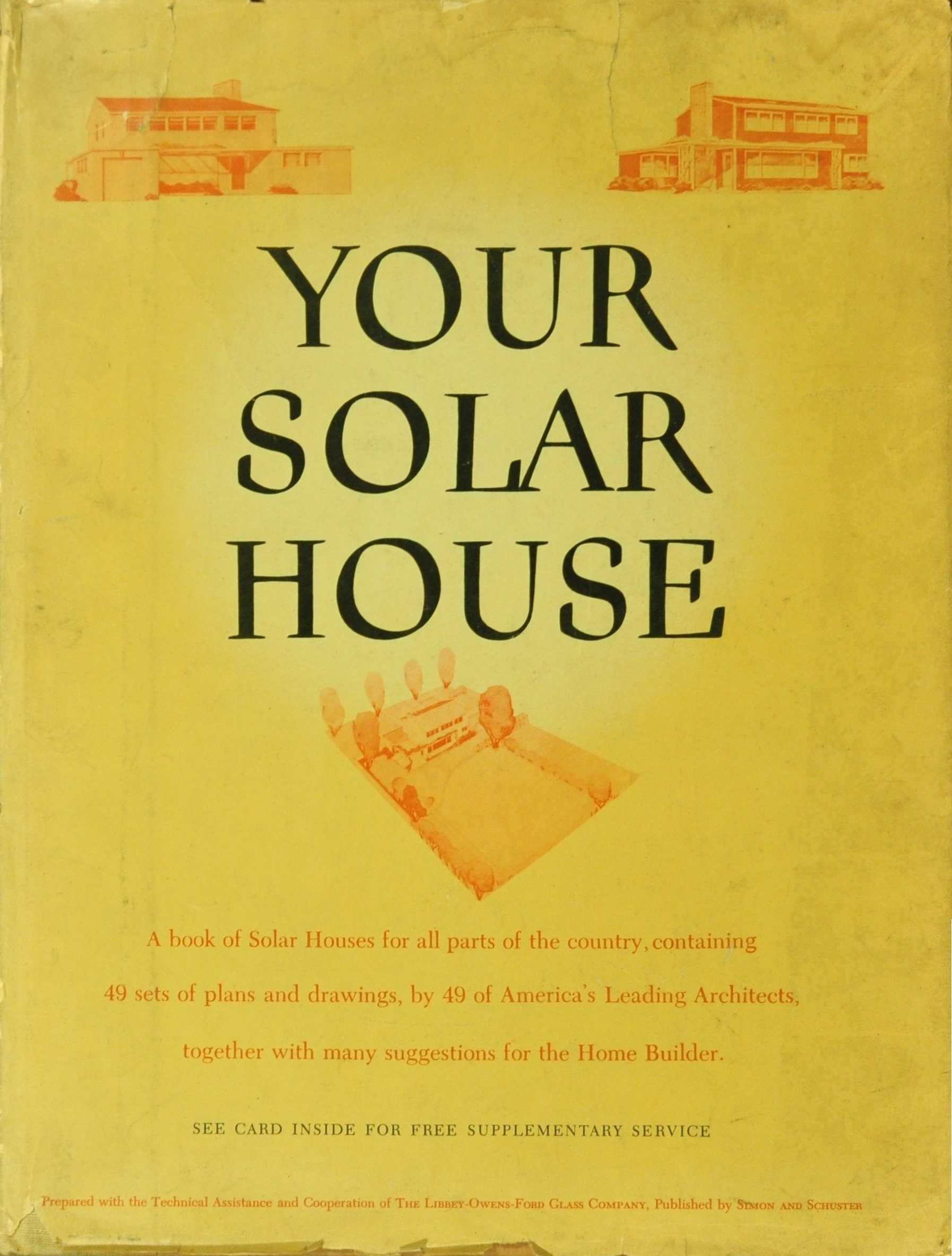
Front Cover of Your Solar House, edited by Maron J. Simon, published in 1947 by Simon & Schuster
Your Solar House was published by Simon & Schuster in 1947 and is subtitled as “A book of practical homes for all parts of the country, by 49 of America’s Leading Architects, containing 49 sets of plans and drawings, together with many suggestions for the Home Builder.” Editor Maron J. Simon’s begins the book with the sentence:
“In this book forty-nine of the leading architects of America present a new approach to living, a concept of home not merely as a shelter but as an opportunity for you to expand your shelter, within the boundaries of a normal-sized building lot, until its ceiling is the sky and its front wall the far-off horizon.”
He then outlines the project’s design parameters:
“Each of the contributing architects has created expressly for this publication a plan and design for a house inspired by his own locality, the characteristics of its people, its climate, its topography.
“The only limits placed on their creations were that the houses they designed should be within the medium-priced brackets, in the localities for which they were intended, and that the houses should lift their faces to the sun through extensive windows, or even walls of glass, not only to enlist solar energy as an auxiliary heating plant but chiefly to unite interiors with the out-of-doors in a spacious, cheer-filled atmosphere.”
Simon’s introduction placed Your Solar House firmly within the modernist milieu of its time, an almost utopian vision of modern architecture then in vogue and promoted by leading architects and writers.[2] But, it was not utopianism that created Your Solar House, it was capitalism.
Libbey-Owens-Ford Glass Company spent most of the 1930s tackling the problem of the “self-insulating window,” i.e. double-paned glass. They finally tackled it at the cusp of World War II with the commercial introduction of Thermopane, a window unit comprised of double-paned glass sandwiching an insulating layer of dehydrated air and sealed airtight with an alloy of aluminum, titanium, and copper.[3] Pioneering solar house architect George Fred Keck’s 1941 Hugh Duncan House in Flossmoor, Illinois used a prototype version of Thermopane, and its ability to maintain a comfortable inside temperature during the frigid Chicagoland winter using passive solar heating was widely reported. So, the company made efforts to cultivate a market for Thermopane. In 1944, Libbey-Owens-Ford initiated the “Your Solar House” program, assembling a panel of architects, writers, educators, and other associated professionals to select architects from the forty-eight states and the District of Columbia to design solar houses, preferably ones that would utilize Thermopane extensively. Though not publicly stated, Libbey-Owens-Ford apparently wanted these solar house designs to actually be built; their efforts to do so were scuppered by World War II and logistical issues. This is the likely reason the book was not published until 1947, three years after the program was put into motion.
The architects assembled in Your Solar House include some of the most nationally or regionally recognized ones who practiced in the mid-Twentieth Century.[4] Noted modernist luminaries Edward Durell Stone, Louis I. Kahn, and Pietro Belluschi are in the upper echelon of mid-century American architects, winning numerous high-profile commissions at home and abroad. Hugh Stubbins, Jr. was one of the pre-eminent skyscraper architects from the 1970s to the 1990s. George Fred Keck was the most devoted proponent of solar houses and is still known in the Chicago area for his designs. Robert Law Weed, Alden B. Dow, John Lloyd Wright, Harris Armstrong, O’Neil Ford, John Gaw Meem, Paul Thiry, and Harwell Hamilton Harris all retain a degree of regional recognition in the cities and states where they practiced, with Texas holding Ford in particularly high regard (though not always high enough to preserve his projects in a white-hot real estate market).
While not a nationally recognized architect, those familiar with Mississippi’s architectural history certainly recognize the man who designed Mississippi’s contribution: Edgar Lucian Malvaney. He practiced as an architect in Mississippi for over fifty years, with forty-four years spent leading his own practice, either solo or in partnership. From the 1930s until his 1970 death, Malvaney was one of the most prominent architects in the state. His varied career ranged from early Tudor Revival and historicist landmarks such as the Wright and Ferguson Funeral Home in Jackson; to some of Mississippi’s best Art Deco and Moderne buildings such as the Old U.S. Post Office and Courthouse (Eastland Federal Courthouse) in Jackson and War Memorial Building on the Old Mississippi State Capitol Green; to numerous post-World War II educational and institutional buildings in every region of the state. His architectural legacy inspired the founder of Preservation in Mississippi to adopt the nom-de-plume ELMalvaney.
I do not know how Malvaney received the commission from Libbey-Owens-Ford’s jury. I know that some of his architectural records still exist and are held in Mississippi State University’s Mitchell Memorial Library Special Collections. Whether those records include correspondence is something I do not have the answer to. The preservation of architectural records for Mississippi architects of Malvaney’s generation is spotty at best; no one thought to preserve them at the time, and what was preserved was usually items such as presentation drawings and architectural renderings (rather infamously, all of N. W. Overstreet’s voluminous office records and business correspondence was thrown in the trash when he retired). Libbey-Owens-Ford’s archives are in The Ward M. Canaday Center for Special Collections at the University of Toledo; various materials related to the Your Solar House project are listed in the collection’s finding aid. Whether those materials include how the jury and Libbey-Owens-Ford chose Malvaney and the other architects is another aspect of this that I do not know the answer to.[5]

Mississippi Solar House designed by Edgar L. Malvaney, from Your Solar House, page 95
Each architect wrote (or at least appears to have written, since it is not explicitly stated in the book that they did so) a synopsis of his design for Your Solar House. These texts give an insight to how each architect wanted his design to be perceived, as well as somewhat of an insight into each architect’s personality (one can unquestionably tell each entry is written by a different author). Quoted below is Edgar L. Malvaney’s text for Mississippi’s contribution to Your Solar House:
“Built almost entirely of native materials and supplies processed near at hand, this solar house will be suitable to almost any one of Mississippi’s historic regions, whether it be the Delta, with its wide, flat fields and rich plantations lands, the Natchez District, still ornamented by the manor houses of the old South, or the new industrialism of the Black Prairie, west of the Tennessee hills.
“Its hand-rived cypress shingles of silver gray, its parasols, columns, and trim in cream, its light-blue soffit of the eaves, will give the house a happy, comfortable, and hospitable aspect in keeping with its Southern environment.
“This solar house was designed with two extremes of temperature in mind. In summer in the deep South, on the occasions when the mercury soars to the 100-degree mark, the greatest possible amount of natural ventilation and protection from the sun’s rays is essential. In the winter the temperature sometimes falls to 10 or 12 degrees, making hearty invitation to solar warmth a wise expression.
“These plans provide a livable, convenient, and attractive house that will meet these two extremes.
“A central breezeway, which is really a large entrance hall opening through double doors onto a rear terrace at the north and onto the main entry at the south, is a central feature of the house. The structure is planned as two rectangles joined together by the breezeway to form an “L.” One rectangle contains the three bedrooms, and two baths, backed by a play area which is in effect the corridor to the bedrooms. It faces lengthwise to the south, giving the three bedrooms an open face in the direction of the sun. The other rectangle contains the living-dining room, fronting on the south, backed by the main entrance, which faces east, the kitchen, and the laundry. Opening as it does into the play area and into the living room, the breezeway provides full circulation of air from complete north-south ventilation.
“Placed diagonally to the rear of the kitchen, the garage offers direct access for the family car by means of a driveway slanting from the street.”
Malvaney’s text is succinct and matter-of-fact, one of the shorter entries in the book. Also of note is that Maron Simon’s introduction specifically singles out Malvaney’s “arrangement of a driveway that cuts corners and leads directly into a ‘carport’ built diagonally to the house” as something that could be adapted to designs in other areas, particularly for a house on a smaller lot. Malvaney’s diagonal carport is an inventive addition to the house’s spatial arrangement. Someone with more knowledge of Mississippi’s Mid-Century Modern residential architecture than I can comment whether any similar carports or garages were ever built.
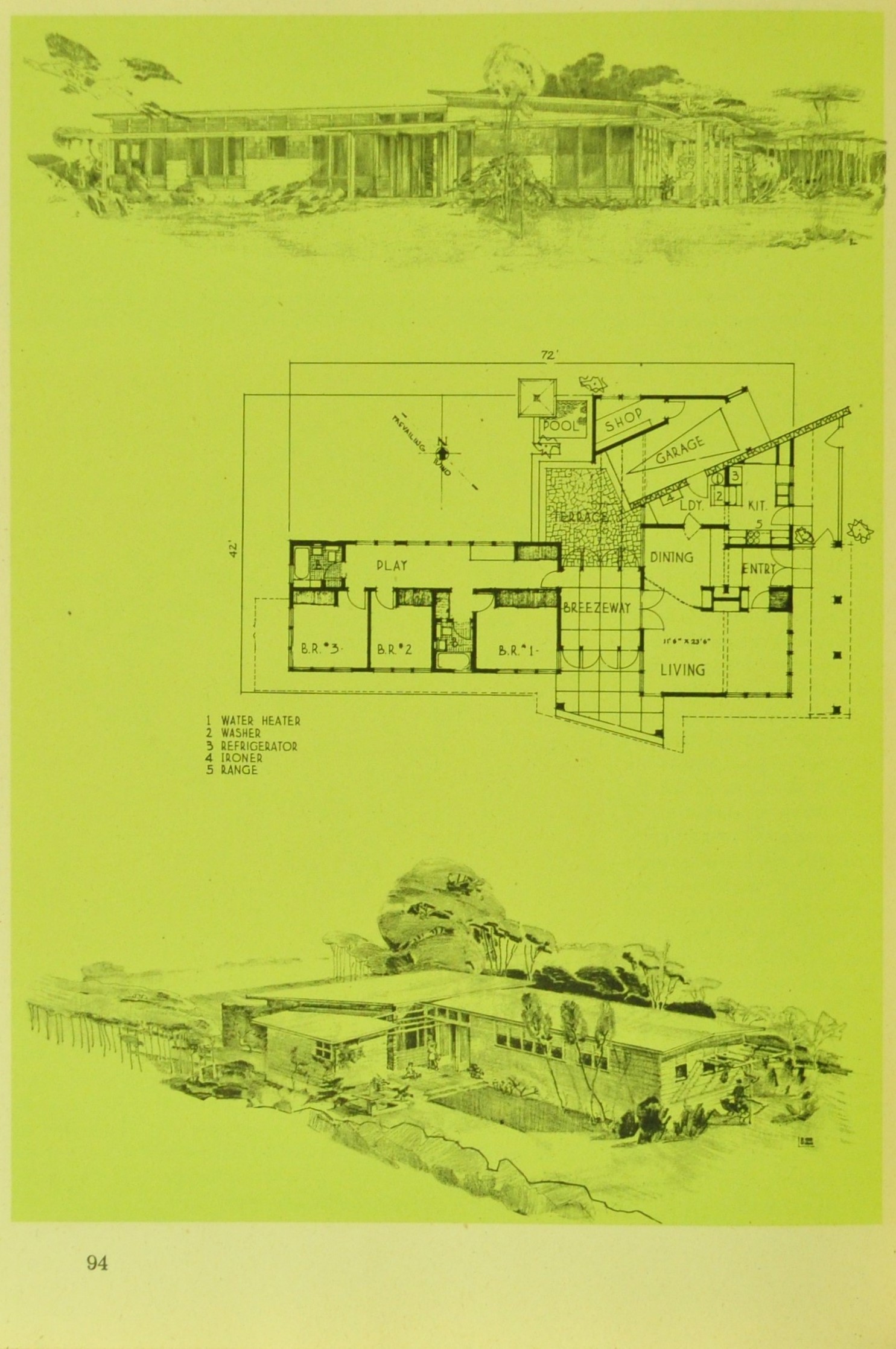
Mississippi Solar House designed by Edgar L. Malvaney, from Your Solar House, page 94
Though Edgar Malvaney billed it as a design suitable for the Delta, Natchez District, Black Prairie, and presumably all points in-between, Mississippi’s Solar House was, to my knowledge, never built. Indeed, I have found no evidence that any of the designs featured in Your Solar House were ever constructed.[6] This is likely one of the reasons Your Solar House has faded into obscurity. Nothing tangible was created by the project, unlike other housing experiments such as the Homes of Tomorrow Exhibition, Aluminaire House, Dymaxion House, Lustron Houses, Alcoa Care-Free Home, or various others. There are only a few instances of Your Solar House being referred to in a contemporary, non-academic setting. Some scholars have brought it back from complete obscurity in recent years, but it is still a footnote to the dominant architectural narrative, a road-not-taken, what could have been.
Whether one is a modernist or a traditionalist, everyone can agree about the deficiencies of our contemporary substandard architectural landscape of badly designed, cheaply constructed, placeless buildings that look the same in Mississippi or a thousand miles across the country and are livable only due to HVAC systems. Compared to that, perhaps today’s architects, builders, and associated professionals would do well to take a page out of Your Solar House and thoughtfully create “a house inspired by his own locality, the characteristics of its people, its climate, its topography.”
[1] For further information on this period of architectural history and the theories being explored at the time, check out the books: 194X: Architecture, Planning, and Consumer Culture on the American Home Front by Andrew M. Shanken, published in 2009 by the University of Minnesota Press; A House in the Sun: Modern Architecture and Solar Energy in the Cold War by Daniel A. Barber, published in 2016 by Oxford University Press; Tastemaker: Elizabeth Gordon, House Beautiful, and the Postwar American Home by Monica Penick, published in 2017 by Yale University Press; and The Solar House: Pioneering Sustainable Design by Anthony Denzer, published in 2013 by Rizzoli International Publications, all of which were used for reference in writing this post. Also referred to were the journal articles: “The Solar House in 1947” by Anthony Denzer from WIT Transactions on Ecology and the Environment, Volume 113, 2008; “Tomorrow’s House: Solar Housing in 1940s America” by Daniel A. Barber from Technology and Culture, Volume 55, January 2014; and “Tomorrow’s House: Solar Energy and the Suburban Territorial Project, 1938-1947” by Daniel A. Barber from 99th ACSA Annual Meeting Proceedings, Where Do You Stand, 2011. The website Solar House History, created by Denzer, has a valuable Resources page.
[2] The vision in Your Solar House was not Simon’s, who appears to have merely been a professional writer for hire for this book project. He is not listed as the copyright holder in the book; the copyright is registered to Libbey-Owens-Ford Glass Company (which actually renewed the copyright in 1974 and did not let it go into the public domain, though Libbey-Owens-Ford itself no longer exists due to spinoffs and mergers). His writing career appears to consist of books on gardening, travel, and history but no other architectural writing other than a freelance writing job for the Lustron Corporation. That job got him subpoenaed to appear before Congress in connection with the Senate investigation into a payment from Lustron to Senator Joseph McCarthy for working on the same writing project. McCarthy was censured in part for receiving $10,000 from the Lustron Corporation “without rendering services of comparable value” while a member of the committee investigating it, then lying about it and his failing to disclose his finances. Standard politics today but not in the 1950s.
[3] The journal article “’Insulation with Vision’: The Development of Insulated Glazing, 1930–1980” by Thomas Leslie from APT Bulletin: The Journal of Preservation Technology, Volume 49, Number 4, 2018 is a concise but very informative history of double-paned windows. I am unaware of any book-length treatment on the subject.
[4] Here is the full list for reference, with the state then the architect listed, arranged by region, which is the order presented in the book.
New England States
- Maine – Ambrose S. Higgins
- New Hampshire – Phillip H. Rogers
- Vermont – Ruth Reynolds Freeman
- Massachusetts – Hugh Stubbins, Jr.
- Connecticut – Douglas Orr
- Rhode Island – Albert Harkness
Middle Atlantic States
- New York – Edward Durell Stone
- Pennsylvania – Oscar Stonorov and Louis I. Kahn
- New Jersey – Allmon Fordyce
- Delaware – Victorine and Samuel Homsey
South Atlantic States
- Maryland – T. Worth Jamison, Jr.
- The District of Columbia – Alfred Kastner
- Virginia – A. Lawrence Kocher
- West Virginia – Martens & Son
- North Carolina – John J. Rowland
- South Carolina – G. Thomas Harmon III
- Georgia – Preston S. Stevens
- Florida – Robert Law Weed
North East Central States
- Ohio – J. Byers Hays
- Michigan – Alden B. Dow
- Indiana – John Lloyd Wright
- Wisconsin – William V. Kaeser
- Illinois – George Fred Keck
West Central States
- Minnesota – Robert G. Cerny
- Iowa – Amos B. Emery
- Missouri – Harris Armstrong
- North Dakota – Harold E. Bechtel
- South Dakota – Harold Spitznagel
- Nebraska – N. R. Brigham
- Kansas – Lorentz Schmidt
South East Central States
- Kentucky – C. Julian Oberwarth
- Tennessee – J. Frazer Smith
- Alabama – Clyde C. Pearson
- Mississippi – Edgar L. Malvaney
South West Central States
- Arkansas – H. Ray Burks
- Louisiana – Richard Koch
- Oklahoma – Henry L. Kamphoefner
- Texas – O’Neil Ford
Mountain States
- Montana – Ralph H. Cushing
- Wyoming – Frederic Hutchinson Porter
- Colorado – Burnham Hoyt
- New Mexico – John Gaw Meem
- Idaho – Theodore J. Prichard
- Utah – Lowell E. Parrish
- Nevada – Laurence A. Gulling
- Arizona – Richard A. Morse
Pacific States
- Washington – Paul Thiry
- Oregon – Pietro Belluschi
- California – Harwell Hamilton Harris
[5] Despite Maron Simon writing in Your Solar House that “The nominees, chosen without any influence by the company, would be accepted without question by Libbey-Owens-Ford and offered commissions to execute the designs,” some of the scholars who have looked into the project believe that Libbey-Owens-Ford did have influence on who the jury selected.
[6] George Fred Keck and O’Neil Ford designed similar solar houses but apparently nothing that matches what they contributed to the book.
Categories: Architectural Research, Books, Environment/Green, Modernism, Recent Past
 Preservation in Mississippi
This is interesting and would like to leave a comment, but your algorithms won’t allow it. Comment: In Mississippi, a grand example of central opening evacuating rising heat is Waverley, antebellum, in Clay County. Dolly West Le Régence Park, Téléos 762, avenue Jean Moulin 83400 Hyères-les-Palmiers FRANCE 33 / (0)6 87 77 07 39 mobile / portable 33 / (0)4 94 08 32 66 home / domicile http://www.dollywest.com
LikeLike
I enjoyed this piece about the book, and E L Malvaney’s Mississippi house. I explored the subject in the newspaper archives for 1947, which was also interesting. Many of the houses were featured in local papers with the architect’s rendering and a floor plan, but others were merely mentioned with a copy of the same description of the project and the book. The Clarksdale Register featured Malvaney’s mention, but without photographs. Two items were critical of the overall designs, calling them mediocre and uninspiring. The Tucson Daily Citizen went so far as to cite only six houses that were “outstanding” in representing contemporary (modern) design “with present developments of solar houses.” Indeed, when I viewed the available renderings and floor plans, they were quite similar, regardless of which geographic region they were supposed to be designed for (George Rosenberg, Nov. 8, 1947, p. 5).
Rosenberg wrote: “The book was published with the assistance of the Libbey-Owens-Ford Glass company. In fact, the entire project was sponsored by that firm, and Simon & Schuster merely printed the results. It is obvious that many of the designers employed glass for the mere sake of using glass and satisfying the sponsor.” Michigan’s entry, for example, featured a house of complete glass wall panels, “to flood every room with the low winter sun, while each room is shielded by roof overhang from the hot summer sun, and what were described as “extensive planting of deciduous trees and small shrubbery.” Roof overhang was most frequently used in buildings featured in the southeast, south central and south western states. One critic opined that most of the designs appeared to adhere far too much to traditional architecture.
LikeLiked by 1 person
I’m glad my post inspired you to do some further research. My post was already becoming a bit of a sprawling mess, so I didn’t delve into how the general public perceived these house designs in general and Malvaney’s in particular. I believe Daniel Barber touches on that a little in his book, but Monica Penick and Anthony Denzer do not in theirs.
The contemporary writer you pointed out, George Rosenberg, pretty astutely picked up on the fact that Your Solar House was a marketing campaign by Libbey-Owens-Ford. The finding aid on the company’s files has the “Your Solar House” project listed under advertising and promotions. Barber also opined that the project’s jury may not have been completely independent of Libbey-Owens-Ford in selecting these architects, though I don’t know the specifics of why he said that.
I also chose not to go into the specifics of every state’s design. They are quite variable in style and solar-ness. Malvaney’s is one of the most modern and most in keeping with being a solar house.
The other point I did not make in the post is whether this house was an aberration in Malvaney’s career. His MDAH project listing contains almost no houses, and the ones it does have are from very early in his career. Was “Your Solar House” just something he did because he and his firm weren’t very busy due to WWII (MDAH only lists three projects for 1944: two school buildings and Camp McCain)? Or, did his firm do residential projects and those projects are simply not recorded on the MDAH HRI? I don’t have the answers to those questions or know if they even are answerable with the records still in existence.
LikeLiked by 1 person
I could have looked a lot further than I did, but your information being so extensive gives me new avenues to search the newspaper archives. I will see if I can turn up any additional information about Malvaney’s early 40s years that might shed light. It won’t change anything, but I enjoy trying to figure out a puzzle without an answer. You might enjoy the snarkiness (which I learned about from our own EL Malvaney of Miss Press) of Rosenberg’s comment about the the Nebraska design:
“Norman R. Brigham’s Nebraska house, for example, hits a new low in modern architecture. His perspective shows what might have happened if a post-Victorian house had been remodeled after being damaged by bomb blast. The net result is nondescript and without positive character.” The design featured a two-story rectangle that had a floor-to-ceiling glass wall on 3 of the walls and looked like a solarium. Inside the living room/solarium was a “dining balcony” and the upper floor featured a sun deck.
LikeLike
William, enjoyed this post, done with your usual combination of facts and “style “!
My parents
LikeLike
(there is something “really wrong” with the website now; I just began my comments and then couldn’t continue; can someone correct the problems?)
my parents designed my childhood home in hattiesburg with features in this book, which they might have seen or owned.
In nice coincidence to William ‘s post, I acquired a copy of the book about a month ago.
LikeLike
same problem—cut off and couldn’t continue or go back and add to an earlier paragraph.
our house was built in 1953. It still stands but has been horribly modified in recent years.
LikeLike
Ed, Preservation in Mississippi is working fine. WordPress’s comment format has changed; it has more features than it used to (including the long-desired and oft-requested ability for people to add photographs to comments). However, I am not sure why you are having issues leaving your desired comments. I have not had any problems writing comments or utilizing these new features, including adding text or going from paragraph to paragraph editing them. You might just need to get more acquainted with the new comment format.
LikeLike
indeed , I do.
LikeLike
I forgot to ask whether you are using a phone or tablet to make your comments? I am using a desktop computer. There could be issues that I haven’t encountered when using another type of device to make comments.
LikeLike
phone.
LikeLike