
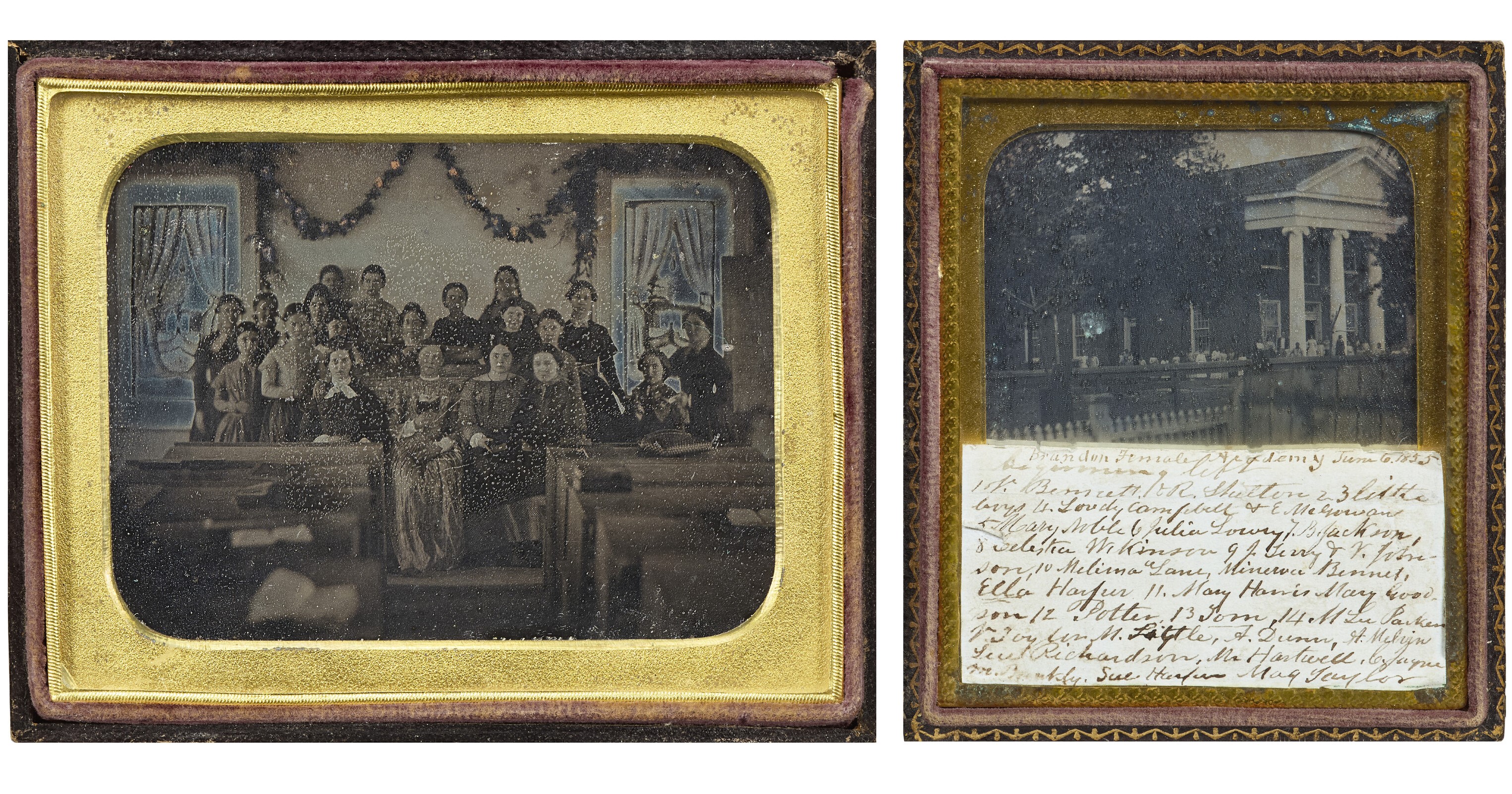
“Group Lot of Two Views of the Brandon Female Academy, Mississippi, 1855” Christie’s The Maillet Daguerreotype Collection Auction, Lot 74
With all the information flying rapidly around online, one never knows what one will come across. Frankly, it is usually just irrelevant nonsense. Sometimes, such as in this case, it means coming across a rare piece of MIssissippiana.
Christie’s is auctioning The Maillet Daguerreotype Collection online from June 12 to June 26. From the sale overview:
“Beginning in the 1960s, Lynn and Yann Maillet pursued collecting daguerreotypes with a fierce passion. It was a period when stupendous pieces were being unearthed, and a wide range of works were readily available in what was then a relatively nascent collecting market. Well-known within the field and yet resolutely private, the Maillets amassed a collection with great depth and outstanding breadth. This collection of over 200 lots of daguerreotypes have never before been on public view.”
While interesting, a New York-based auction largely comprised of Nineteenth Century portraits from the Northeast would not normally pique the interest of architectural historians or historic preservationists based in the South, despite the presence of some rather nice photographs of New England and Midwestern buildings and townscapes. But, among all the other daguerreotypes the Maillets collected is lot 74 in the auction: “Group Lot of Two Views of the Brandon Female Academy, Mississippi, 1855.”
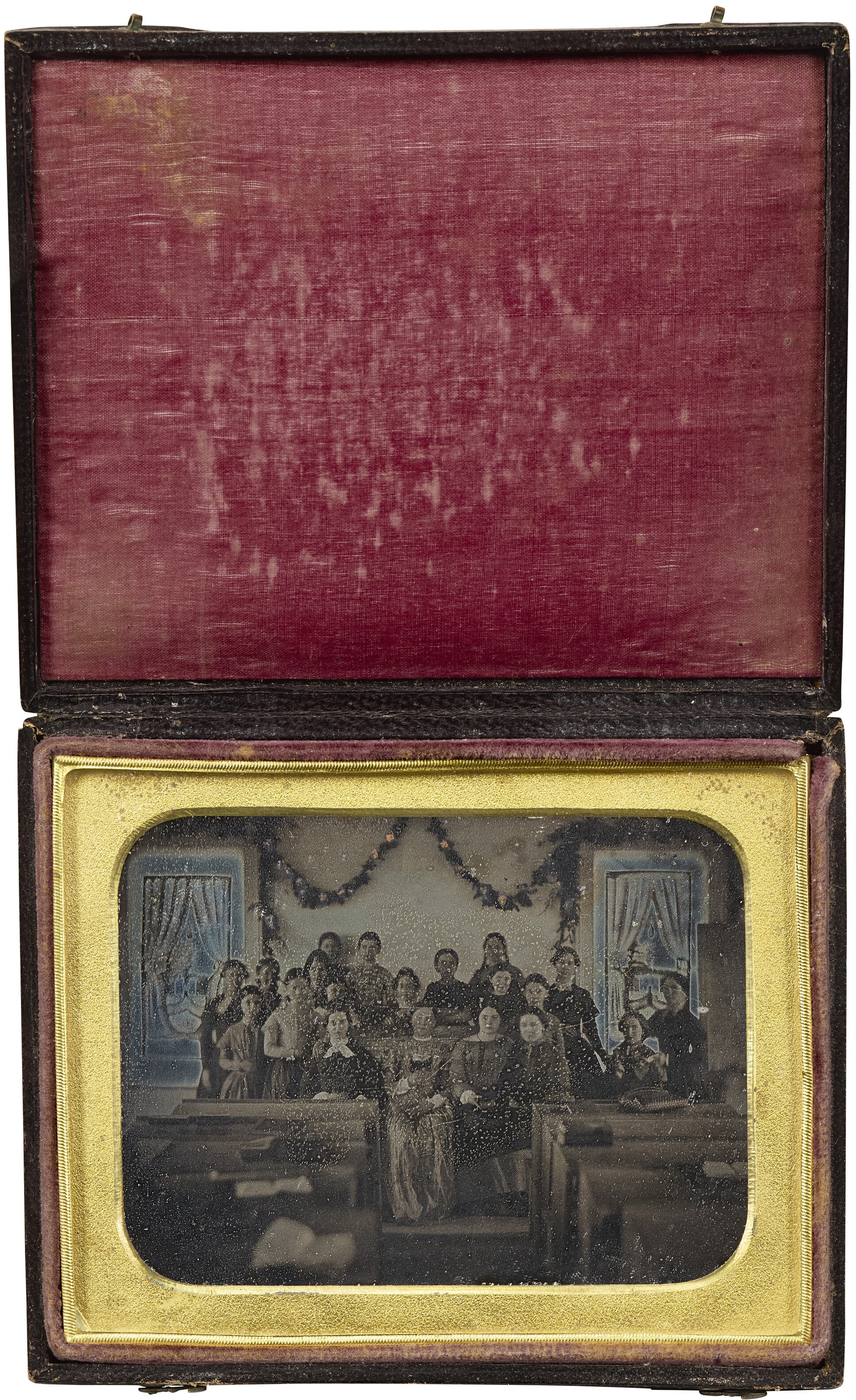
Quarter-Plate Daguerreotype from “Group Lot of Two Views of the Brandon Female Academy, Mississippi, 1855” Christie’s The Maillet Daguerreotype Collection Auction, Lot 74
Since very few people are familiar with historic photographic processes, a primer on daguerreotypes. The daguerreotype was the first widely available type of photography and was the principal method of photography in the 1840s and 1850s. It was named for its inventor, Louis Daguerre. Each image taken with the process is unique, since the image was directly exposed onto a polished silver-plated copper plate and developed using mercury vapor. Since the image was very easily damaged by physical contact or tarnished from exposure to air, the images were usually sealed in decorative cases. The daguerreotype was almost always a mirror image of its subject, something to keep in mind when looking at one. Plate sizes were standardized. Whole plates measured 6.5 x 8.5 inches. Quarter plates were 3.25 x 4.25 inches, and sixth plates 2.75 x 3.25 inches. Those image sizes seem small, and daguerreotypes could be considered a relatively primitive form of photography to the uninitiated, but it has only been very recently that digital cameras have been developed that can capture more visual information than a mid-Nineteenth Century daguerreotype. Their sometimes poor image quality can be attributed to age, improper storage conditions, and the original photographer’s abilities (or lack thereof).
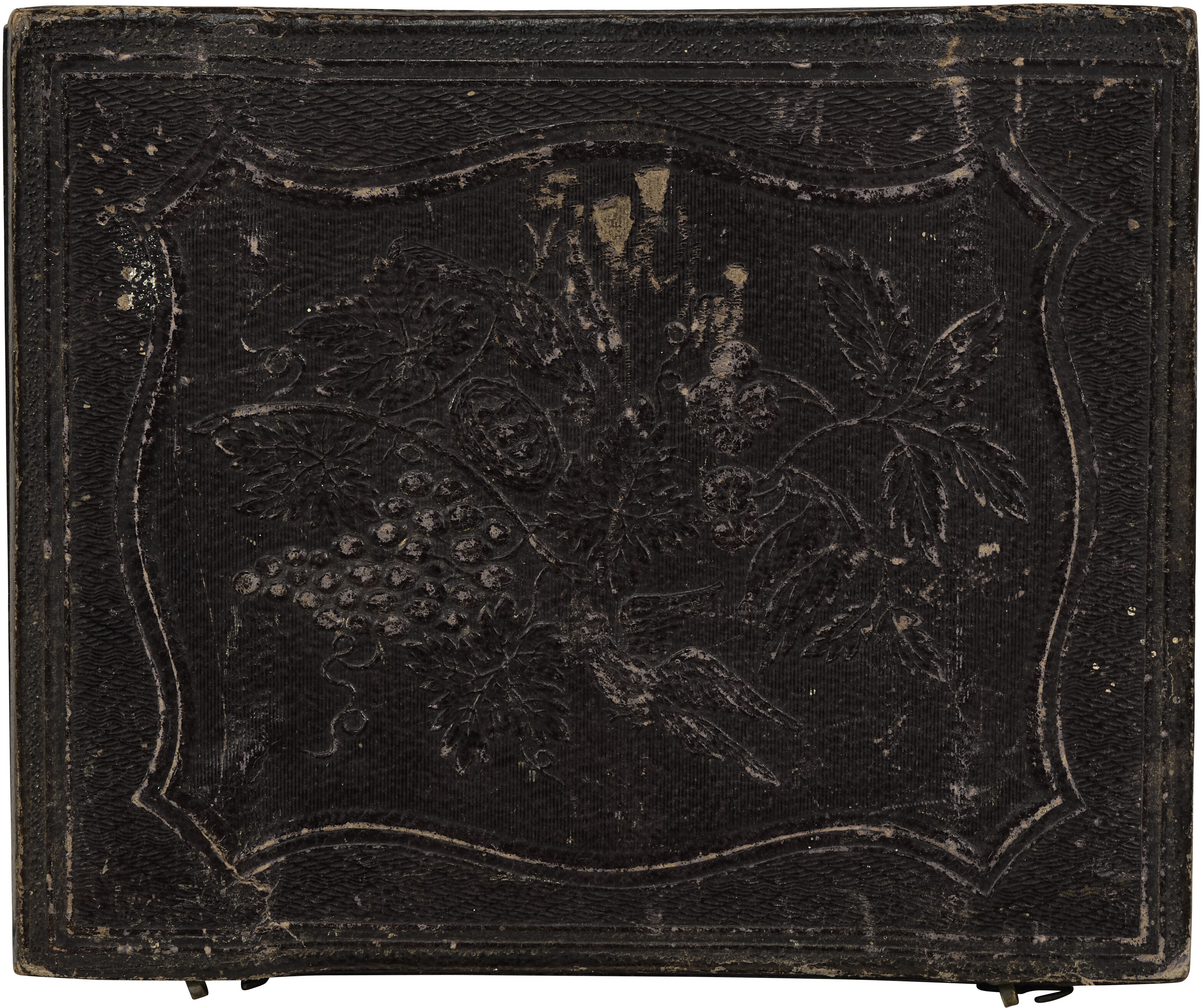
Quarter-Plate Daguerreotype Case from “Group Lot of Two Views of the Brandon Female Academy, Mississippi, 1855” Christie’s The Maillet Daguerreotype Collection Auction, Lot 74
The auction lot, “Group Lot of Two Views of the Brandon Female Academy, Mississippi, 1855” consists of two daguerreotypes taken by an unknown photographer, one quarter-plate and one sixth-plate with the cased sixth-plate annotated by an unknown hand in ink on an affixed label. The larger, quarter-plate photograph is of a group of students gathered together in a classroom, your standard class portrait, but one that is likely among the earliest surviving for any Mississippi school and one of the earliest interior views of any Mississippi building. The sixth-plate photograph shows students lined up around the Brandon Female Academy building, a striking brick, Ionic-columned, temple-fronted Greek Revival structure known as Johnson Hall, on June 6, 1855, 170 years ago to the day. The label below the image is of the students and teachers in the photo, again like the school photos we have all been a part of.
Antebellum Mississippi had numerous small public and private schools that were important to their communities, and Brandon Female Academy was no different. Johnson Hall was a centerpiece of Brandon for many years. From the “Historical Development of Brandon, ca. 1828–1941” portion of the National Register of Historic Places Multiple Property Documentation Form for the Historic and Architectural Resources in Brandon, Rankin County, Mississippi prepared by Marsha R. Oates and John L. Hopkins:
“The legislature in 1829 approved an act to establish a seminary in Rankin County, to be called Pearl River Academy. In 1833 Brandon Academy was established; but neither it nor the Pearl River Academy received enough funds to operate, so the interest from their school funds as well as their governing boards were combined. The new school was known as Brandon Male and Female Academy until 1847 when the curriculum was raised to meet collegiate standards. In 1849, the school was chartered as Brandon College but retained this status for only two years, closing in 1851. The school reopened as a lower school in 1855 and changed hands several times during the next ten years. In 1865, Miss Frank Johnson took over the school, at which time it became Brandon Female College. It was part of the free public school system for a few years after the Civil War, but it later reverted to private ownership and operated until 1896. The school was located on South College Street. Johnson Hall, ca. 1837, was the Academy’s major building. It was a two story brick building with a three bay façade and a quatrastyle, pedimented portico. It was demolished in 1923 and its site used for the present Brandon High School.”
Brandon Female Academy plays a part in the history of most of Brandon’s historic church congregations. Brandon’s Methodists met at the Academy building from the 1863 arson of their original church until the completion of their second church in 1873 (a building which unfortunately only exists in the pages of Lost Churches of Mississippi today as it was demolished in 1958). Brandon’s Episcopalians and Baptists also held services at the Academy before their churches, the original St. Luke’s Episcopal and First Baptist Churches, were constructed.
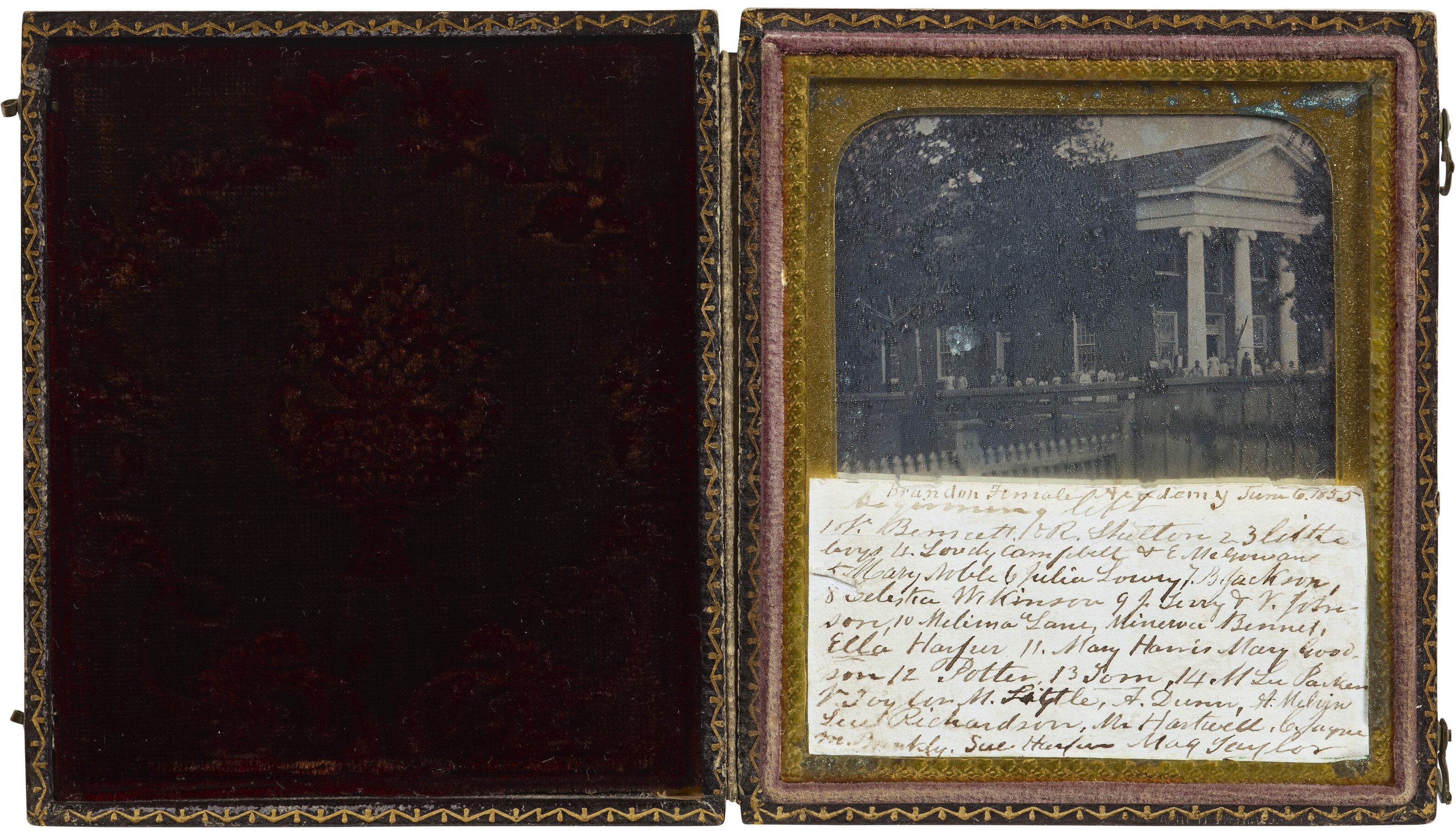
Sixth-Plate Daguerreotype from “Group Lot of Two Views of the Brandon Female Academy, Mississippi, 1855” Christie’s The Maillet Daguerreotype Collection Auction, Lot 74
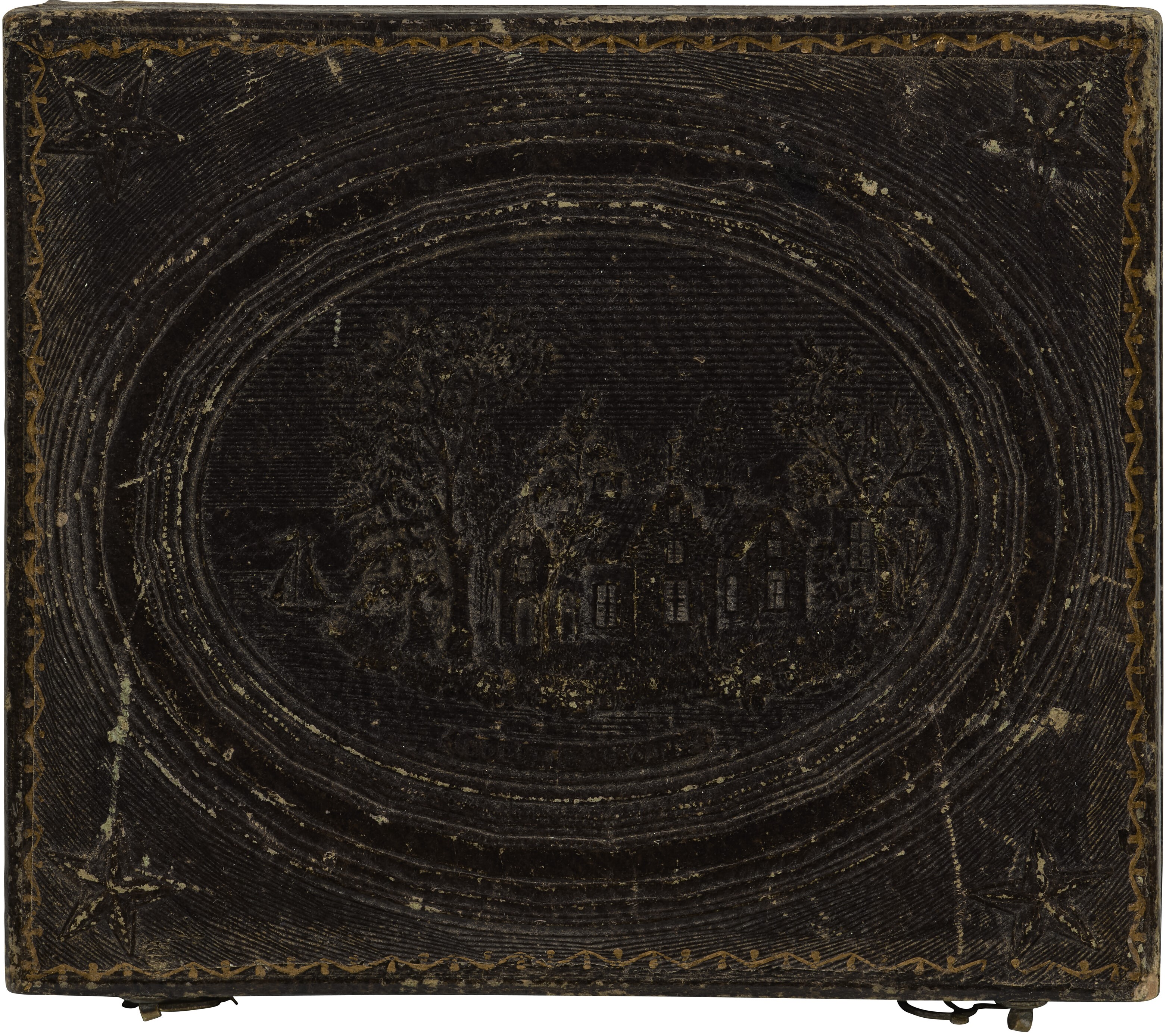
Sixth-Plate Daguerreotype Case from “Group Lot of Two Views of the Brandon Female Academy, Mississippi, 1855” Christie’s The Maillet Daguerreotype Collection Auction, Lot 74
I can only hypothesize how these two daguerreotypes made their way into the Maillet collection. The head of the Brandon Female Academy when these photographs were made was William H. Potter, a Rhode Island native who was a professor and Baptist deacon for forty years. He was one of numerous New England educators who dispersed across the country (and around the world) in the mid-Nineteenth Century. In his case, he returned to his native region, living at 7 Rathbun Place in Mystic, Connecticut. He was a well-known individual, written about in various local histories, and his stature in Mississippi was still such that The Clarion reported on April 20, 1887 to its readers that he had recently died (a shame that the modern-day Clarion-Ledger does not do such thorough reporting of the Jackson region). Yale University has a collection of his private journals, ledgers, and scrapbooks, the William Henry Potter Papers, in its archives.
Johnson Hall is long demolished and all those who attended school within its rooms passed away decades ago, most taking their memories and experiences with them, unrecorded for those today to read and learn from. The decentralized educational landscape of antebellum Mississippi that it was a part of, comprised of small schools, colleges, academies, and institutes dotted among equally small towns, has largely disappeared. A few educational institutions still exist or have preserved previous institutions’ antebellum buildings, such as the University of Mississippi, Mississippi College, and Alcorn State University. A few are preserved as museums or government buildings, such as Jefferson College, Eureka Masonic College, and Port Gibson Female College. A few are in ruins or in danger of falling into ruin, such as the Chalmers Institute in Holly Springs and Elizabeth Female Academy in Washington. But most are gone with nary a trace remaining. The Brandon Female Academy is among those, still existing only on the polished silver surfaces of these two photographs.
If any Preservation in Mississippi readers or Mississippi museums wish to add a pair of irreplaceable glimpses into Mississippi’s antebellum past, the auction estimate is $3,000–$5,000, with the bidding starting at 10:00 AM eastern time on June 12 and running to 10:00 AM eastern time on June 26.

Sixth-Plate Daguerreotype Detail from “Group Lot of Two Views of the Brandon Female Academy, Mississippi, 1855” Christie’s The Maillet Daguerreotype Collection Auction, Lot 74
Categories: Antebellum, Asides, Brandon, For Sale, Lost Mississippi, Schools


Thank you for sharing this information!
Harold L. Storment
Attorney at Law
6011 Brownsboro Park Blvd., Suite A
Louisville, Kentucky 40207
w: 502 589 5533
e: hstorment@msn.com
LikeLike
Excellent work William. Maybe someone will purchase these for MDAH or another Mississippi archival collection.Best regards,Mattie Abraham
LikeLike
I enjoyed reading this, and learning more about the past schools. Thank you for this contribution.
LikeLike
yikes! Is this site working again? Ed, lyons, ny
LikeLike
I am having a terrible time now creating comments. I have tried unsuccessfully to write something after my first comment a few minutes ago!!! Did anyone else notice that the script on the paper under the exterior view of the Brandon academy exterior view states, “ June 6, 1855”— 170 years ago “to the day”? Creepy!
LikeLike
in the small world department, lot 17 shows a dag of the Bemis bookstore in nearby canandaigua ny. Bemis was a very important man in this area in many fields, and, a month ago, friends who live closer to Albany acquired a superb portrait of him painted in Paris ca 1835 at an auction near Buffalo. I have sent the auction lot info to them as well as to the Ontario county historical society in canandaigua; any early dag of this area is “important “ regardless of the identity of a
LikeLike
still having trouble making comments — I wasn’t quite finished with my comments in the previous mail and “hit a roadblock “. To conclude, any local dag is important!
LikeLike
My grandmother graduated from the Brandon Female Academy in 1892. I have copies of the graduation program and some other ephemera associated with it.
LikeLike
I would like to be in touch with contributor Tom Roselle, whom, I believe, has my email.
LikeLike
On a different topic, I highly recommend that readers watch today s outstandingly informative Mdah “history is lunch” program ( via YouTube) on “Katrina in Mississippi” , with panelists Ken ppool, nan Prince, Jennifer baughn, and Jeff rosenberg.
LikeLike
the Brandon academy dags seem to have sold for $15,120.
LikeLike
I purchased the pair of daguerreotypes and am very happy to add them to our collection. I can’t wait to remove the glass of the 6th plate to see what lies under the information.
LikeLike
Congratulations on your purchase.
LikeLike