
If you get off the interstate at Vaiden and go about 7 miles on the highway, then turn onto a paved county road and go another 7 miles, turn right onto a gravel road for a mile or so, then left onto another gravel road, through the red dirt and towering pines, you’ll come to a homeplace that oozes history but whose future is precarious.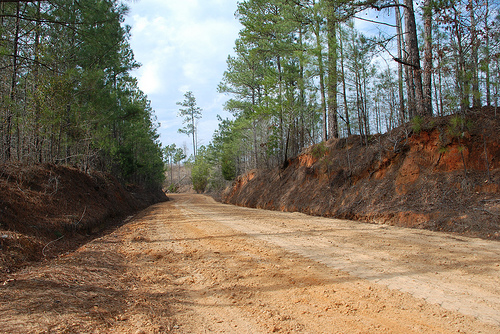
The main house started with an 1883 hall-and-parlor form with a full undercut front porch, cabinet rooms behind the main rooms, a small back porch, and stairs to the partially finished attic space. (The ceilings in this part of the house feature an interesting throw-back to the beamed and paneled ceilings of the 17th and 18th centuries–strips of wood with a single bead on the edge form battens over the ceiling planks in every room–I haven’t seen anything like it before.) Probably in the 1890s, the owners built a small addition to one side–maybe one large room, maybe two, hard to tell–now it’s a kitchen and small bathroom. 
The current owners bought the place sometime in the early 1970s when it had seen better days. They fixed it up and loved it and made it their own, but they pretty much left everything as it was architecturally. Later, in the 1990s, they found an old log cabin abandoned somewhere nearby and moved it onto the property, sitting it down a few feet from the kitchen addition and connecting it to the main house with a hallway lit by a skylight; they filled the inside of the log cabin with an amazing U-shaped balcony overlooking the comfortingly large re-built stone fireplace. They put a screened porch on the back of the cabin and furnished it with a bed–a real live sleeping porch; they placed a couch on the front porch of the main house and spent a lot of time out there sitting on it. The husband died a few years back, leaving his widow to keep the sheep and keep building their dream.
Out back, there’s an original smoke house and outhouse, the remains of a farm road; there’s a 1920s garage (or car-house, as the owner calls it) in front, along with three little buildings they have built from material salvaged from demolished places around or had milled from the many trees that fell on the property during a bad storm in 2001. Right now, the owner is in the process of having a “tree house” built over remains of an uprooted tree from that storm–it’s like something from the Swiss Family Robinson, and it shows a willingness to create whimsical spaces for no other reason than for the love of them.
 I had a wonderful time wandering around and under this place–the feel of history permeated everything. I wish I could show it to every new owner of a historic house who tells me he needs to spray insulation into every tiny nook to keep the drafts out, or absolutely must have a jacuzzi tub installed, or (the best) needs to glass-in the porch to make it more “livable.” This house is livable in every way, but its livability is a result of adaptations by both the house and the owners. The owners’ creativity shows itself in the many additions and changes, but while they changed the place, they allowed the place to change them too, so that their lifestyle came to live comfortably with the house. They never forced the house to be something it wasn’t.
My friends in the Vernacular Architecture Forum would have loved to spend the day exploring this place with me. They formed this group waaaay back in 1980 in response to what they perceived as the over-emphasis of architectural historians on the Great Works and the Great Architects. The VAF was the first professional organization I joined, back when I could only scrape up enough money for one set of dues per year. I joined it because a friend of mine told me that they were “hard-core architectural historians” and that sounded like my kind of people. I’ve learned alot from the VAF, and especially appreciate its primary focus on American vernacular in contrast to the international focus of some other architectural history organizations.
I started by saying that this place had a precarious future, but as I think about that statement, I realize that the same could be said for every building and place, no matter how well-loved and preserved it is. Just look at the Mississippi Gulf Coast: regardless of the years of work preservationists spent ensuring the future of the Tullis-Toledano House, the Tivoli Hotel, and hundreds of others, these landmarks that had stood forever it seemed, were wiped out in the blink of an eye.
Maybe I’m being a fatalist, but is part of loving “vernacular” also accepting that sometimes change means allowing something to melt away? Would quiet abandonment be more dignified and honest for this place at the end of the road than becoming someone’s weekend home complete with glassed-in porch? Is part of the beauty of the place its transitory nature? What role should preservationists play?
For now, I’m thankful for the chance I had to get to know the place and its owner and spend time with both. These questions have obviously already occurred to the owner, as evidenced by this enigmatic plaque near the well.

Categories: Cool Old Places, Historic Preservation, National Register, Urban/Rural Issues, Vernacular Architecture


I love this post and vernacular architecture. Do you know the owners or did you meet them while exploring this place?
LikeLike
Thanks–vernacular appeals to my historian side, which is the larger side of me. No, I only met her that day, but we had a great time chatting. I saw that VAF is linked on your site, so assumed you were a kindred spirit!
LikeLike