
The Heathman Plantation in Sunflower County was originally known as Dogwood Ridge Plantation. It was purchased in 1871 by J. M. Heathman and renamed. Heathman was married to Lille Brown, the daughter of James Brown who built the house later known as Beauvoir in 1848 (Heathman family history, ancestry.com). Heathman was killed by a horse kick in 1885, not long after his marriage. His widow married J. A. Crawford in 1888, which explains the J. A. Crawford, 1911 stone visible between the upper floor windows of the commissary building (or plantation store).
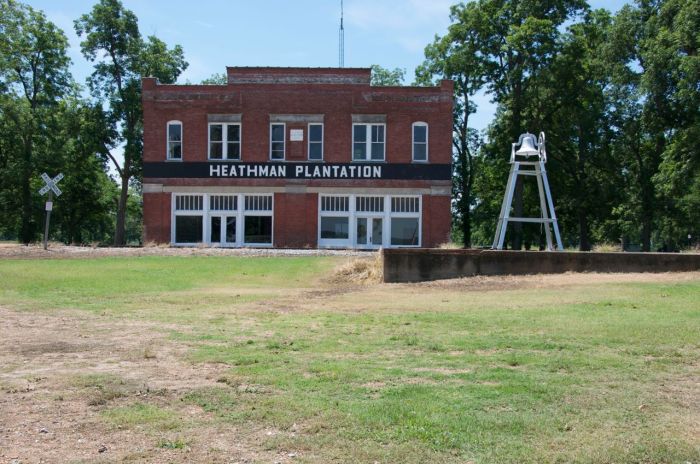
The plantation was later the Billups plantation, and the records in the MDAH Historic Resources Inventory identify buildings as the Billups plantation. The train ran in front of the commissary building, and the foundation of two buildings on this side of the railroad tracks are visible. The interior of the building appears to be in remarkably good condition, and the shelves, dishes, and back office are visibly fairly clearly, even though I was photographing through the glass of the front windows. A commissary building held the supplies for the plantation during slavery. Afterward, the use was like a general store for the sharecroppers or tenant farmers. Like most “company stores” the workers had a line of credit, or else were paid in “scrip”. Scrip was a token that could only be redeemed at the store where issued. Prices were generally higher than elsewhere, due to the length of time the owner carried the loan, and in general, workers were always indebted to the company store. Tennessee Ernie Ford popularized the concept in his song “Sixteen Tons” :
You load 16 tons and what do you get?
Another day older, and deeper in debt.
St. Peter don’t you call me ’cause I can’t go
I owe my soul to the company store.
The slideshow below provides details of the building and the surrounding area. I hope you enjoy the trip as much as I did on a beautiful Mississippi summer day.
Categories: Cool Old Places, Delta, Indianola


Who owns this fantastically intact buiding? Looks like someone has planted crape myrtles along the old railroad bed. The grounds are well-tended.
LikeLike
Apparently, it is part of the Billups Plantation, based on public records available. I read somewhere (forgot where) that the current owner had the Heathman name repainted on the commissary to recognize the early history.
LikeLike
Come back and would love to show you inside. Great pictures
LikeLike
Thank you! That would be wonderful!
LikeLike
This store was built in 1911 as plaque on front of store displays The plantation was in 1871 so there were never slaves on this plantation . Interestingly, there were many Italian families that came in in the early 1900’s to this area and some lived on Heathman. We are beginning to restore the building and youmare welcome anytime. My email is robertsonlois@ hotmail.com
LikeLike
There were slaves there. My family comes from the Billups Plantation
LikeLike
I am generally curious when there is a statement about which I have no direct knowledge, so when I read Kevin McCray’s comment of this past week about there were slaves on the plantation, and his family came from there, I began to do additional research. I will not do extreme details in the comment due to space, but there are important points to note that substantiate Mr. McCray’s comment.
The first mention of Dogwood Plantation I could locate in newspapers was in reference to Col. Christopher Gillespie, who began to acquire the plantation around 1954 and sold some or all of it 1859 (Weekly Mississippian, Sept. 21, 1859). James Brown settled there in 1848, coming up from the property now known as Beauvoir. I find no specific information regarding slaves on the plantation during that time period, but one could assume that any plantation in Mississippi would have held enslaved Africans during that time. April 1, 1855, the Sheriff Sam’l Edwards of Warren County announced the arrest of HENRY, belonging to Christopher Gillespie of Sunflower County, and in the typical newspaper announcement, bade the “owner come forward, prove property, and take said slave away” (Vicksburg Daily Whig, May 5, 1855). In 1860, a HENRY was arrested in Yalobusha County who reported he “belonged” to Berge Heathman who owned a plantation in Sunflower County. Berge was James Martin Heathman’s father, and J. M. purchased the Dogwood (former Brown, subsequently Gillespie) plantation in 1871 and renamed it Heathman.
While there might have been no “slaves” on the plantation after Heathman purchased it in 1871, the sharecropper system introduced following emancipation and which continued into the mid-20th century, was by numerous academic, scholarly research documents as well as many documented oral histories of former slaves and sharecroppers, a legal mechanism for continued subordination and oppression of those of African descent. It is well documented that the majority of sharecroppers or tenant farmers were indeed still enslaved by the economic system that assured the likelihood they would never get out of debt.
LikeLike
Hello,
I just had to email you about this article. It brought back so any childhood memories. How could I possibly come by to look not only around but even show my children where their dad grew up and even shopped as a child. I even worked me and my brother for the bookkeeper to clean up the old place. I would love to see other pics or hear from you.
LikeLike
my namer is Charlie Hubbard Jr. i raze on Heasthman Plantation. i went to School at Friendship babptis church they used church for School in 1940 do you have any information about it?
LikeLike
I grew up on Heathman Plantation from 1967 to 1982, the Coleman Family
LikeLike
susassippi, maybe you should read the article in DElta Magazine called “When Cotton was King” about Heathman Plantation…pretty interesting article.
LikeLike
I will look for it; thanks.
LikeLike
the history of friendship school in 1938-46
LikeLike
I wonder if the Billup’s were tied into the gas station some how ?
LikeLike
YES,SAME FAMILY!!
LikeLiked by 1 person
Yes. They owned gas stations throughout the area including one that was across from the old fire departent on old 82 as it came into downtown Indianola. Part of th plantation included a huge cattle ranch where my dad worked for close tto 20 years called the “3B Ranch.”
LikeLiked by 1 person
The railroad is still used by the Columbus & Greenville Railway, although not often, it is.
LikeLike
The train runs twice a day everyday
LikeLike
Hello Lois,
My name is Shunda R. McWain and my family lived on Heathman The Banks my Grandfather worked in the cotton gin and as a little girl I remember going to the country store. If you have any information to help with my Family Tree please email me at abbypapinty@mail.com
LikeLike
I grew up in the 60s and 70s and ran every inch of the plantation with my cousin.
LikeLike
Scott, I am a Heathman in Texas. Please tell me about your youth and the plantation!
-Amanda
amanda.heathman@yahoo.com
LikeLike
My uncle was the general manager of then Billups plantation. They lived just west of the store in the big white house. My family visited regularly until 1974
LikeLike
Scott, my maiden name is Billups and this Plantation has always been on my mind. I live in Chicago now and have on several occasions drove by this plantation traveling from Birmingham, MS on Hwy 82 in Sunflower County. I feel spiritually drawn to this Plantation. I asked my father about our history and he explained that once we were freed, some of the family went north of the Mississippi River and other went South.
I know my ancestors were slaves on this plantation. Can you tell me if there are any historical records available on slaves that were held at the time.
Thanks. My email is fbb2011@att.net.
LikeLike
Dear Scott,
I had a friend, recently deceased, who told me of attending dove hunts there in the 1960’s . Can you tell me anything about this?
LikeLike
They did huge dove hunts during the time I grew up and after. My uncle owned Labrador retrievers. Special fields were made and the hunts were huge with plenty of birds to go around for everybody.
LikeLike
Hello,
I just had to email you about this article. It brought back so any childhood memories. How could I possibly come by to look not only around but even show my children where their dad grew up and even shopped as a child. I even worked me and my brother for the bookkeeper to clean up the old place. I would love to see other pics or hear from you.
LikeLike
my name is C. D. Hubbard. i was rais on Heathman.
i remember when F. D. was born. my email is hubbarddesk@hotmail.com
LikeLike
Was the last name FD Dunn. I knew an FD Dunn He was about 10 years older than me.
LikeLike
Hello it was FD Dones. Are you a family member? How did you know him?
LikeLike
Hi Scott, I too grew up on the Billups/Heathman Plantation in the 60s and 70s.
LikeLike
DO YOU KNOW LOUIS HOLLINS.?
LikeLike
Thanks so much for the history lesson. I rode my first horse on Heathman Plantation in the great “50’s” & also thrown!!! The Quinby’s were living there at the time. Friends with Ann. Believe there were 7 daughters. Does anyone know of them today?
LikeLike
Thank you for sharing!
LikeLike
Hey Ms Lois! I love hearing all this history about Heathman/Billups as it is my history too :). Cannot wait to see it restored one day! Hope you are doing well! Merry Christmas! Cari Jane
LikeLike
This plantation carries many years of history in the delta. I grew up on this place and saw many changes over the 25 or so years if my life I spent here. I am proud to say that my grandfather JW Waldrup managed this farm for the Billups family for over forty years. He made this place his home for the biggest part of his life. He has been able to share lots of stories of changes that took place over these years. It is nice to see that the Robertson family is making the efforts to be sure the history of this place is not lost or forgotten. As I said before there is a lot of history there. This place touched many families through the years. Thanks Mrs. Robertson this is a special place to me and my family.
LikeLike
Hello Lee, this Derrick Dones, F.D. Dones son and I just had to post here this article brought back so many memories. I remember working there helping Mr. Hodges both me and my brother Tony and there are just such fun memories. I would love to come back and visit and walk around inside the old place. By the way Lee my dad passed away this week on Monday on December 2, 2013.
LikeLike
Well said Lee, many wonderful family memories at this plantation. From the Cotton Gin, to the dusty turn rows where the dirt felt like powder on our feet, to buying candy in the old store when I was little….This place brings back so many amazing memories…Happy to see it not forgotten. Thank Mrs. Robertson
LikeLike
Hey Lee, Hope this message find you and yours doing well. Many memories from the place.
LikeLike
I lived on Billups Plantation from 1960 to 1967 when I left to be married. Dad ran the gin from 1960 until after that time. We lived in the first house on the right when entering from Hwy 82. Most of all houses gone. The Mansion was still there during that time. Hate that so much infrastructure was removed.
Progress: “you can’t keep it down” (Tony Joe White song).
Dad also worked on Dockery in 1940’s and we lived there (worked in Dockery gin too).
Mr. Stubblefield ran the store; James Hodges was the bookkeeper. Good memories there.
J.W. Waldrup manager gave me a job one time driving a tractor for a while during off school days.
I learned a lot though about things I did not know reading this page.
thanks
LikeLike
I’ve been tasked to work our family tree and have heard of stories regarding the Billups plantation. I know that this article and the posting are from 2013, I’m hoping that you are still alive and hoping that you would shed light on my family history. My personal email address is adendav@yahoo.com
LikeLike
I bet it did “touch” a lot of families
… How is the question!
LikeLike
Lois, I was hoping you and Tom would restore the building to a bed and breakfast, or restaurant and bar. Either would be great!!!!
LikeLike
Cha, you are up early!!!
LikeLike
hello everyone, i was also raised on billiups Plantation. I am Mary Attaway ,my mother was named Emma and dad was called texas, We lived across the track in a large green and white house. I remember the train passing by, and of us kids. we would jump up and down . Thank you for the memory, Sometime we need that. attn: Lindell Lyas, were you related to lillie mae Lyas and Ms Rean. Did you know Ms. Sallie May who sold candy from her footlocker truck?
LikeLike
I just visited here with my parents. Both of my grandparents were born on Heathman plantation. We were searching for the cemetery where Italians were buried. I am trying to get this cemetery registered with the MS Dept. Of Archives and History. If anyone else is interested, or knows someone that might be, or possibly knows of a relative buried there, please let me know! This is a forgotten part of our cultural heritage. My email is: Lgrezza@aol.com
LikeLike
Gone, but not forgotten.
That was Senator Leroy Percy’s Sunnyside Plantation scheme to dupe Italian and Spanish immigrants to become share croppers in the Mississippi Delta. As US Senator, Percy introduced immigration legislation in Congress to that effect.
https://www.newspapers.com/clip/34647892/senator_leroy_percys_sunnyside/
LikeLiked by 1 person
Mr Billups was a good friend and occasional client of mine.
LikeLike
Hello my name is Brad and I stumbled across this chat looking at the old Billups pictures on Google. My father Butch and and uncle Dennis and are family’s would come down from Kansas to harvest fall crops for two or three months of the year from 1974-tell the last year I came in 2010. I can remember year after year harvesting beans across 82 hwy from the store, painting up are equipment under the pecan grove off to the South east for storage for the winter tell we came back for the next fall. I also remember Mr.Roberts, Mr. Larance, Mr. JW, Mr James, I think about them a lot. I have a lot of good memories from there I share them with my kids all the time. Told them sometime we would go down there and I would show them where there Dad and Grandpa worked ever fall sorry this got so long just a lot to say just wondering if anyone remembers us I sure like reading your stories I guess the older I get the more of a history buff I’m becoming thanks for reading
LikeLike
Are there any businesses still in Heathman, MS? My great grandfather was buried at Heathman, MS by Wells Funeral Home. I wondered if I might be able to find records from about 1929 from the funeral home or from newpapers.
LikeLike
Published historian Rufus Ward’s Billups family lineage is through his mother.
He writes in tThomashis Sunday column atf the Commercial-Dispatch of a Billups family member’s role during the American Revolutilon.
LikeLike
https://www.newspapers.com/clip/34582291/feds_send_two_billup_bros_to/
LikeLike
Photo:
https://www.newspapers.com/clip/34640195/heathman_plantation_near_indianola/
LikeLike
Heathman Plantation and the Minnie Cox Affair:
https://www.newspapers.com/clip/34647534/a_nyc_yankee_opinion_on_cr_agitation/
LikeLike
It is believed that blues legend, Charley Patton, died here in 1934. At the time he was living just down the road in Holly Ridge
LikeLike
Hello, in regards to the question of slaves, I know the Billups owned slaves because Billups is our surname. I’m black and my great father was one of the slave owners son. The wife of the slave owner Billups, hated to have her husbands slave baby around so he was forced to live on the brothers property. My grandfather’s name is Eddie Billups Sr. He was born in 1919 in Leflore county.
He looks very much like the Billups in the Cottonlandia Museum in Greenwood Ms.
We don’t know the names of which Billiups was my ancestor,but if anyone has any knowledge of this story. Please feel free to comment or email me at Mashan.cooper@gmail.com. Thank you.
LikeLike
My name is John Crawford. I was born and raised in Greenville, Ms. My dad was John Crawford, Sr. ( Jack ). He was born in the upper room of the brick building on Heathman plantation. My great grandfather was J. A. Crawford and married Lillie Mae Brown Heathman after her 1st husband died. There is a Crawford cemetery plot in the Indianola cemetery where many Crawford family members have been laid to rest. I’ll share a neat story as to how my great grandfather met Lillie Mae Brown Heathman. My great great grandfather was living in Downey, California in the mid 1880’s when J. A. Crawford went there to visit his dad, my great great grandfather. It just so happened that Lillie Mae was in Downey on vacation at the same time. They met, fell in love and married soon after that. Another interesting little twist happened about 100 years later in 1988. My wife, Marilyn lived in Downey, California for a time as a young woman. She eventually moved to the Dallas area where I lived. We met, fell in love, and married. I am a big day dreamer, but I could never have imagined this story taking place in my live.
LikeLiked by 1 person
This is John Crawford again. For any further correspondence, my email address is j.lcrawford10@yahoo.com
LikeLiked by 1 person
Hello, My Name Is JAMES HOLLINS I WAS BORN ON H. PLANTATION. ON OCT. 12th. 1964 . I HAVE PIC.OF COOK OUT ON THE PLANTATION. YOU CAN EMAIL ME @ JHOLLINS 568@GMAIL.COM THANKS.
LikeLike
Hello James. Where do you live now ?
Sent from my iPad
<
div dir=”ltr”>
<
blockquote type=”cite”>
LikeLike
My family were slaves there when it was Heathman plantation before the names changed. Smith, Turner, Wise, & Anderson. My grandmother was born on this plantation even though they were free slaves. I see the water she said they crossed when they left from there. My family is from the Deltas & some of them still live there….their offsprings, etc.
LikeLike
my grandmother was born on this plantation Bertha Dunbar 1937 (Luckett) mother Iona Brown.
LikeLike