
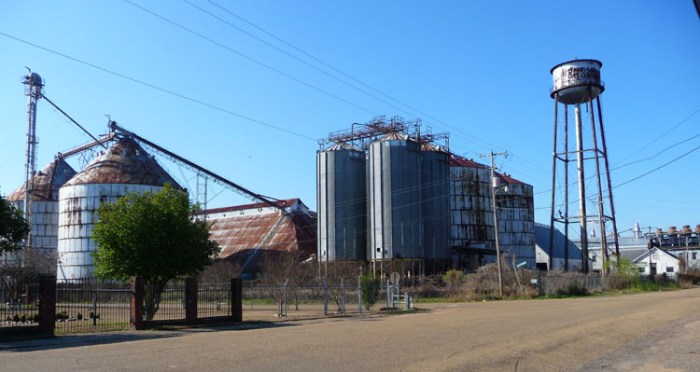
The abandoned plant of the Mississippi Cotton Oil Company wasn’t on the recent Port Gibson Holiday Home Tour, but as I was wandering about before the tours started, I was drawn to the place, just north of downtown, like a moth to the flame. I’ve always been intrigued by cotton seed oil mills–the strange shapes of the buildings, the rusty metal, and odd protruding machinery and pipes running this way and that. I find the seed houses, with their distinctive steep roof and clerestory, especially compelling, but unfortunately, I don’t understand how the whole operation works together. I know just enough to be fascinated.
This 1994 article in Agricultural History, “Cotton Gins and Cottonseed Oil Mills in the New South” may be worth the $14 that JSTOR wants to charge me. And this 1948 Sanborn on microfilm at MDAH (and a little cleaned up on Photoshop) shows somewhat of the layout and functions of each building, although it doesn’t show the later silo-type buildings.
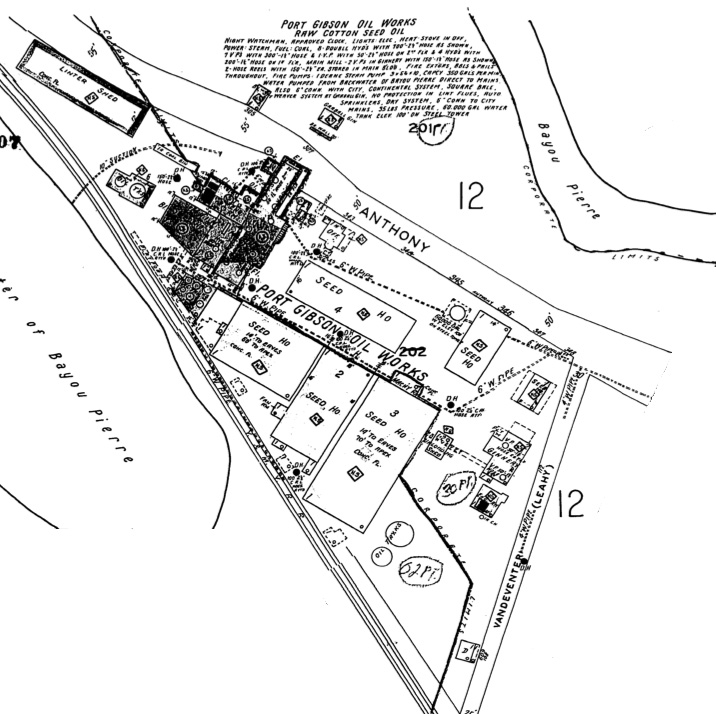
Port Gibson Oil Works, 1948 Sanborn Insurance Map
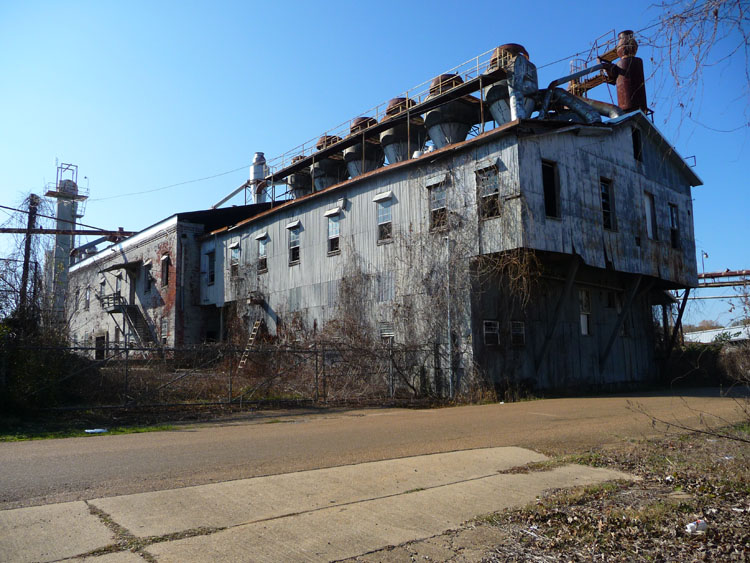 The original brick building, constructed in 1882, was listed on the National Register in 1979, and that brief National Register documentation is the only real source of information I’ve found online about the Port Gibson plant:
The Port Gibson Oil Works is one of the earliest cottonseed crushing mills in the U.S., operating continuously from 1882. While the products of the milling operation remain the same, the process has undergone major changes.
Formerly, cottonseed arrived at the mill by train. It was unloaded into seed houses, and fed into the cleaning room of the mill for removal of bolls and sand. Delinting and hulling of the cottonseed produced two by-products: lint (textile product) and hulls (cattle feed). Seed meats were steam-cooked and placed under a hydraulic press with 5000p.s.i.
Cottonseed oil was extracted, and the remaining “cake” was ground into meal for cattle feed.
Cottonseed now arrives at the mill by truck. A chemical solvent, hexane, is used to extract oil from the seeds. The hexane is recovered in a steam still and a desolventizer located in another building.
I discovered while poking around on the internet that the Mississippi Film Office has the Oil Works as a potential film location, which would make for a pretty interesting film. I also noticed a For Sale sign that indicates the State of Mississippi owns the place. Whether there are any environment cleanup issues, I don’t know.
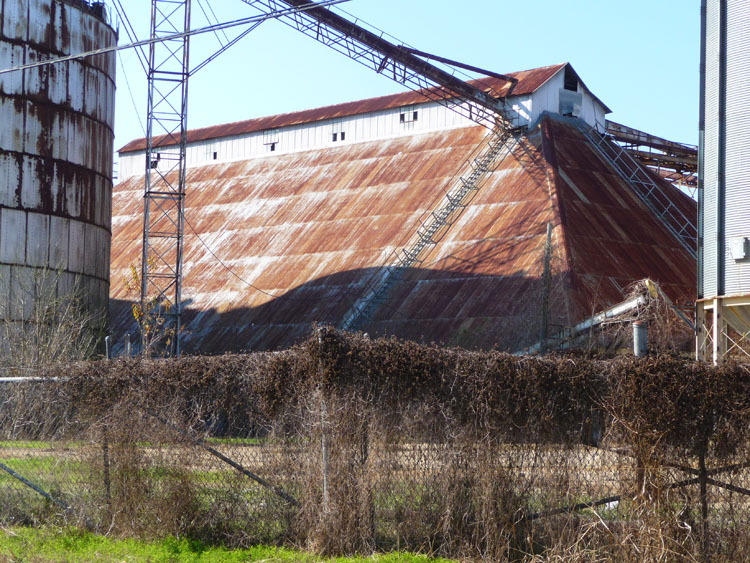 The Oil Works was still in operation when the site was listed on the National Register, and maybe some of our Port Gibson readers can give us a little more background on when it closed and any other history not covered in the NR nomination. I notice that MDAH has a subject file on Port Gibson Industry that might have some information, but I missed that when I was there last.
I would love to take a tour of this place with someone who had actually worked there and understood what all the buildings and pieces did. Cotton seed oil mills were such an important part of Mississippi’s industrialization and yet we often overlook them because they aren’t on the well-trod pilgrimage tour path. For that matter, it would be a really different and worthwhile tour to visit several of Mississippi’s industrial sites, including cotton seed oil mills, textile mills, the Carnation plant in Tupelo, the Soule Steam Feed Works in Meridian (as far as I can think, the one true industrial museum we have in the state?), and even the Nissan plant in Canton. The Society for Industrial Archeology is a group that does these types of themed tours, but it looks like they haven’t done much in the South.
I don’t know what the prognosis is for the Port Gibson Oil Works, but in an ideal world, it could be creatively re-used, either as a museum to the cotton industry, or as something so imaginative that my puny brain can’t even imagine it. Any thoughts out there?
more Abandoned Mississippi . . .



Categories: Architectural Research, Industrial, Port Gibson
 Preservation in Mississippi
From the New York Times;
A Vestige of King Cotton Fades Out in Mississippi
By PETER T. KILBORN
Published: October 18, 2002Sign In to E-Mail
Print
The Port Gibson Oil Mill died in June. The steam whistle that once summoned all 50 workers at 7 every morning — and woke everyone else in town — is silent. The day-and-night din of machines crushing cottonseeds is gone, and with it the comforting odor of the seeds cooking. The big tractor trailers have all moved on.
The mill ran for 120 years, which townspeople say is longer than any other cotton-oil mill anywhere. It was the town’s biggest private employer, its biggest taxpayer and the last vestige of an industry that once made Port Gibson one of the richest little towns in America. Shutting it down, said Emma Crisler, editor and publisher of the weekly Port Gibson Reveille, ”is like losing a piece of your soul.”
The Archer Daniels Midland Company of Decatur, Ill., the agribusiness behemoth and the mill’s owner for the past 11 years, closed it with two weeks’ notice, then filed a request to demolish it. ”There was overcapacity in the industry,” said Larry Cunningham, senior vice president at Archer Daniels. ”The Port Gibson facility was less efficient, smaller and older than other facilities. Market conditions dictated survival of the fittest, which unfortunately did not include Port Gibson.”
This town of 1,840 between Natchez and Vicksburg, eight miles east of the Mississippi, is fighting back. It has thwarted the demolition, at least for now, and local business owners are searching for someone to revive the mill. Failing that, civic leaders would use it for some other purpose, like a museum. ”We want A.D.M. to donate it to the city,” Mayor Amelda J. Arnold said. ”But A.D.M. wants a piece of change.”
Port Gibson is 80 percent black, and poor. Twenty percent of the families have incomes less than $10,000 a year, the 2000 Census found. About 10 percent of the work force is unemployed. It has an entrenched population of whites, many of whom are related and have some historical connection to cotton.
”My husband’s family and mine have not moved more than 50 miles since 1763, when the British first acquired the area,” Martha Lum, a widow, said. Her forebears were early investors in the mill, and for many years her father was president of the board. She fought the sale of the mill to Archer Daniels and lost.
An assemblage of immense sheds and tanks sheathed in gray metal on 10 acres behind a chain-link fence, the mill is just a five-minute walk from the Claiborne County courthouse. By all accounts, it was a good neighbor. There is no record of complaints about the trucks or the odor. It paid most workers $8 to $9 an hour, a good wage here. With new investment in plant and machinery, said C. Y. Katzenmier, 93, for many years the general manager, ”they almost doubled the capacity.”
But cottonseed oil has become a troublesome commodity. Once the only widely used vegetable oil, it has lost ground to soybean and corn oils. The supply of cottonseeds has declined as dairies have begun feeding the seed to cows. ”Cotton oil production has declined 30 or 40 percent in the last 12 years,” said Ben Morgan, executive vice president of the National Cottonseed Products Association in Memphis.
No one here has tallied up the toll of the closing. The city is losing $10,000 in local taxes, a sizeable chunk of its budget. It has also lost its biggest water and gas customer. Local plumbers, electricians and machine repairmen have lost their best customer. Only one employee, Jerry Messer, 48, a former shift foreman who started at the mill in 1979, remains. He keeps it secure and cuts the grass.
”I’m the last man standing between me and those pigeons,” Mr. Messer said. ”Before, this mill never shut down unless we ran out of seeds. It was a good place. They never laid anybody off that didn’t want to be laid off.”
Some other former workers have found lower paying jobs; some have found nothing. Percy McGloster, 52, worked in the ancient seed-crushing building. ”Ain’t no jobs around here,” he said. Like other workers, he received severance of a week’s wages for every year worked up to 21 years, and two months’ health insurance.
Mr. McGloster’s wife Derdira, 39, is a cashier at the M & M grocery store in town. They have a daughter, Brittany, 11. Mr. McGloster had a two-minute walk to the mill from the 16-by-80-foot mobile home that the McGlosters bought in March. They could soon lose it because of the payments.
”I started working there when I was 19,” Mr. McGloster said. ”My daddy worked there. He worked there for 50 years. He loved that oil mill. He used to love to hear that old whistle blow.”
At work one day in late May, Mr. McGloster said, ”They said, ‘You all get yourselves together’ in the clapboard office. ‘We’re going to close it down,’ they said. They said the mill wasn’t putting out enough production. It didn’t make sense. We were putting out good production. We were booming.”
”It was a hurting thing to walk in there and tell my wife I didn’t have a job any more,” Mr. McGloster said. ”You know a husband, he always got to be strong. Even when you’re hurting, you got to act like things aren’t hurting.”
Some people attribute the plant’s demise to a bitterly fought decision among the heirs of early investors to sell it in 1991. The mill’s last general manager, James Beesley, 80, acquired close to a third of the stock and negotiated the sale. One group of heirs, including Mrs. Lum, delayed the sale while less partial investors reviewed it.
In the end, said Robert D. Gage IV, chief executive of the River Hills Bank in Port Gibson, ”We felt it was in the best interests of the shareholders to sell, but to negotiate a better price.” Most went along, and Archer Daniels accepted a price of $430 a share, or about $4 million.
”A.D.M. committed to operate it for the foreseeable future,” Mr. Beesley said. ”They operated it for 10 years. I guess you can say that’s more than the foreseeable future.”
There is still some hope for the mill. It lies within the city’s historic district, so the company needs the approval of the Port Gibson Historic Preservation Commission to alter its buildings. On July 26, Archer Daniels filed its request to demolish the mill. On Aug. 6, a company official met with local officials. ” ‘If we tear everything down,’ they said, ‘we will give you the whistle,’ ” said Joan Beesley, president of the commission and Mr. Beesley’s wife.
”But that’s not the way the process works,” said Alton C. Hollingsworth, who manages an organization that is restoring the downtown. ”With demolition, you have to see if there are other uses first.” So Archer Daniels proposed selling the mill to the city for $750,000 and claiming a charitable contribution of $3 million.
”The city doesn’t have $750,000,” Mrs. Beesley said. Mayor Arnold said,”In my opinion, they should give it all to the city and have a bigger tax write-off.”
Mr. Gage and other business leaders, meanwhile, have found two oil mill operators in Mississippi who have shown interest in reviving the mill. ”I’ve tried to contact A.D.M.,” he said, ”but they will not return my phone calls.”
The company, Mayor Arnold said, ”doesn’t want the competition.”
Mr. Cunningham of Archer Daniels said, ”We’re open to ideas and suggestions.”
LikeLike
I had no idea it had closed down that recently–must have had my head turned in some other direction in 2002. Thanks for finding and sharing that article, John. It certainly does round out the picture, and puts this story in the same category as the many other long-standing Mississippi-based businesses that got sold off in the 1990s and are now out of business: Jitney Jungle, Deposit Guaranty, McRaes . . .
LikeLike
You are welcome, of course. Offering something off the internet is only fair play! Your blog provides almost every morning something of great interest and, also, great fun for cyber-sluething. I and others should thank you with every morning cup of coffee.
I noticed several on-line articles about possible biofuel production in Port Gibson. One point of historical preservation is to make us more aware of how to best utilize the future. To take this example, the question of how dependent should one town be on one sort of economic plant and industry comes to mind, along with the question of how to build structures so they are suitable for later possible re-adaptation and re-use.
Of course, one point of interest to everyone: circa 2001 property taxes of $10,000 on a facility ADM thought could justify $750,000 in cash and a $3 million write-off? I had thought residential property taxes in Mississippi were low, but jeepers!! I assume the $10,000 figure represents prior great tax concessions aimed to keep the facility in production.
LikeLike
My great grandfather Herman Goepel (Goebel) was one of the founding people of Port Gibson Oil Works. My mother said he walked the floors at night worrying over the mill. He was from Sturtgard Germany. My mother had stock in the works when I was a litle girl. Where can I find the history?
LikeLike
At one time, the Port Gibson company had at least one branch operation, that being in Leland, Mississippi. “In 1890 a business was started which has remained an important part of Leland’s business community until the present. This business, known as the Leland Oil Works, is a branch of the Port Gibson Oil Works which was founded in 1882 for the purpose of producing cotton seed oil. The Leland mill has always paid highest market prices for cotton seed and has had excellent facilities for crushing the seeds. These facts and their prompt service have made it a popular and successful business, supported by the local planters.” THE HISTORY AND ARCHITECTURE OF LELAND
by Dot Turk ~ Washington County Historical Society ~ January 25, 1981, at http://www.tecinfo.com/~wchipman/washco_hist/hist@leland.htm
LikeLike
My dad and I hauled a many a ton of cotton seed there and Leland too. I remember one year there was so much seed, they put them on the ground in a huge pile. We also hauled cotton seed hulls and meal from the plant back to Louisiana.
LikeLike
My great grandfather Herman Goepel started Port Gibson Oil works in port Gibson Mississippi. I have wanted to find out more about the company. My mom had stock in it up until 35 years ago. Any info you can share?
LikeLike
”It was a hurting thing to walk in there and tell my wife I didn’t have a job any more,” Mr. McGloster said. Brought tears to my eyes. ‘If we tear everything down,’ they said, ‘we will give you the whistle,’ ” said Joan Beesley – more tears.
I’m happy they didn’t demolish it. It would be wonderful if it could be restored so we all could learn about this important part of Mississippi’s industrial history.
I know I have read it somewhere on the site, but can’t remember what the building is at the top of Preservation in Mississippi’s pages (header). It looks like a mill.
LikeLike
The mill in the header is the cotton gin and grain silo at Thornton, in Holmes County
LikeLike
That header will be changing in the next couple of weeks, by the way, since we traditionally change it on the anniversary date of the blog, which I think is Feb 8, but I keep thinking it’s Feb 9. At any rate, I guess that means I need to start searching around for a picture that can take its place up there, unless someone out there has an idea.
LikeLike
Mr. Malvaney, Charlotte and Carl Monte Reeves own the Cotton Oil Mill in downtown Jackson on Mill Street. We would enjoy talking with you about your article and also sharing with you our plans for the Mill. If you would like a tour, we would be happy to show you our “treasures”.
LikeLike
Hi Charlotte, are you still the owner of the Cotton Oil Mill in Jackson? If so, I am very interested in hearing more about your vision for the mill.
LikeLike
According to Lynnette Boney Wrenn in her _Cinderella of the New South: A History of the Cottonseed Industry, 1855-1955_ (1995):
The Port Gibson Oil Works in Mississippi, is believed to be the oldest cottonseed-oil mill in continuous operation today, began life in the early 1880s. The enterprise was organized by six men, including a father and son who were “Dealers in Dry goods, Groceries and Plantation Supplies.” Two other investors managed the business at different times. The major pieces of machinery purchased initially cost under $5,000, and the enterprise began with an operating capital of only $285. That level of investment was the minimum reported by the _Manufacturers’ Record_ in 1885. (pg. 15-16)
Wrenn’s source is Walter B. Moore, “Oldest Cotton Oil Mill has Had Unique History,” _Cotton Gin & Oill Mill Press_ 56 (3 Dec. 1955): 12-13, the R. G. Dun Collection at Harvard and the _Manufacturers’ Record_ 8 (19 Sept. 1885): 178…and maybe Hillyard, New South, 35
LikeLike
Looks like Dr. Wrenn left all her research to the University of Tennessee:
Finding Aid for the Lynette Wrenn Cottonseed Collection, 1855-1996
http://www.lib.utk.edu/spcoll/manuscripts/2837.html
LikeLike
Wow, what an obscure and wonderful source of information the Cotton Gin & Oil Mill Press must be! Guess it will be a while until that makes it into Google Scholar, although I did find this 1919 edition, which talks about oleomargarine: http://books.google.com/books?id=jmtCAAAAYAAJ&ots=LZEE-3WBeR&dq=cotton%20gin%20and%20oil%20mill%20press%20walter%20b.%20moore&lr&pg=PP1#v=onepage&q&f=false
LikeLike
I thought everyone had read the CG&OM.
LikeLike
Wow, indeed! Mr. Wintory, today you obviously had both your breakfast food fit for champions and Tang, the drink of astronauts, before you began examining resources. Kudos!
LikeLike
John, it was just luck that I had bought that book back in November when McCormick’s Book Inn in Greenville closed.
LikeLike
Say what you will to claim false modesty, I am convinced you bought that paticular volume merely to complete your set and that ELMalvaney somehow let her subscription lapse beginning in 1920. You both are amazing. . .
LikeLike
Emma Crisler at the Port Gibson Reveille can give you the exact date the Port Gibson Oil Mill closed. I believe it was shortly after the turn of the century. Archer Daniels Midland bought it, ran it for about 12 years & then shut it down. At the time of its closing it was the oldest continuously operating cotton seed oil mill in U. S. (maybe in the world). The State probably acquired it for failure to pay taxes.
LikeLike
I don’t believe I realized the comparative size, back in the day, of this operation.
As yet another side-light, a January 14, 1911, issue of the Imperial Valley Press stated (at p. 2) that unbtil a few years before, the Port Gibson Mill had the largest production in the world, pressing more than 40,000 tons a year. However, the advent of the boll weveel had reduced that to almost nothing. The son of the then-owner of the Mill was in California’s Imperial Valley seeking to plant land in long-staple cotton and begin a branch mill. ( I am having unexpected problems reproducing the link, but googling the following should do it: i [PDF]
IMPLEMENTcdnc.ucr.edu/cdnc/cgi-bin/imageserver/imageserver.pl?oid…You +1’d this publicly. Undo
File Format: PDF/Adobe Acrobat – Quick View
gion, according to Robert E. Goepel of Port Gibson, Miss., who has been telling the Los Angeles Herald of his plans for building a cottonseed oil millat El Centro. .)..
The American Machinist of January 26, 2011, briefly mentioned the same plan. http://books.google.com/books?id=p2EfAQAAMAAJ&pg=PA187&lpg=PA187&dq=Robert+Goepel+%22port+Gibson%22+Mississippi+mill&source=bl&ots=S49YKxx_q9&sig=3iDLnCXszBE4kyr8JdFfvFu-zYw&hl=en&sa=X&ei=zushT9WeN4nsggfotLmACQ&sqi=2&ved=0CB4Q6AEwAA#v=onepage&q=Robert%20Goepel%20%22port%20Gibson%22%20Mississippi%20mill&f=false
LikeLike
Sloss Furnaces might provide some interesting ideas. http://www.slossfurnaces.com/
LikeLike
You should also cover the Cotton Oil Mill in downtown Jackson on Mill Street, pretty interesting stuff down there!
LikeLike
Thank you for noticing the Mill. We have big dreams for it – not only to benefit Jackson, but the entire state. We would enjoy hearing any suggestions or thoughts you have on the Mill.
LikeLike
A Nicaraugua company has puchased newer equipment and it is being removed from the plant and shipped to Africa for reconstruction as of February, 2012.
LikeLike
I hate to hear that–does this mean the buildings are also coming down or is just the equipment being removed?
LikeLike
A ‘newer’ building on the north side of the road will go to Africa. I have been told that a portion of the roof will be removed to extract a boiler from the older section of the operating building to the south. I am not clear about the circumstances of ADM conveying the property. I have heard there is a tax lien. The circumstances of its ownership appear occult.
LikeLike
This has been the fate of many of Mississippi’s cottonseed oil mills. The equipment was removed, either for sale overseas or for salvage.
LikeLike
is this location still accessible to photograph and explore?
LikeLike
I rode by there today. The folks from Nicaragua are successfully removing their equipment. One large building is dangerous. These industrial buildings really “stand out” in the rural Mississippi landscape.
LikeLike
My dad is 63 yrs old. He began working at this place at the age of 14 and probably would still be there if it hadn’t closed.. My dad is Percy McGloster! I’m Brittany his daughter, I’m now 21! My dad worked many days & hours here.. He still regrets missing most of my childhood, but I love him and appreciate his dedication and eagerness to provide for his family.
LikeLike
Reblogged this on Fiction and History and commented:
Here’s an interesting set of photographs from the actual cottonseed oil mill in Port Gibson that inspired the fictional one in the story “Coin of the Realm,” the mill that Lawyer Ducat and Sterling Estep are trying to save.
LikeLike
It looks like I am jumping in here at a late date! I must say I ended up reading many of these comments thru my tears. Those of joy, as one that was privlidged to have the Port Gison Oil Mill as my life, and sadness, as I was driving by, and around it this week. My beloved dog Rusty should still be inside those gates buried many years ago.
My grandfather was the mill superintendent at the Leland mill until his death. I was under 2! My father worked for the Leland/Port Gibson Mills for 51 yrs, and then remained on the Board thru the 1970’s, when James Beasley was involved. Daddy moved to Port Gibson in 1940, to manage the Port Gibson Mill. When Mr. Red Anderson passed away daddy became the General Mgr. of both mills. Mr. Shaifer was manager in Leland, and Mr . Batton the manager in Port Gibson. I believe I was in 6th grade about that time, 1955 or 56.
I have no idea what happened to the Solvent Plant! I drove by one day, and it was just gone! Leveled, and a piece of cement left. I would love to see something done to, or with, the Oil in my lifetiime, and I would love to help in any way I could. It is so horrible looking now, and a terrible waste of property, and history!
There are stories about Mayor Arnold still floating around, and who knows what is real, and not real, but her. Under her reign the Oil Mill started a very serious, and bad time of deteriotation! It is only worse now.
Why is this being allowed to happen? My son has told me that a part of the mill is on display at the Agriculture Museum in Jackson, Ms. I have not seen it.
Daddy passed away in 2005, at age 96, but he left behind quite a few pictures of the Leland, and Port Gibson Mills, both from the air, and ground.
Would love to hear from anyone with any stories or info. Email me at brnsouth@aol.com
.
LikeLike
In a way this article is bittersweet to read. My father Robert Hudson was the Maintenance Supervisor of this mill at the time of it’s closing. He was a farmer all his life until 1984 he started working at Port Gibson Oil Works. The story as he told it was that he married my mother on a Friday, had their honeymoon in Natchez, Mississippi that Saturday and Sunday. Then that Monday he started his first day of work at that Mill. I watched him work his way through the ranks since I was born in 1988 from a shift worker to what he was at the time of it’s closing. I basically grew up going back and forth to this place and have many fond memories visiting him. I remember when ADM bought the mill, and I also remember the day my mother and I arrived to hear that ADM was shutting it down.
LikeLike
Has anyone approached Cargill about this facility? They produce cottonseed oil and are the largest privately owned food Ingredient Company in the world with annual revenue at ~$135B per year. Just a suggestion if this has not been done.
LikeLiked by 1 person
No one ever complained about the smell because that smell was just a part of Port Gibson. Thinking about that stinky smell brings back so many wonderful memories! Riding/driving to school every morning, knowing you were getting closer to school because you could smell that mill. holding your breath when you drove by it to see if you could hold your breath long enough to get past the smell, knowing that you could never actually make it long enough because the smell sort of clung to you when you drove by. Looking up at that one part of the building you had to drive under wondering what they were doing while walking over you. The mill was a huge part of my growing up memories that I will love and cherish forever.
No, the town does not have $750,000. But I know for a fact that some of the more well to do Port Gibson citizens could get together and come up with more than enough money to buy it. They are just too stingy and selfish to give up their money, even if it is for a good cause.
LikeLike
I visited the mill today. It is in such horrible disrepair. I really do hate to say it, but any hope held by folks to have this facility come to life again, either as a museum or an operational concern, can be tossed out the window. I love old buildings. And I’m always first in line to support their survival, in any way. But sadly this mill is too far gone to be restored. Even if it were to be restored to a museum, the wooden structure on the inside of the “old” part of the mill is so far gone it would have to be completed torn down and rebuilt. And in that case, you really no longer have the historical building that it is, was. As the largest producer of cotton seed oil in the country (as reported here), serious efforts should have been made years ago to preserve it. I have no link to the building except my love of history and buildings. This was a true gem. Very very sad to see what has happened to her. Rest in peace ole girl.
LikeLike
A private individual owns this mill now. It’s sad to see that it was not turned into a museum at some point, but yes it is too far gone. When people purchase a property and say they will do something, I believe they should be held accountable. It now only sits and decays and it will eventually completely collapse.
LikeLike
My great grandfather Herman Goepel was a part founder of this mill. Port Gibson Oil works paid the highest stock dividend ever according to my mother. She would say that her mother said her father walked the floors at night worrying over this business. They had 9 children and Herman passed away several weeks before his daughter’s wedding . In Port Gibson Cemetary there is a statue of him on his grave.
A time long gone but so important to the development of our country . I wish they would make a museum as well. Do you know who owns it?
LikeLike
I still remember the smell as we walked to and from Addison.
LikeLike